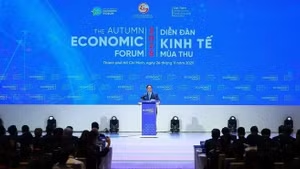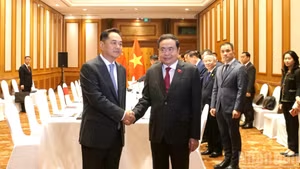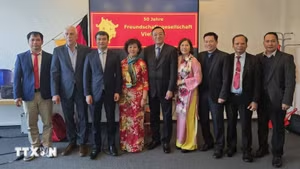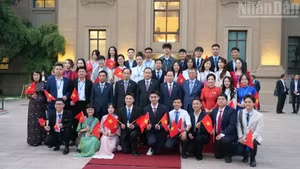
Auckland, where activities within the framework of the high-ranking Vietnamese delegation’s visit took place, is New Zealand’s largest city and an important centre of economy, education, innovation, and international connectivity. Known as the “City of Sails”, Auckland is home to the bustling Waitemata Harbour, where sails are moored or gliding across the blue waters, welcoming the earliest rays of dawn on earth. The vibrant atmosphere of a city full of vitality in the South Pacific seemed to add a new rhythm to cooperation with fresh directions.
Viet Nam is strongly renewing its growth model, taking science, technology, innovation, digital transformation, green transition, and high-quality human resources as development drivers. New Zealand is also actively implementing its “Going for Growth” economic strategy, with pillars including talent development, a competitive business environment, global trade and investment promotion, innovation, technology and science, and infrastructure for growth. The priorities Viet Nam is striving to pursue are all areas in which New Zealand has leading experience and reputation and where the two sides are also carrying out effective cooperation.
New Zealand is also an effective development cooperation partner, focusing on areas with long-term impact such as education, human resource training, high-tech agriculture, and climate change response. Although the scale is not large, the approach is practical and persistent. The two sides noted that there remains great potential that needs to be further tapped in the coming time.
At the Viet Nam-New Zealand Business Roundtable, Party General Secretary and State President To Lam was impressed by the open sharing of the business community. Stories about technology, aviation, market connectivity, and innovation showed that enterprises of the two countries not only see great cooperation potential but are also creating business models and expanding new markets.
Party General Secretary and State President To Lam said this is precisely the spirit of innovation, dynamism, and future orientation that Viet Nam always encourages, and an important foundation for the two countries to develop together in the new period.
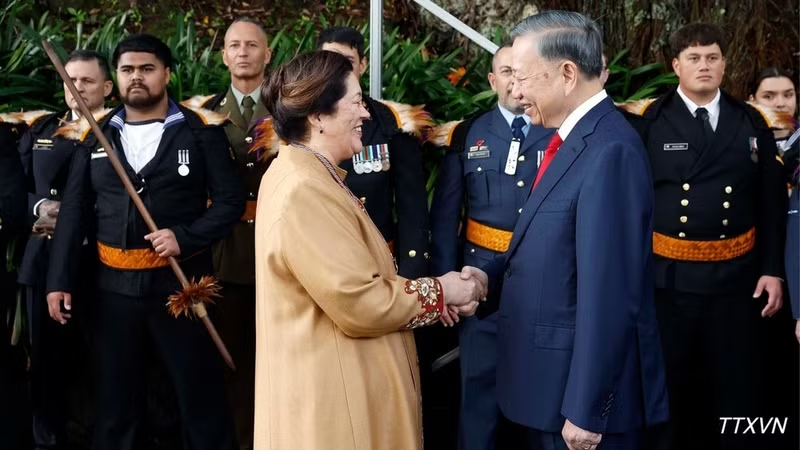
The beautiful island nation of New Zealand is renowned for its majestic natural landscapes and unique, identity-rich culture. Although the Vietnamese delegation’s time there was not long, it clearly felt the country’s traditional culture. This was reflected in the friendliness and hospitality of the people, and in the traditional rituals of the indigenous Maori that remain present in state-level diplomatic ceremonies. The impressive traditional dance performance with Maori costumes and language, together with the “hongi” greeting ritual of touching noses, not only expressed joy and a respectful welcome for distinguished guests but also demonstrated appreciation for and honouring of the host country’s traditional culture.
The beauty of the host country’s traditional culture was also conveyed through the Vietnamese community, showing overseas Vietnamese’s attachment to and integration into the host society. At the meeting between Party General Secretary and State President To Lam and the Vietnamese community in New Zealand and South Pacific island countries, overseas Vietnamese were deeply moved, as this was the first visit to New Zealand by a Vietnamese party general secretary and state president. They also expressed their joy that Viet Nam is strengthening diplomatic connectivity with South Pacific countries, creating opportunities for overseas Vietnamese to help deepen friendship and contribute to national construction and development.
In a warm and open atmosphere, on behalf of the Vietnamese community in New Zealand, Ambassador Phan Minh Giang respectfully presented Party General Secretary and State President To Lam with a unique indigenous cultural symbol, the “Koru”. This is the Maori name for a young unfurling fern frond, symbolising the growth of new life, the strength to rise and peace. It was followed by a gift of Manuka honey, a local speciality known as “liquid gold” and a proud symbol of New Zealand.
Encouraging overseas Vietnamese to continue strengthening solidarity and building an increasingly strong community, Party General Secretary and State President To Lam emphasised that each member of the Vietnamese community is a cultural ambassador, promoting the essence of Vietnamese culture and the image of the country and people of Viet Nam to international friends while making practical contributions to the homeland’s development process.
Within the framework of the visit, leaders of the two countries exchanged views and agreed on future cooperation directions. The two sides agreed to increase contacts at all levels and promote practical action, ensuring that all high-level commitments are concretised through specific results. They agreed to create stronger changes in trade and investment cooperation in line with the two countries’ potential and create favourable conditions for both countries to jointly participate and soon reach the target of 3 billion USD in two-way trade.
Cooperation in agriculture and the environment, as well as science and technology, is an important pillar suited to the development goals of both countries. The two sides will expand cooperation in smart agriculture, climate change adaptation, and carbon markets, linked to Viet Nam’s green growth goals, as well as build exemplary cooperation models in agriculture and sustainable development. They will further expand cooperation in education and training, tourism, and people-to-people exchanges, with the goal of developing high-quality human resources in the new stage of development.
For many years, education cooperation has been a bright spot in relations between the two countries. It is also the most enduring thread of Viet Nam-New Zealand friendship. In the 1990s, when Viet Nam had just begun its “open-door” process, New Zealand helped provide English-language training for Vietnamese officials. Many generations of Vietnamese officials have matured through New Zealand scholarship programmes. Cooperation has now expanded to vocational education, skills training, and high-level human resource development. With around 2,000 students at present, Viet Nam ranks fifth in terms of the share of international students in New Zealand.
At the Viet Nam-New Zealand Higher Education and Vocational Education Forum held within the framework of the visit, Penny Simmonds, New Zealand’s Minister for Vocational Education, Universities, Science, Innovation and Technology, affirmed that New Zealand always welcomes Vietnamese students to study at many of its educational institutions. She expressed her hope that higher education institutions of the two countries will coordinate effectively to equip students with the knowledge and skills needed to succeed in a rapidly changing world. She said that in recent times, education cooperation between the two countries has also been strengthened by alumni networks, whose members return to Viet Nam after completing their studies in New Zealand and make use of the knowledge and experience they have accumulated.
Spreading that spirit, the Viet Nam Knowledge Network in New Zealand was recently established to connect and bring into play the intellectual resources of the Vietnamese community, promote people-to-people cooperation, and make active contributions to the common development of Viet Nam and New Zealand.
Nguyen Lam Giang, Co-Chair of the Viet Nam Knowledge Network in New Zealand, shared that the network is not only for outstanding individuals, entrepreneurs, or intellectuals. They are only the first pieces of the puzzle, and the network hopes to welcome Vietnamese people living, working, and studying in New Zealand, those with rich life experience and practical knowledge who can share widely with all overseas Vietnamese, helping everyone go further on the path towards achieving their goals and contributing to the construction of the homeland. The network is developing activity plans for implementation in the coming time, with the companionship of students studying at New Zealand universities, who will be important contributors to Viet Nam’s future development.
On the foundation of more than 50 years of expanding mutual understanding and trust, the visit by Party General Secretary and State President To Lam and the high-ranking Vietnamese delegation has created fresh momentum for Viet Nam–New Zealand relations, bringing ever-increasing depth to the comprehensive strategic partnership framework. The outcomes of the visit promote more concrete and practical cooperation in education, agriculture, trade, and sustainable development, helping turn political commitments into practical benefits to serve each country’s development goals, while contributing to peace, stability, sustainable development, and regional resilience.