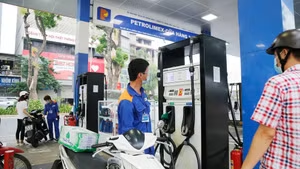
The OECD has just released its December 2025 Global Economic Outlook, assessing that the global economy continues to demonstrate resilience but still contains many vulnerabilities.
For Viet Nam, the OECD notes that growth has remained positive in 2025, with real GDP increasing by 8.2% in the year entering the third quarter of 2025. The main growth drivers include final consumption, investment, and exports of goods and services.
The unemployment rate remains at 2.2%, a record low since the third quarter of 2024; underemployment has sharply declined; and labour force participation has risen.
Despite global policy uncertainty, exports of goods and services grew by 15.5% in the first nine months of 2025 compared with the same period in 2024. Exports to the US alone, which account for 30% of Viet Nam’s total export turnover, increased by 27.7% during the same period.
The OECD assesses that FDI inflow has continued to rise steadily since mid-2023 and remains an important growth driver for Viet Nam.
Over the next two years, the OECD forecasts that Viet Nam’s real GDP growth may be affected as weaker external demand impacts exports.
However, private consumption is expected to continue rising due to improvements in real wages and employment, while investment will remain supported by increased public investment and favourable financial conditions.
The OECD also warns that risks to the growth outlook will increase if trade barriers continue to rise or if developments in trade and tariff policy reduce Viet Nam’s attractiveness to investors.
The OECD assesses that current monetary policy, beginning in June 2023, is accommodative through interest rate reductions and setting credit growth targets. In the context of rising prices, the OECD recommends that the State Bank of Viet Nam closely monitor inflationary pressures and make policy adjustments if needed.
Regarding fiscal policy, public investment spending will continue to play a stimulating role in short-term growth, offsetting lower-than-planned disbursement in previous years. However, as inflationary pressure increases, the OECD suggests gradually shifting towards a more neutral fiscal stance.
The reduction of VAT from 10% to 8% is expected to end by late 2026. In addition, higher pensions, minimum wages, and public service prices, along with VAT adjustments, will create inflationary pressure in 2026–2027.
The OECD notes that Viet Nam’s productivity and economic efficiency can be strengthened through a series of reforms. Moving towards a monetary policy framework more reliant on market price signals will enhance economic resilience and improve capital allocation.
The organisation also recommends creating incentives to reduce the scale of the informal labour sector, which currently accounts for around two-thirds of the labour force, in order to expand social security coverage and raise overall economic productivity.
Moreover, institutional reforms, fostering greater competition, and attracting FDI into the services sector will further advance value-added production, create a more level playing field for the private sector, and allow resources to shift to more productive firms.
The OECD assesses that Viet Nam remains among the fastest-growing economies in Asia. Although the short-term outlook is affected by trade risks and global policy uncertainty, Viet Nam continues to maintain a positive growth foundation, with room for reforms to reinforce recovery and growth momentum.




![[Infographic] Viet Nam's 16 Comprehensive Strategic Partners](https://en-cdn.nhandan.vn/images/nyM650OGFWrOVWc-xajqN-rTZ68Rlmc1fiGJOhBRYHHdkBILL2hAdMw_FHcqH-128bTaQBSOAMd0_NcTypwz7H-j_NBZzuSdgF8ETMmVl1xLtdcCjym8rCUyKZqQgOZtC4ouMEzxlJoQ-MllehtjehDxIkn58uqaoaCRy4fSY54/1792513260540-1528117236743671738-1528117236743671738-9e797c256fe32c7c7b9c1cc03b0ca64e.jpg.avif)