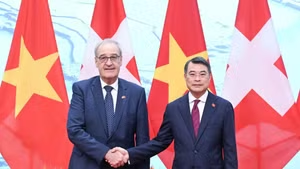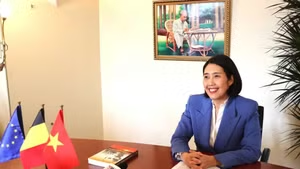
This was the assessment made by Chau Mai Anh, Vietnamese Ambassador to Switzerland concurrently accredited to Liechtenstein, in an interview with a reporter from Nhan Dan Newspaper on the significance of the official visit to Viet Nam by Brigitte Haas, Prime Minister of the Principality of Liechtenstein.
Turning opportunities into concrete cooperation programmes and tangible results
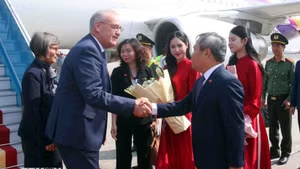
Ambassador Chau Mai Anh said that at the invitation of Prime Minister Le Minh Hung, Prime Minister of the Principality of Liechtenstein Brigitte Haas would pay an official visit to Viet Nam from October 17 to 19, 2026. This will be the first visit to Viet Nam by a prime minister of Liechtenstein since the two countries established diplomatic relations in 2008. The visit is of major significance, taking place at a time when bilateral relations are presented with new opportunities for development, particularly in the fields of economic and trade, investment, science and technology, and innovation cooperation.
During meetings held as part of the visit, senior leaders of the two countries will have the opportunity to exchange views on the situation in their respective countries and discuss key orientations for promoting cooperation in the coming period. Viet Nam will also be able to draw on Liechtenstein’s experience in enhancing competitiveness through quality, technological capabilities, and the ability to create distinctive added value, thereby supporting the successful transition to a new growth model, boosting productivity, and developing high-tech industries.
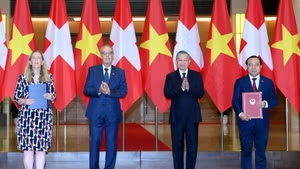
According to Ambassador Chau Mai Anh, a notable highlight of Prime Minister Brigitte Haas’s visit to Viet Nam is that Viet Nam and Liechtenstein will sign two documents of great importance. These are the free trade agreement (FTA) between Viet Nam and the member states of the European Free Trade Association (EFTA), with Liechtenstein currently holding the EFTA Chair, and the Viet Nam–Liechtenstein Agreement for the Avoidance of Double Taxation. These agreements will provide important legal foundations for economic cooperation, creating a stronger basis for businesses on both sides to establish partnerships and implement long-term investment and business plans.
Ambassador Chau Mai Anh therefore believes that Prime Minister Brigitte Haas’s visit to Viet Nam will not only promote political and diplomatic relations but also open more practical avenues for cooperation between the business communities of the two countries.
“The visit will help turn these opportunities into concrete cooperation programmes and tangible results, promote cooperation on the basis of trust, equality, and mutual benefit, and thereby ensure that Viet Nam–Liechtenstein relations develop in a substantive and effective manner, more fully reflecting the potential of both sides,” Ambassador Chau Mai Anh said, expressing her expectations.
Prospects for formation of more favourable legal frameworks for economic and trade cooperation
Sharing about the achievements of Viet Nam–Liechtenstein bilateral cooperation in recent years, Ambassador Chau Mai Anh said that the two countries established diplomatic relations in 2008. Since then, they have maintained friendly relations and gradually expanded cooperation across various fields. Specifically, the two countries have sustained high-level and other-level exchanges and supported each other at multilateral forums.
In economic and trade cooperation, the two countries have achieved noteworthy results, with bilateral trade reaching 9.8 million USD in 2025. Liechtenstein ranks 84th among countries and territories investing directly in Viet Nam, with total investment capital of 4 million USD. Exchanges between ministries, sectors, and business representatives in recent years have helped identify areas with cooperation potential, including high-tech industries, pharmaceuticals, medical equipment, and finance. These are also sectors in which Viet Nam’s development needs and Liechtenstein’s strengths are, to some extent, complementary.
According to Ambassador Chau Mai Anh, one particularly significant expectation from Prime Minister Brigitte Haas’s visit to Viet Nam is the prospect of establishing more favourable legal frameworks for economic relations. The conclusion of negotiations on the FTA between Viet Nam and the EFTA member states, together with the completion of negotiations and initialling of the Viet Nam–Liechtenstein Agreement for the Avoidance of Double Taxation, mark important milestones that will help create more favourable conditions for strengthening cooperation between the two countries.
The visit to Viet Nam by Liechtenstein Prime Minister Brigitte Haas will not only promote political and diplomatic relations but may also open more practical avenues for cooperation between the business communities of the two countries. The visit will help turn these opportunities into concrete cooperation programmes and tangible results, promote cooperation on the basis of trust, equality, and mutual benefit, and thereby ensure that Viet Nam–Liechtenstein relations develop in a substantive and effective manner, more fully reflecting the potential of both sides.
Ambassador Chau Mai Anh
Sharing her views on areas in which the two countries have considerable room and potential for cooperation, Ambassador Chau Mai Anh said that Liechtenstein had strengths in high-value-added industrial products, precision engineering, specialised equipment, and manufacturing technologies. Viet Nam has substantial demand for industrial modernisation, productivity improvements, the development of supporting industries, and deeper integration into global value chains. The two sides could explore opportunities for cooperation in technology transfer, component supply, technical workforce training, and business networking in sectors where their strengths complement each other.
In addition, pharmaceuticals, medical equipment, and healthcare technologies also offer considerable potential for cooperation, particularly as Viet Nam is focusing on improving the quality of healthcare services, developing its pharmaceutical industry, and strengthening its medical equipment manufacturing capabilities. Further cooperation could be promoted through business networking, product distribution, and appropriate technology transfer, while ensuring compliance with market quality standards.
As a country with experience in financial services, asset management, and professional services supporting international business, Liechtenstein could step up exchanges with Viet Nam on corporate governance, risk management, compliance, and investment support services, on the basis of compliance with the laws of both countries and relevant international standards.
Alongside identifying areas of potential for stronger cooperation in the coming period once the FTA between Viet Nam and the EFTA member states enters into force, Ambassador Chau Mai Anh also emphasised the benefits of Viet Nam and Liechtenstein having completed negotiations and initialled the Agreement for the Avoidance of Double Taxation in June 2026, particularly in promoting bilateral economic cooperation.
According to Ambassador Chau Mai Anh, the completion of negotiations and initialling of the Viet Nam–Liechtenstein Agreement for the Avoidance of Double Taxation represents a meaningful and practical step forward in bilateral economic cooperation. The agreement concerns not only tax policy but also helps establish a more favourable, transparent, and predictable legal environment for investment and business activities between the two countries.
The agreement will help improve the investment climate and encourage long-term investment decisions, expand opportunities for cooperation between businesses in the two countries, and complement broader economic cooperation frameworks, particularly the FTA between Viet Nam and the EFTA member states. While the FTA will provide a more favourable framework for trade, market access and investment cooperation between Viet Nam and the EFTA countries, the Agreement for the Avoidance of Double Taxation will add an important component relating to the tax environment in bilateral economic relations between Viet Nam and Liechtenstein. Although the two frameworks have different scopes and functions, they can complement each other in creating a more favourable business environment.