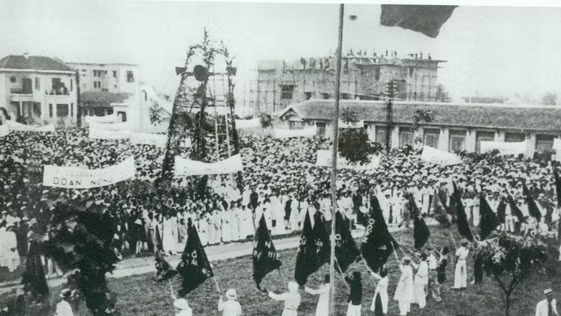
Under the banner of the Party, the working class and farmers rose up to break the shackles of slavery, and established Soviet-typed revolutionary administration in many areas. At the same time, progressive policies in terms of politics, economics, culture and society were implemented.
Despite fierce repression by the French colonists, the 1930-1931 revolutionary climax affirmed the fact that the Vietnamese revolutionary path led by the Party was proper. Many valuable lessons were drawn from this climax, especially on building the coalition between the working class and farmers, the construction of the unified National Front, the launch of mass movements, as well as how to defend the administration.
The first plenum of the Party Central Committee, which was held in Hong Kong (China) from October 14-31, 1930, decided to rename the Communist Party of Vietnam to the Communist Party of Indochina, passed the Party’s Brief Political Platform, Brief Policy and Brief Statutes and adopted a political programme and important resolutions on urgent tasks to mobilise particular groups of the masses. The meeting elected the official Party Central Committee with Tran Phu as the General Secretary.
The Political Platform affirmed the fundamental issues on the revolutionary strategy in Vietnam. It also presented deep analysis on the domestic and global situation, and identified that capitalism ended the period of temporary stabilisation and switched to the period of total crisis. The proletarian revolution and colonial revolution developed to a high level. At that time, the world revolutionary movement had a strong influence on the revolutionary movement in Indochina. The working class and people in Indochina needed to have close links with the world revolution.
Although the French colonialists suppressed patriotic movements, especially the 1930-1931 revolutionary climax, the Party and the revolutionary movement still existed with even stronger growth. Comrade Le Hong Phong, as a member of the Executive Committee of the Communist International, together with other communist leaders in Vietnam reorganised the movement and made a preparation for the National Party Congress.
The first National Party Congress took place in Macau, China, from March 27-31, 1935, with the participation of 13 delegates from domestic Party committees as well as overseas Party organisations. The congress set out three key tasks: consolidating and developing the Party, intensifying mass mobilisation and increasing public awareness of the anti-imperialism and the anti-war cause.
The Congress elected a 13-member Party Central Committee. Leader Nguyen Ai Quoc was nominated the Party representative to the Communist International. Le Hong Phong was elected as Party General Secretary. In July, 1936, Ha Huy Tap was elected as Party General Secretary. Nearly two years later, in March, 1938, the position was taken over by Nguyen Van Cu.
The First Congress of the Party is an important milestone, which was held after five years of organisational consolidation of the Party Congress, and founded the Communist Party of Vietnam. Congress marked the restoration of party organisations from the central to local level, at the same time, uniting the revolutionary movement of the working class, farmers and social strata, under the banner of the Party.