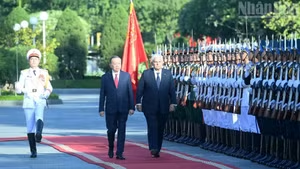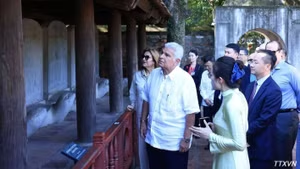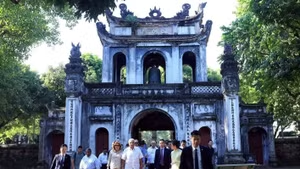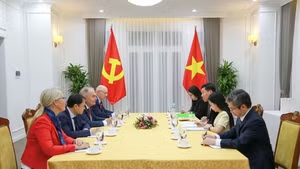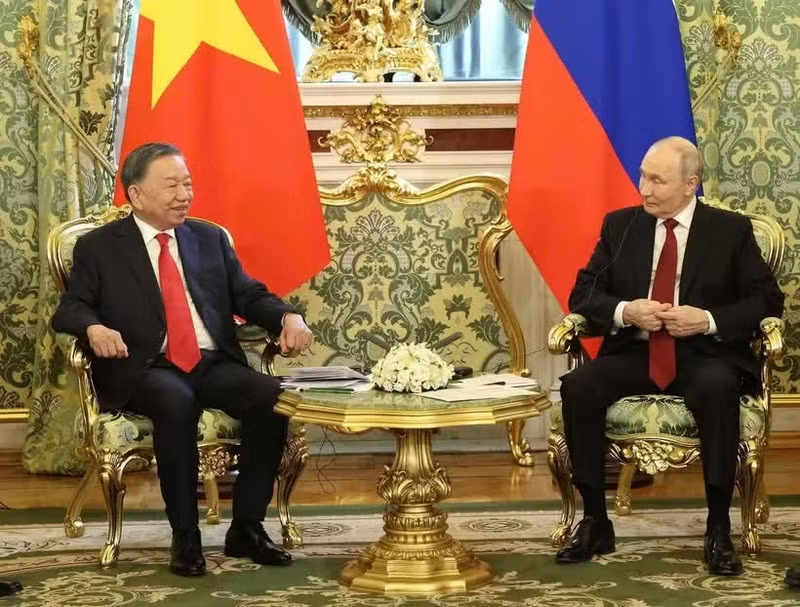
On September 9, the official Kremlin portal and numerous Russian newspapers and websites highlighted key remarks by the Vietnamese leader during his talks with Russian President Vladimir Putin.
They quoted General Secretary and President Lam as affirming that Viet Nam always attaches great importance to developing relations with Russia, considering this a top priority, a consistent policy and an important strategic choice in its overall foreign policy.
Viet Nam also highly values Russia’s influence and position, as well as President Putin’s leadership role in shaping a new multipolar world order and contributing to global energy and food security, he said, stressing that Viet Nam maintains good relations with Russia because it understands the deep historical foundation of the bilateral relationship.
Earlier, the Russian Government portal and other media outlets provided extensive coverage of General Secretary and President Lam’s meeting with Russian Prime Minister Mikhail Mishustin, highlighting the priority Russia gives to new-generation joint ventures with Viet Nam in areas such as the digital economy, peaceful use of nuclear energy, transport infrastructure, industry and agriculture.
The Russian media also noted the strong year-on-year growth in the number of Russian tourists choosing Viet Nam as a holiday destination.
The news website ura.news published a commentary saying Russia has high expectations for long-term cooperation with Viet Nam which, in turn, is ready to serve as a bridge for Russian companies to enter ASEAN, which is emerging as a global economic hub, and other international markets.
Ura.news cited Ekaterina Koldunova, Director of the ASEAN Centre at the Moscow State Institute of International Relations (MGIMO) under the Russian Ministry of Foreign Affairs, as saying that as Russia pivots to the East and Viet Nam seeks to accelerate economic growth and become a developed, high-income country by 2045, the two sides are witnessing the recovery and expansion of ties several areas such as nuclear energy, information technology, agriculture, infrastructure, logistics and education.
She noted that these areas serve the interests of both countries, adding that closer relations with Viet Nam are particularly important to Russia as Viet Nam takes on the role of country coordinator for ASEAN–Russia dialogue.
Russian economist Nikita Maslennikov of the Centre for Political Technologies said ASEAN is expected to become a major centre of gravity of the global economy over the coming decades. Maintaining a presence in the region will help Russia keep up with the broader global economy, he said, describing this as a geoeconomic strategy.
Talking to the Viet Nam News Agency, Dr Anton Bredikhin, a senior researcher at the Institute of China and Contemporary Asia under the Russian Academy of Sciences, perceived that General Secretary and President Lam’s state visit has set a new historic milestone and reaffirmed the two countries’ determination to further deepen their Comprehensive Strategic Partnership.
He noted that this was the first state visit to Russia by a top Vietnamese leader since 1991, taking place shortly after the 14th National Party Congress and the election of the 16th National Assembly of Viet Nam, as the country is pursuing broad economic and political modernisation.
Bredikhin said that at the key talks between President Putin and General Secretary and President Lam, the two sides signed a number of important bilateral agreements and cooperation documents, focusing on science – technology, energy and oil and gas while promoting economic, trade and investment links.
He also highlighted President Putin’s presentation of the Lev Tolstoy International Peace Prize to the Vietnamese leader in recognition of the latter's significant contributions to friendship between the two countries.
Bredikhin said the visit advanced several strategic cooperation initiatives, including an agreement to expand logistics corridors by rail, air and sea. Russia also invited Viet Nam to participate in the development of the Trans-Arctic Transport Corridor.
He particularly noted Russia’s emphasis on the planned Ninh Thuan 1 nuclear power plant using Russian technology, describing the project as a strategic step towards strengthening Viet Nam’s energy security and supporting its greenhouse gas reduction goals.
The two sides also agreed to enhance cultural exchanges, tourism promotion and high-quality human resource training. Bredikhin said a planned branch of the Moscow Power Engineering Institute in Viet Nam and the effective operation of the alliance of technical universities between the two countries will also be promising areas of cooperation.
Positive reactions to General Secretary and President Lam’s visit have reaffirmed Viet Nam’s steady foreign policy amid global changes, while highlighting the enduring trust and friendship between Viet Nam and Russia, which are working together to create new breakthroughs in bilateral cooperation.