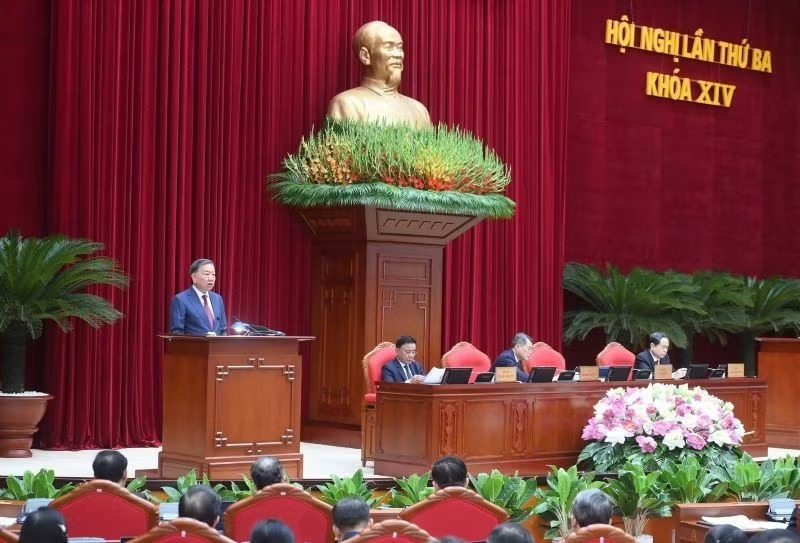
The third plenum of the 14th Party Central Committee took place as the country is entering a new stage of development, with imperative demands for renewal in thinking, institutions, and governance methods. The resolutions adopted not only set orientations for the immediate period, but also unveil a long-term development vision, creating a foundation for realising the aspiration to build a fast-growing, sustainable, and strong Viet Nam in the new era.
Following the outcomes of the plenum, what impressed me most was not only the content of the resolutions, but the consistent message emphasised by Party General Secretary and State President To Lam: all resolutions must be quickly translated into action and concrete results; practical effectiveness and people’s satisfaction must be taken as measures of the quality of leadership and national governance.
From implementation mindset to renewing the development model
As the room for growth under the traditional model based on resource exploitation, investment capital, and cheap labour is increasingly narrowing, development drivers must be forged through the quality of institutions, science and technology, innovation, digital transformation, and high-quality human resources. Therefore, implementation capacity will become the decisive factor in the effectiveness of all guidelines and policies.
I am particularly compelled by the resolutions on renewing the development model towards sustainability and the strategy to forge Viet Nam into a strong maritime nation. In my view, these are not merely economic development goals, but strategic choices aimed at enhancing national competitiveness, strengthening the resilience of the economy, and affirming Viet Nam’s position in the region and the world.
Notably, there has been a clear shift in development thinking: from growth based mainly on capital, resources, and cheap labour to growth based on science, technology, innovation, and the quality of human resources. For the marine economy, the goal is not only to harness marine resources effectively, but also to build a modern marine economic ecosystem, with synchronous development of seaports, logistics, marine industries, renewable energy, maritime services, and the digital economy at sea, while closely linking these efforts with environmental protection, climate change adaptation, and the safeguarding of national sovereignty.
Resolutions measured by practical effectiveness
Reading the resolutions of the third plenum of the 14th Party Central Committee, I clearly feel the convergence between current policy-making thinking and the concerns and recommendations that scientists and experts have persistently studied and pursued. From the requirement to transition the growth model from extensive development to development based on science, technology, and innovation, to the strategy of turning Viet Nam into a strong maritime nation through a circular marine economic ecosystem that links green growth, environmental protection, and national defence and security, all are core arguments that I have analysed many times in the press over recent years.
In addition, the core of policy quality also lies in the ability to connect scientific knowledge, practical review, and the responsibility of advisory teams. It is encouraging that these academic and practical perspectives are now clearly reflected in the strategic vision of the Party Central Committee.
In my view, this shows a very positive shift: the policy-making process increasingly attaches importance to scientific foundations, listens to the opinions of the people and intellectuals, proceeds from reality, and aims at development effectiveness. This is an important foundation for resolutions to become more feasible and gain stronger social consensus.
Effectiveness is the final measure
Another point with which I strongly agree is the statement by the Party General Secretary and State President that the policy of merging communes and wards should not continue after the recent round of administrative reorganisation. In my view, this is a reasonable and far-sighted decision. After a large-scale organisational reform of the apparatus, the most important task now is to create conditions for the new apparatus to operate stably, prove its effectiveness, and have sufficient time to be assessed through practice.
Streamlining is not the ultimate goal, but a means to elevate the quality of national governance and enhance the effectiveness and efficiency of the political system. After the organisational restructuring is completed, the focus should shift to improving institutions, strengthening the capacity of cadres, and promoting decentralisation and delegation of authority in parallel with inspection, supervision, and accountability. In particular, the most crucial step for the system to operate truly effectively is to accelerate digital transformation in administrative governance.
A streamlined apparatus can only maximise its effectiveness when data and procedures are strongly digitalised, thereby mitigating procedural barriers and better serving the people.
For the spirit of the third plenum of the 14th Party Central Committee to rapidly permeate society, in my view, it is necessary to focus on three key requirements: continuing to improve institutions to remove development bottlenecks; renewing the method of evaluating cadres and management agencies based on outputs, with the effectiveness of serving people and businesses as the main criterion; while further strengthening the role of experts, scientists, the business community, and social organisations in shaping, reviewing, and overseeing policy implementation.
It should be noted that such practical effectiveness cannot be evaluated solely through broad qualitative generalisations, but must be quantified through independent and transparent evaluation indicators closely linked to the personal responsibility of leaders.
Overall, the greatest imprint of the third plenum of the 14th Party Central Committee lies not only in the newly adopted resolutions, but also in a shift in thinking on leadership and development governance: from management to enabling development; from focusing on the formulation of guidelines to prioritising implementation capacity; and from the pursuit of growth alone to rapid growth that is sustainable, effective, and inclusive.
Conclusion
The development history of many countries demonstrates that success is not determined by the number of resolutions or strategies issued, but by the ability to translate sound guidelines into concrete outcomes in people’s lives. This is also the measure of leadership mettle, the quality of national governance, and the strength of the entire political system.
I believe that, with the determination for renewal demonstrated at the third plenum of the 14th Party Central Committee, together with the unity of the entire Party, people, and armed forces, and the companionship of intellectuals, the business community, and all strata of the people, the resolutions of the Party Central Committee will quickly enter life, creating substantive changes in every sector, locality, and field.
This will be the most vivid evidence of implementation capacity, of the aspiration for national development, and of confidence in a strong and prosperous Viet Nam in the new era of development.