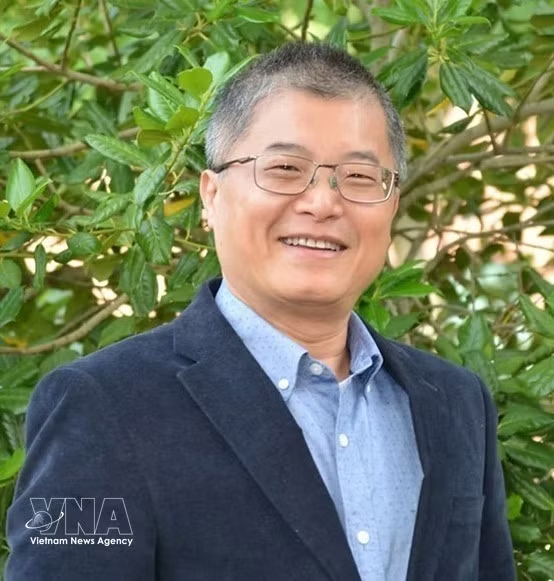
Talking to Viet Nam News Agency correspondents in the US, Ho, Chief Scientific Officer, Founder and President at HeMemics Biotechnologies Inc., said the top Vietnamese leader’s assessment of opportunities and challenges in science and technology, innovation, digital transformation and artificial intelligence (AI) is in line with global trends.
According to Ho, breakthroughs in AI and digital transformation require a corresponding hardware foundation. While economies such as the Republic of Korea, Japan and Taiwan (China) are investing heavily in AI and hardware manufacturing, particularly traditional silicon chips, the physical limits of existing technologies are approaching.
He said this presents an opportunity for Viet Nam to enter at the most fundamental level by mastering chips and technology at the molecular level. Mastering 2D materials such as graphene, he said, could provide a foundation for next-generation science and enable Viet Nam to make a “leap” towards a leading position in next-generation microchips and energy.
However, only a small group of countries, including the US, Japan, the RoK and Spain, can currently produce graphene, he noted, urging Viet Nam to move quickly to master the technology to avoid dependence on major powers in the era of green energy and smart healthcare.
The US expert described General Secretary and President Lam’s call for inclusive, safe, transparent and responsible technology governance, while respecting national and digital sovereignty and the right to development autonomy, as a highly strategic vision.
He stressed that digital sovereignty and development autonomy depend on mastering the physical foundations of technology, noting that control of 2D materials such as graphene could give Viet Nam a unique strategic position by unlocking new areas of innovation at the molecular level.
A country that masters graphene technology will have a decisive voice in global technology governance, as it controls a critical material for energy security, including batteries and solar power, as well as healthcare security through biosensors, he said.
Ho suggested Viet Nam establish regulatory sandboxes and breakthrough incentives to attract companies such as HeMemics to bring core technologies to the country, helping strengthen technological autonomy and enable Viet Nam to have a greater role in shaping international rules.
To realise General Secretary and President Lam’s vision and reduce the risk of dependence, Viet Nam should not merely import technology but become a place where its technological foundations are produced, Ho said, suggesting Viet Nam make use of the global trend of “friend-shoring” – shifting core technology supply chains to trusted partner countries.
The expert highlighted the need for Viet Nam to prioritise three main policy areas – establishing sandbox mechanisms and special incentives for deep-tech and advanced-material projects such as graphene; providing co-financing or infrastructure support, including land and administrative procedures, to build research and development (R&D) ecosystems around high-tech manufacturing plants; and linking national policies with strategic investment funds of partner governments such as the US to attract capital for hardware infrastructure manufacturing rather than focusing solely on software.
He also underlined the importance of bringing advanced core technologies to Viet Nam, scale up production and create economic value, noting that mastering the production of core materials for global industries could reduce the country’s dependence on foreign technology.
Ho said Viet Nam-US cooperation could create opportunities in emerging technologies, particularly AI, new materials, biotechnology and energy. He described cooperation in new technologies as being at a “historic golden moment”, driven by US policies to reduce reliance on risky supply chains and promote “friend-shoring”.
Regarding the global graphene market, Ho said most graphene remains in raw, low-quality forms unsuitable for high-tech applications such as next-generation AI chips, advanced biosensors and high-performance batteries. He viewed this as a strategic gap that Viet Nam and the US could jointly address.
According to the expert, HeMemics has been working directly with the US International Development Finance Corporation (DFC), which has shown strong interest in financing and supporting the company in building a graphene manufacturing plant in Khanh Hoa province.
The project aims to bring high-tech manufacturing technology to Viet Nam to produce high-purity graphene at a commercially viable breakthrough price, providing Viet Nam, the US, and partner countries with a stable supply of high-quality 2D materials for advanced products and R&D activities.