Topic

Highlights

Packaging mangoes for export at Vina T&T Group. (Photo: MINH ANH)
Business

Standardising supply sources to maintain export orders

The country's exports of agricultural, forestry, and fishery products reached 49.31 billion USD after eight months, up 7% year on year. The final months of the year are when market demand rises sharply and also when businesses race to fulfil orders on schedule. To ensure the capacity to supply high-quality goods, businesses need to take the initiative in securing raw materials and strictly controlling quality to meet the requirements of each market.

The Asian Development Bank (ADB) forecasts Viet Nam’s economy will grow by 7.8% in 2026. (Photo: NHA TRANG)
Policy

ADB raises Viet Nam’s 2026 growth forecast to 7.8%

The Asian Development Bank (ADB) has raised its economic growth forecast for Viet Nam to 7.8% in 2026 and 7.6% in 2027, reflecting stronger-than-expected economic performance in the first half of 2026, according to the September 2026 edition of the Asian Development Outlook (ADO), released on September 23.

Enterprises display products at the conference on investment connectivity and development cooperation between Ho Chi Minh City and provinces and cities in the southeastern region and the Mekong Delta.
Policy

Creating an inter-regional investment space

Ho Chi Minh City stands ready to serve as a bridge and accompany localities and the business community in shaping a development space, attracting investment and generating new growth momentum. This will help promote the strengths of each locality in the southeastern region and the Mekong Delta, turning them into a new growth driver.

Improved logistics capacity helps businesses expand markets and access international orders. (Photo: CHQ)
Business

FDI attraction must go hand in hand with stronger domestic linkages

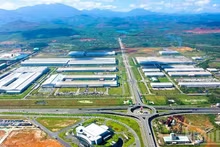
Foreign investment flows continue to find their way to Viet Nam, however, the amount of capital attracted is not the only measure of success. More importantly, stronger linkages between the foreign-invested sector and domestic businesses are needed, along with higher localisation rates and greater participation by Vietnamese businesses in higher-value segments of supply chains.

Back to top