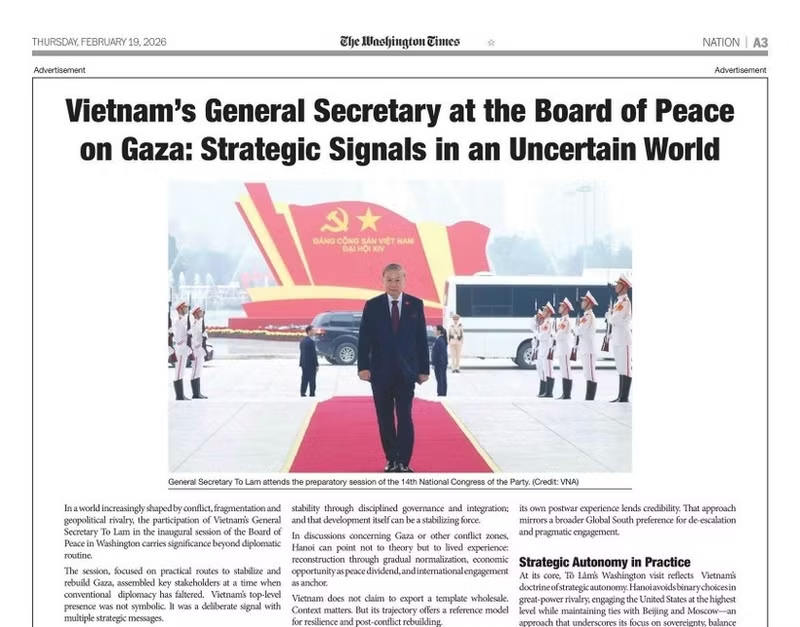
The article noted that in a world increasingly shaped by conflict, fragmentation and geopolitical rivalry, the participation of the Vietnamese leader in the session carries significance beyond diplomatic routine.
“The session, focused on practical routes to stabilise and rebuild Gaza, assembled key stakeholders at a time when conventional diplomacy has faltered. Viet Nam’s top-level presence was not symbolic. It was a deliberate signal with multiple strategic messages.”
According to the author, Viet Nam accepted the invitation at an early stage, and General Secretary Lam’s presence at the session followed shortly after the conclusion of the CPV’s 14th National Congress – the country’s most consequential political event.
The timing confirms readiness to contribute to global peace efforts and operate as a responsible member of the international community. The decision also demonstrates the strategic direction of building a new era of national rise with science, technology and innovation as the engines of long-term growth. The 14th congress pointed to a more forward-leaning foreign policy – focused on protecting peace, shaping a stable external environment for growth and engaging more actively on shared global challenges. Participation in a multilateral peace initiative aimed at de-escalation and reconstruction in Gaza aligns with that vision.
The article wrote: “Perhaps the most compelling undercurrent of the visit is Viet Nam’s implicit peacebuilding narrative – one rooted in its own history.”
It said that few countries understand the value of peace and the complexities of post-conflict reconstruction as intimately as Viet Nam. After decades of war, the nation rebuilt infrastructure, normalised relations with former adversaries and integrated into the global markets. The once-divided country now exports electronics, hosts multinational manufacturers and engages in global forums as a confident middle power. The normalisation of relations with the US in 1995, once unthinkable, is now foundational.
“Viet Nam now presents itself as a proponent of reconstruction, reconciliation and development-driven peacebuilding. Ha Noi demonstrates that former adversaries can become strategic partners; that post-conflict societies can achieve stability through disciplined governance and integration; and that development itself can be a stabilising force.”
According to the author, Viet Nam’s presence at the opening session also reflects the importance it assigns to relations with the US and President Donald Trump.
Over the past decade, bilateral ties have expanded dramatically, spanning trade, maritime security, climate cooperation, technology supply chains and education. The relationship has matured from normalisation to a Comprehensive Strategic Partnership.
The article noted that the Board of Peace initiative, launched and championed by President Trump as a mechanism to stabilise Gaza, has drawn swift backing from Viet Nam. By accepting the invitation and engaging at the highest level immediately after the Party Congress, even during the Lunar New Year, Viet Nam signals both the seriousness of its commitment to peace efforts and its recognition of the host nation’s role in advancing the initiative.
It added that at the same time, this engagement unfolds within Viet Nam’s broader foreign policy of diversified partnerships. Strengthening cooperation with Washington in areas of mutual interest proceeds alongside maintaining stable and positive relations with other partners. “This is not a deviation from Viet Nam’s balanced diplomacy, but a flexible application of it.”
The article assessed that General Secretary Lam’s Washington visit underscores a maturing Viet Nam-US relationship and Viet Nam’s willingness to engage in peace initiatives with greater confidence following the 14th National Party Congress. On that basis, Viet Nam is affirming its role as a bridge between parties, with a nation once scarred by war now emerging as a symbol of reconciliation, development and cooperation.