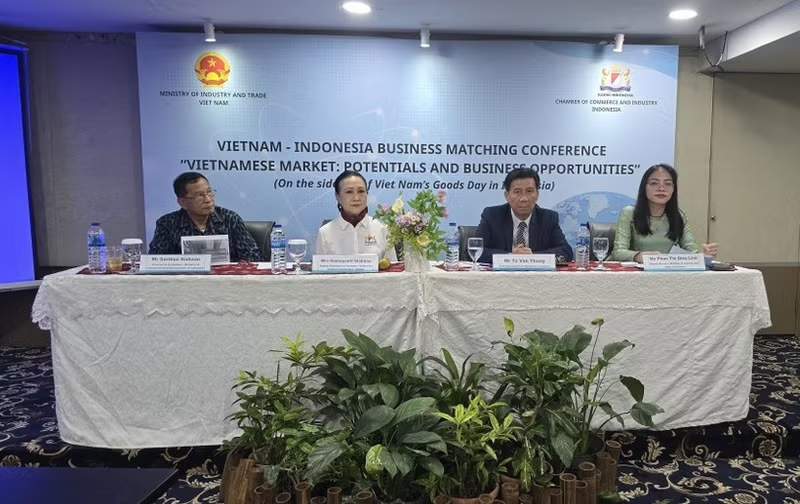
Around 40 Indonesian companies met with nearly 20 Vietnamese firms at the Viet Nam–Indonesia business matching conference held in Jakarta on July 29. The event was jointly organised by the Foreign Market Development Department under Viet Nam's Ministry of Industry and Trade (MoIT), the Viet Nam Trade Office in Indonesia, and the Indonesian Chamber of Commerce and Industry (KADIN) on the sidelines of Viet Nam Goods Day in Indonesia, attracting more than 100 participants.
Vietnamese companies showcased a wide range of products, including agricultural produce, seafood, beverages, consumer goods, textiles, household products, furniture and handicrafts. Product exhibitions, tasting sessions and business matching activities enabled companies from both countries to explore market demand and partnership opportunities.
Addressing the conference, Vietnamese Ambassador to Indonesia Ta Van Thong said the elevation of bilateral ties to a Comprehensive Strategic Partnership in 2025 has created favourable conditions for expanding trade and investment. Although two-way trade exceeded 17.2 billion USD last year, he noted that considerable room for growth remains if businesses strengthen direct cooperation and explore new areas of collaboration.
Phan Thi Dieu Linh, deputy head of the Southeast Asia, South Asia and Regional Cooperation Division under the MoIT's Foreign Market Development Department, said regional trade agreements, including the ASEAN Trade in Goods Agreement (ATIGA) and the Regional Comprehensive Economic Partnership (RCEP), have provided significant tariff advantages.
However, she stressed that companies must identify suitable partners and gain a better understanding of technical standards, consumer preferences and distribution networks to fully benefit from these agreements.
Linh said the two economies are highly complementary, with Indonesia offering abundant raw materials and Viet Nam possessing strong manufacturing and processing capabilities. The conference also gave Vietnamese businesses an opportunity to engage directly with Indonesian importers and distributors, receive feedback on product quality, packaging, pricing and consumer preferences, and better understand Halal certification and distribution requirements.
The MoIT expected the business contacts established at the event to gradually develop into concrete cooperation agreements and commercial contracts, with continued support from the Viet Nam Trade Office in Indonesia.
Damayanti Siahaan, Vice Chairperson of the Viet Nam–Indonesia Bilateral Committee at KADIN, said the outlook for business cooperation is highly promising thanks to the complementary nature of the two economies. She identified electric vehicles, agriculture, fisheries, electronics and semiconductors as sectors with significant potential, adding that businesses should build on their strengths rather than view each other as competitors.
The conference's business matching sessions opened new channels for cooperation, laying the groundwork for Vietnamese and Indonesian companies to expand partnerships and strengthen business ties in the years ahead.