Against this backdrop, the implementation of the two-tier local government model further underscores the role of the People's Public Security force. Beyond safeguarding security and public order, it serves as a key factor in fostering a stable, transparent, and effective governance environment.
The reorganisation of administrative units has fundamentally reshaped jurisdictions, chains of command, data systems, public assets, and social relations. After one year of implementation, experience has shown that maintaining security and public order is no longer simply about preserving the achievements of reform; it has become an integral component of national governance capacity.
Rather than standing outside or behind the reform process, the People's Public Security force has directly contributed to safeguarding institutional integrity, ensuring the smooth operation of the state apparatus, strengthening public confidence, and providing a stable foundation for the two-tier local government model to operate effectively.
Constructive security in the two-tier local government model
The reorganisation of administrative units has created new opportunities for development while also presenting fresh challenges for national governance. Changes to administrative boundaries, organisational structures, personnel arrangements, public assets, databases, and management methods during the transitional period inevitably create potential vulnerabilities if not managed effectively.
Under such circumstances, security and public order are both the outcome of good governance and a prerequisite for ensuring the uninterrupted operation of the state apparatus, the lawful exercise of state authority, the protection of public assets, the security of data, and the strengthening of public trust.
As the establishment of the two-tier local government model represents a strategic step forward, it also requires corresponding innovation within the People's Public Security force. The focus of its work has shifted from responding to incidents after they occur to proactively preventing risks, identifying emerging threats at an early stage and building the people's security posture in close association with the people's trust. This helps create a stable environment in which the new governance model can function effectively. This role is reflected in four core capabilities.
The first is the ability to maintain political and ideological stability and social consensus from the grassroots level. Changes in administrative boundaries, the names of administrative units, office locations, and job assignments may directly affect the psychology of officials, Party members, and the public, particularly regarding issues involving legitimate interests, historical traditions, cultural identity, and access to public services. Such concerns deserve to be heard, fully explained, and addressed through transparent, consistent and publicly accountable policies.
Throughout this process, the Public Security force remains closely engaged at the grassroots level, keeps abreast of developments in public sentiment, clearly distinguishes between legitimate petitions and attempts to exploit democracy to incite unrest, and coordinates the timely dissemination of accurate information. This helps to prevent complex incidents from emerging at an early stage while also preserves social consensus throughout the transition.
Equally important is the capacity to safeguard internal security, economic security, and the integrity of the entire reform process. The merger of administrative units involves an enormous volume of work relating to offices, land, projects, budgets, records, and public assets. These are highly sensitive areas where vested interests, the concealment of wrongdoing, the undervaluation of public assets, unlawful interference in auctions and bidding processes, or corruption and profiteering during the transitional period may arise.
Accordingly, the People's Public Security force works closely with organisational, inspection, auditing, financial, and specialised agencies to detect early signs of improper interference in personnel management, asset administration, and resource allocation.
All legal records must be comprehensively cross-checked against actual usage, land data, accounting documents, and the responsibilities of relevant parties to ensure that the transition is conducted openly, transparently, and in full compliance with the law, thereby preventing asset losses and governance gaps.
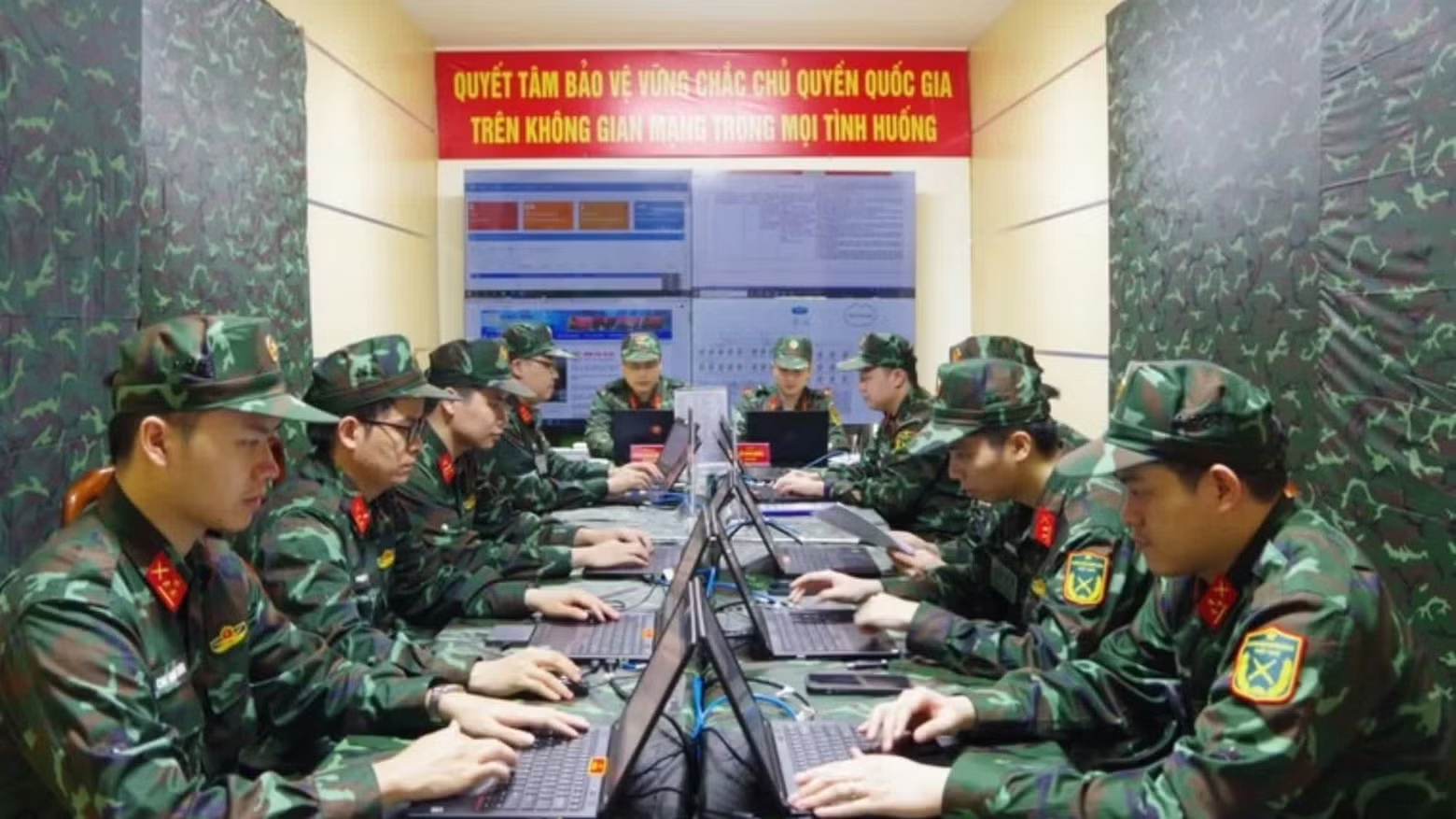
Amid rapid digital transformation, the ability to safeguard data security and cyberspace has become a direct requirement for effective national governance. The merger of administrative units entails changes to administrative codes, administrator accounts, access rights, and the synchronisation of vast volumes of data relating to population, land, civil registration, businesses, social welfare, taxation, healthcare, and education.
In a digital administration, even a minor data discrepancy can affect thousands of transactions, while the compromise of a single administrator account may have widespread consequences.
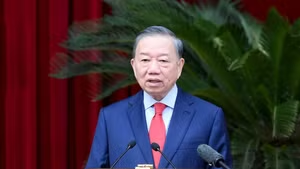
In line with the principle that "where development advances, security must advance alongside it," as directed by Party General Secretary and State President To Lam, the people's security posture must be developed in a coordinated manner across both the physical and digital domains.
Accordingly, the People's Public Security force proactively develops risk maps, strengthens cybersecurity monitoring, and detects and prevents data theft, the impersonation of officials, the dissemination of false information, and online fraud.
Mass mobilisation in the digital era has also evolved beyond one-way communication towards equipping people with stronger digital resilience, enabling them to verify information, recognise new methods of deception, and proactively report suspicious activities from the grassroots level.
The ability to prevent and combat crime amid constantly evolving jurisdictions and increasingly sophisticated criminal methods is another equally important requirement. Following the mergers, many commune-level administrative units have simultaneously become larger in scale, encompassing industrial parks, urban areas, rural communities, border regions, and adjacent localities.
This has also become a period during which criminals increasingly impersonate officials to "update" citizens' identity cards, fraudulently appropriate assets, exploit land-use planning, or take advantage of document conversion procedures to commit scams.
This requires provincial-level Public Security authorities to strengthen analytical and forecasting capabilities, provide operational intelligence, deploy specialised forces, and establish rapid inter-commune response mechanisms.
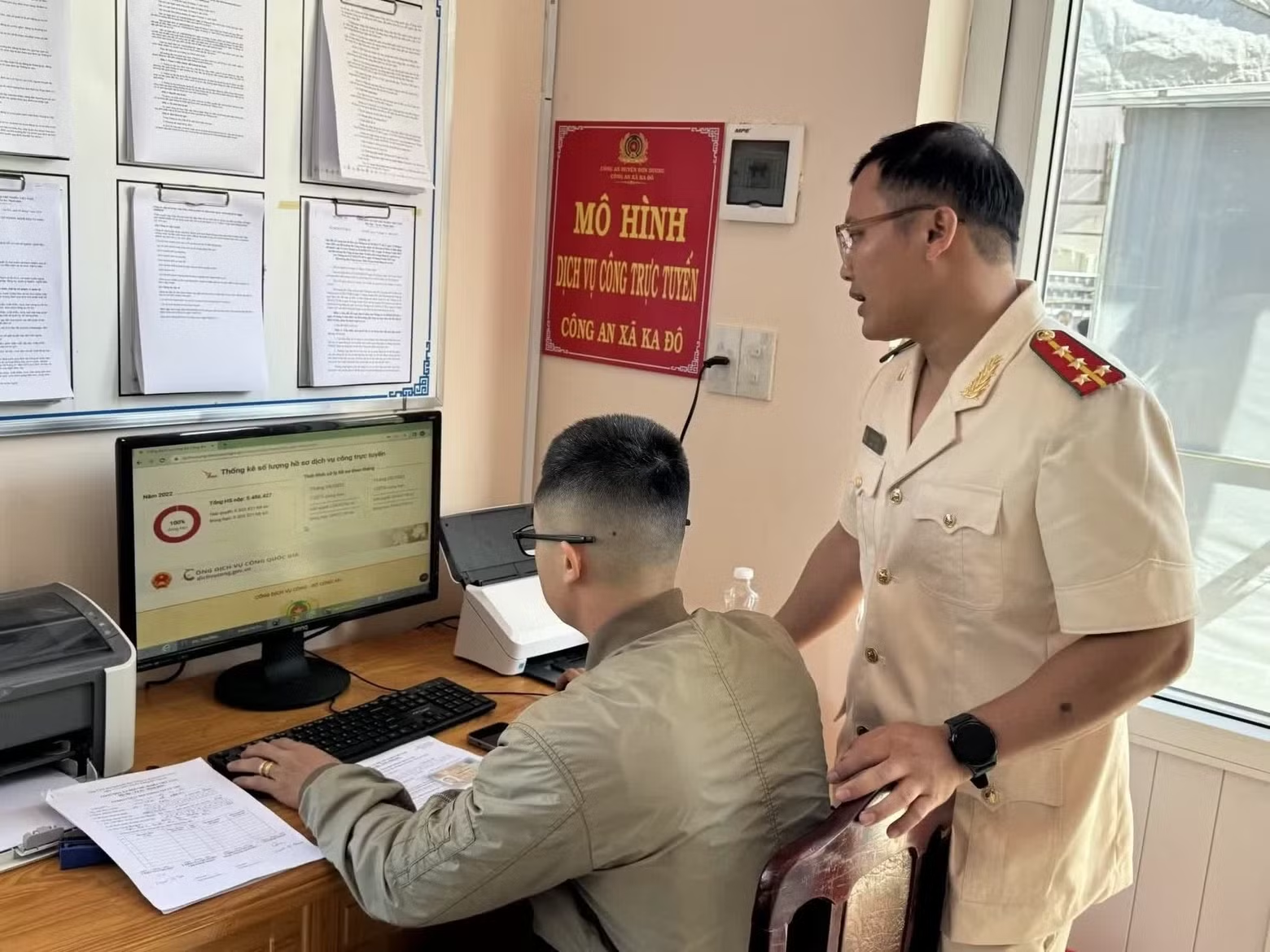
Meanwhile, commune-level Public Security forces must maintain a thorough understanding of their localities, manage residency, receive crime reports, preserve digital evidence, oversee conditional business sectors, and ensure road traffic safety as well as fire prevention and firefighting.
Consequently, work mindset has undergone a fundamental shift from reacting to incidents after they occur to proactively controlling the security situation, placing crime prevention at the centre of operations and measuring performance by the safety of local communities and the satisfaction of the people.
This demonstrates that, under the country's new development conditions, the mission of the People's Public Security force has expanded beyond maintaining security and public order to proactively creating a stable, transparent, and secure environment in which institutional reform, digital transformation, and socio-economic development can proceed smoothly. This is the essence of constructive security — making security the foundation for expanding development opportunities, rather than merely responding to risks after they emerge.
Grassroots public security: Where “loyalty to the Party – comradeship – public trust” converge
If the two-tier local government model is where the Party's guidelines and the State's policies are directly translated into action, then communes, wards, and special administrative zones are where governance capacity is tested every day through the quality of public service delivery. They are also where risks to security and public order first emerge and where the benefits of reform are felt most directly in people's daily lives.
The strategic policy of deploying regular Public Security officers to the commune level is therefore far more than a personnel deployment or an increase in grassroots staffing. In essence, it brings the capacity to safeguard national security, maintain public order and safety, and ensure effective governance directly to where problems arise.
Throughout this process, the values of "Loyalty to the Party – comradeship – public trust" are not merely ethical principles for Public Security officers; they have become the three pillars underpinning the professional capacity of grassroots Public Security forces. The "Three Best" movement — most disciplined, most loyal and closest to the people — translates these values into practical standards of conduct for every task, every locality, and every officer.

"Loyalty to the Party" is first and foremost reflected in the People's Public Security force's ability to uphold political direction and steadfastness throughout the process of modernising national governance. Being "Most loyal" is demonstrated through the capacity to safeguard the Party's sound policies, maintain political stability, and create a secure environment for the people's development.
The experience of Tan Vinh Loc Commune Public Security in Ho Chi Minh City, which maintained stability in a complex locality without allowing any unexpected security incidents throughout 2025 and the first months of 2026, and that of Long Sap Border Commune Public Security in Moc Chau District, Son La Province, which detected and handled 12 illegal drug possession cases in the first three months of 2026 while effectively managing residency registration, vehicle registration, and activating nearly 5,000 electronic identity accounts for border residents, demonstrates that loyalty to the Party must be translated into the ability to safeguard the people, maintain order in local communities, uphold the rule of law, and create a stable environment for development.
"Comradeship" is embodied in the organisational capacity, discipline, and coordinated spirit of the entire force. The smooth operation of a two-tier local government requires that grassroots Public Security forces never work in isolation but always draw strength from a unified organisation in which comradeship is inseparable from discipline, responsibility, and operational coordination — an embodiment of the principle of being "Most disciplined".
Officers stationed in local communities strictly observe regulations and professional procedures, while higher-level authorities provide data infrastructure, equipment, specialised personnel, and timely reinforcement mechanisms.
As of April 2026, 99.1% of commune-level Public Security units nationwide have appointed either their chief or deputy chief as intermediate or senior-level investigators, reflecting the substantive transfer of investigative capacity and judicial authority to the grassroots level.
Results such as those achieved by Can Tho City Public Security, which organised more than 300 activities and implemented over 100 effective initiatives during the first six months of the "Three Best" movement, represent not only campaign achievements but also demonstrate the effectiveness of a force organised under unified discipline and operating through close coordination.
"Public trust" is the direct result of the ability to stay close to the people, understand them, and serve them. It is also the clearest measure of the requirement to be "Closest to the people". When people feel protected, receive convenient public services, and know that their concerns are heard and respected, they are more willing to work alongside the Public Security force in safeguarding security and public order.
The image of Hop Tien Commune Public Security in Thanh Hoa Province bringing public reception services directly to villages, assisting 1,294 citizens, and helping 16 people avoid online fraud; Public Security officers in Lao Cai Province helping elderly and vulnerable households harvest rice; and Can Tho City Public Security mobilising resources to build 1,000 houses for disadvantaged families all demonstrate that people's security cannot be built through administrative orders alone.
It is founded on trust, responsibility, and the close bond between the Public Security force and the people. That trust, in turn, generates valuable information, social solidarity, and a resilient people's security posture from every village, hamlet, and residential neighbourhood.
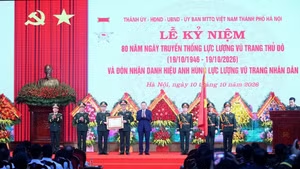
At the ceremony marking the 80th anniversary of the People's Security Force Traditional Day (July 12, 1946 – July 12, 2026), Party General Secretary and State President To Lam emphasised: "Human security and public trust are at the heart of every security policy," while calling for the building of a People's Public Security force that is "most disciplined, most loyal, and closest to the people." This guidance defines the direction for force development in the new era while reaffirming the organic relationship among the three values of "loyalty to the Party, comradeship, and public trust."
Loyalty to the Party ensures political direction; comradeship creates organisational strength; and public trust provides legitimacy and social support. Together, these three values form the foundation that enables the People's Public Security force to fulfil its mission of safeguarding security and public order while supporting the modernisation of national governance.
Continuing to strengthen governance and security capacity in a new stage of development
After one year of implementation, practice has demonstrated that the policy of establishing a two-tier local government model is both sound and well suited to the country's development requirements in the new era. However, as with every major reform throughout history, the value of any governance model depends not only on the initial determination to reform but also on its capacity for continuous improvement through lessons drawn from practical experience.
As the country enters a new stage of development, the objective has moved beyond ensuring the smooth operation of the two-tier local government model to continuously enhancing its governance quality. This requires institutional reform to advance in parallel with digital infrastructure development, capacity building for officials, the modernisation of governance methods, and the strengthening of national security in both the physical and digital domains.
Only when institutional reform, governance innovation, and security enhancement progress as an integrated whole can the two-tier local government model realise its full long-term value.
No governance achievement can be sustainable unless it rests upon a stable security environment, a robust rule-of-law state, and continuously strengthened public trust.
Throughout this process, the People's Public Security force not only maintains public order and safety but also directly contributes to safeguarding institutional integrity, creating an enabling environment for development, and transforming the outcomes of reform into national development capacity. This is the enduring value of the two-tier local government model in the country's new era of development.