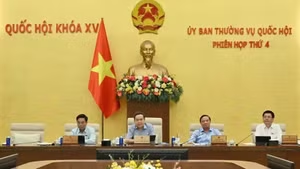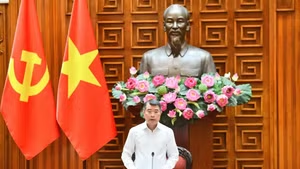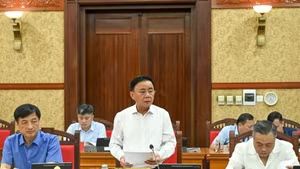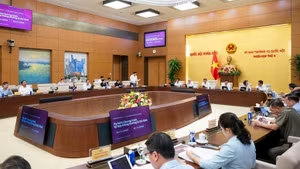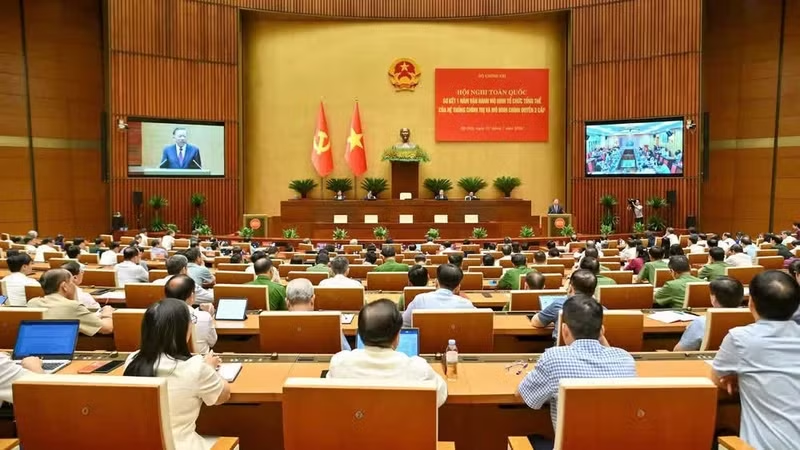
At the National Conference summarising one year of operation of the overall organisational model of the political system and the three-tiered government model, organised by the Politburo on July 1, 2026, General Secretary and President To Lam affirmed: “The policy of reforming and reorganising the political system's apparatus to be streamlined, efficient, and effective is entirely correct, necessary, and strategically significant for the country's development.”
However, with sinister intentions, hostile forces, reactionary elements, and political opportunists have weaponised media campaigns to distort the achievements, spread false information to sow doubt, and incite discontent among a segment of society.
Firstly, detractors are peddling the baseless propaganda that abolishing intermediate levels and reorganising local government is an internal purge, a restructuring of power positions, a pretext to eliminate those not aligned with their faction, or to concentrate absolute power in the central government. The goal of this rhetoric is to distort the essence of reform, deliberately erasing the drive to construct a more honest, transparent, people-oriented, and accountable government apparatus.
Secondly, they weaponise minor transitional obstacles in the transitional period to claim that the new model is stifling economic activity, causing inconvenience to the people, and fabricating the narrative that reforms only lead to more bottlenecks... The tactic here is to turn the phenomenon into the essence, using isolated cases to represent the whole picture, and using a few isolated incidents to derail an overwhelmingly positive trajectory.
Thirdly, they incite populism, fostering anxiety among officials and civil servants subject to restructuring, transfer, or redundancy, arguing that streamlining the apparatus will lead to tens of thousands of job losses and violate social security rights. This constitutes a profoundly malicious attack because it deeply affects the sentiments of those directly impacted by the reforms.
However, it is necessary to clearly clarify that restructuring public service to improve the quality of the apparatus in no way equates to abandoning the workforce. The issue is to continue improving policies on placement, training, utilisation, support, and ensuring the legitimate rights of those affected; we cannot permit inflammatory rhetoric to exploit personal difficulties to undermine the overall policy.
Undeniably, no major reform is without its obstacles. However, these are inevitable difficulties in the transition process and hardly equate to failure. The fact that Party and State leaders frankly point out bottlenecks, demand continued institutional improvement, decentralisation coupled with resource allocation, and improved operational quality is a manifestation of serious, open-minded, and responsible governance towards the people.
The results achieved after one year of operation serve as the ultimate rebuttal. The whole country has received over 42.5 million applications; the online submission rate reached 91.74%; the on-time resolution rate remained over 95%; and over 16.5 million applications have been digitised, reaching nearly 95%.
The reduction and simplification of 3,466 administrative procedures and 1,754 business conditions have driven a 53% reduction in processing time and a 54.6% reduction in compliance costs. The level of public satisfaction reached 83.08%. Notably, 89.09% of respondents noted that harassment and inconvenience by civil servants have largely disappeared. These metrics offer ironclad proof of an administration shifting from a management-oriented mindset to a service-oriented one.
The practical experience from local areas powerfully underscores the positive results of the reforms. In Thanh Hoa, the number of commune-level administrative units decreased from 547 to 166. This is a locality with a large population, vast area, and a high proportion of mountainous regions, so the workload after reorganisation is very heavy. However, the basic system operates stably; the commune-level public administrative service centres received more than 912,000 applications, with a timely resolution rate of over 99%.
In Ha Noi, after a year of implementation, the city has successfully stabilised its organisational structure and effectively operated the political system and government at all levels, especially at the commune and ward levels. The formation of public administrative service centres, independent of administrative boundaries, the deployment of support forces at the grassroots level, and the promotion of decentralisation and the application of technology have drastically slashed the number of documents passing through multiple intermediate steps.
The city’s GRDP growth rate in 2025, the first quarter, and the first months of 2026 remains robust, creating an important foundation for achieving the year’s growth targets. This success confirms that the assignment of tasks, decentralisation of management, and allocation of resources to the grassroots level have been implemented correctly and effectively.
In Ho Chi Minh City, decentralisation and delegation of authority have been aggressively pursued. Based on 1,065 tasks delegated in 28 government decrees, the city has delegated and authorised 900 tasks from departments and agencies, and 108 tasks from the People’s Committee and the Chairman of the People’s Committee to the commune level. The rate of timely processing of applications reached over 99.5%; the rate of online applications reached over 88%; the satisfaction level of citizens and businesses reached over 96%; and 100% of documents were exchanged electronically.
The above examples prove that streamlining the apparatus does not weaken the system if accompanied by clear delegation of authority, appropriate resources, seamless data flow, and controlled accountability. Conversely, a multi-tiered apparatus with overlapping authority and dispersed responsibilities is more likely to lead to stagnation, buck-passing, and avoidance.
It must be definitively stated that the new model does not change the fundamental nature of the socialist rule of law in Viet Nam. This does not diminish democracy or deny the Party's leadership role, as deliberately distorted narratives claim. On the contrary, a more streamlined organisational structure, clearer responsibilities, and better service to the people are a more complete way to implement the principle that State power belongs to the people.
A year of operating the overall organisational model of the political system and the three-tiered government model confirms that organisational reform is an objective requirement of development. Current difficulties need to be addressed through institutions, resources, technology, and public service discipline. However, we cannot deny the achievements already confirmed by practice because of the obstacles of the transitional period.
General Secretary and President To Lam clearly stated: “The reform of the organisational structure of the political system is a very large and difficult task that must be carried out persistently, systematically, and scientifically. We cannot be hasty or subjective, but we also cannot stop or hesitate in the face of the shortcomings pointed out by practice.”
The comrade emphasised that the task in the coming period is to “shift the focus to improving the operational quality, service capacity, and development-creating capacity of the new apparatus”. Correct understanding, synchronised action, and persistent efforts to perfect the new model serve as the crucial roadmap to consolidate unity within the Party, strengthen social consensus, and ensure rapid and sustainable national development in the new era.