A shift in approach is opening a new direction for historical tourism, where the past is recounted in a way that resonates more closely with today’s generation.
When young people experience history
On a weekend at 11A Ngu Xa, Ba Dinh Ward (Ha Noi), visitors flocked to experience the “Patriotism — Subsidy Era Space” tour. The crowd included elderly men and women in their seventies and eighties, children not yet in first grade, and young university students alike.
Among the crowd that day, Nguyen Hong Van and her two children arrived earliest. Born in 1970 and raised in Thanh Xuan, Ha Noi, Van belongs to the generation that lived through the subsidy era. Returning to this space, she was deeply moved by the familiar artifacts of that time. Her two children (born in 2002 and 2008), meanwhile, embraced the experience with excitement and curiosity.
Although they had heard their mother’s stories about the subsidy era before, seeing, touching, and using the actual objects that were once part of their parents’ and grandparents' lives gave them a concrete understanding of a historical period that they had never personally experienced. This intersection of memory and firsthand experience highlights the unique value of bringing history closer to the public through tangible artifacts.
Creating such “touchpoints” was a key objective for Ba Dinh Ward when developing the “Patriotism — Subsidy Era Space” tour. Nguyen Dan Huy, Vice Chairman of the Ba Dinh Ward People’s Committee, stated: “The distinguishing feature is that the tour does not recount history in the conventional manner; instead, it immerses visitors in an experience akin to traveling back in time.
The artifacts here are authentic, and we encourage visitors to interact with them. Rather than imposing information or conveying it rigidly, we allow visitors to explore and ask questions on their own, thereby absorbing historical and cultural values. It is precisely this authentic, experiential approach that has generated a highly positive ripple effect, exceeding the organisers’ expectations.”
Many historical sites across Ha Noi also saw a surge in visitor numbers during the recent National Day holiday. The sites and museums managed by Ha Noi’s cultural authorities — such as the Hoa Lo Prison Relic and the cluster of revolutionary and resistance-era sites (including 48 Hang Ngang, 90 Tho Nhuom, 5D Ham Long, and the President Ho Chi Minh Memorial House) — welcomed a total of 112,112 visitors. These figures partly illustrate how these destinations create experiences that successfully attract the public.
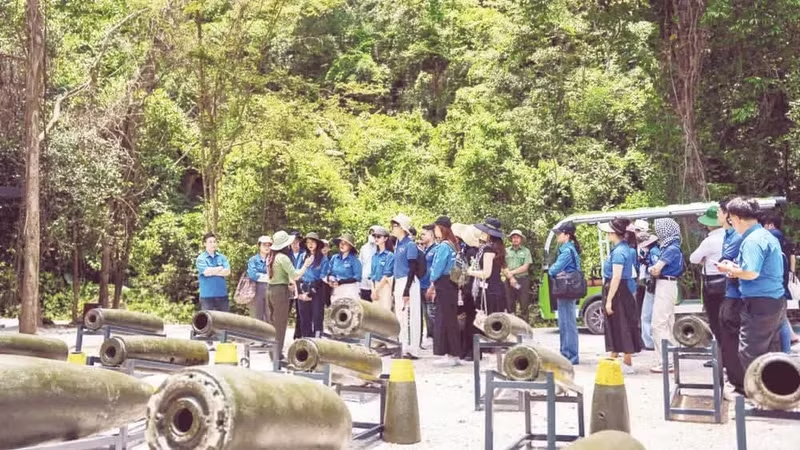
In Quang Tri, the “Legendary Truong Son Trail – Command Cave” eco-tourism site transports visitors to a setting linked to the heroic years of the Truong Son Trail. Here, historical narratives unfold within the natural landscape of Phong Nha-Ke Bang. Visitors can explore areas associated with the combat, communications, medical, and logistical operations of the Truong Son soldiers.
During the four-day National Day holiday, the Command Cave welcomed approximately 2,000 visitors, ranging from children, students, and young families with small children to the elderly and international tourists.
Nguyen Chau My, Director of T20 Quyet Thang Co., Ltd. — the operator of the Legendary Truong Son Trail – Command Bunker Ecotourism Site — stated that technology has been integrated into the visitor experience to facilitate engagement with history.
Features such as VR360, QR codes, and interactive elements spark curiosity among young people and provide children with vivid visual insights; they offer older visitors an opportunity to reminisce and share their memories, and they provide international tourists with a way to connect with historical narratives despite language and cultural barriers.
Innovating approaches while preserving historical value
Observing the recent surge in young visitors exploring historical sites, Assoc Prof, Dr Bui Hoai Son — a National Assembly deputy and full-time member of the Committee for Culture and Education — viewed this as a highly encouraging sign, demonstrating that history is far from alien to the younger generation.
The issue is not that young people are indifferent to history, but rather how historical stories are told so that they see themselves as part of the narrative. Instead of confining history to display cases, placards, or standard guided commentaries, heritage sites need to craft stories that resonate with the interests and experiences of today’s youth.
Consequently, storytelling, experiential activities, interactive elements, night tours, and digital technology applications can serve as initial touchpoints, drawing young people deeper into the history, culture, and underlying values of each site.
However, innovating the approach does not mean allowing technology or presentation formats to overshadow the content itself; technology, interactivity, and immersive experiences should be viewed merely as supporting tools.
The more realistic the experience created by modern technologies — such as 3D, AR, VR, or AI — the greater the need for content to be rigorously verified, grounded in authentic records, and developed with the input of historical experts.
This approach is being fully implemented at the “Legendary Truong Son Trail – Command Cave” eco-tourism site. According to Nguyen Chau My, technology is simply a medium, while the core objective remains preserving, recounting, and sharing historical values in a way that connects with contemporary audiences.
The goal is to ensure that upon leaving the Command Cave, visitors not only recall what they saw but also carry with them a profound appreciation for the sacrifices made by previous generations and the true value of peace. This new approach allows young people to directly explore the traces, stories, and memories of previous generations.
Tran Trung Bac (Education and Communication Department, Hoa Lo Prison Relic) noted that while technology is being thoughtfully integrated, not every activity requires or benefits from a reliance on it. For a revolutionary historical site, authentic artifacts and the stories they tell remain the foundation of its appeal.
Key attractions for visitors include exhibitions that are carefully researched and themed, as well as reenactments that bring history to life — closely aligned with exhibition content and subjected to rigorous rehearsal and final dress rehearsals.
This new approach allows young people to directly explore the traces, stories, and memories of previous generations. However, maintaining historical authenticity requires a clear boundary.
“We can innovate the storytelling but not the facts themselves; we can enhance the entertainment value but must not trivialise history; we can utilise cutting-edge technology, but the ultimate goal must be to help people gain a deeper understanding of the past, cherish the sacrifices of earlier generations, and act more responsibly in the present,” emphasised Assoc Prof, Dr Bui Hoai Son.