A lever to boost economic efficiency
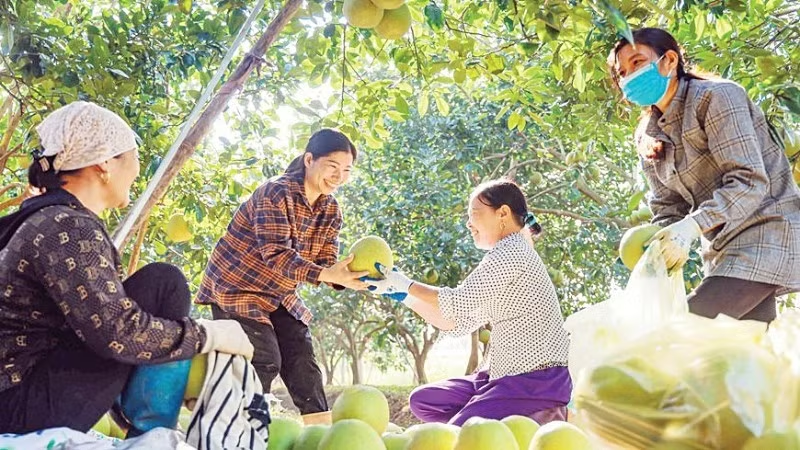
Tran Xuan Loat, Director of the Choa Agricultural Cooperative in Phuc Trach Commune (Ha Tinh), said that with a scale of more than 18 hectares, the cooperative supplies the market with over 100 tonnes of Phuc Trach pomelo each year. In the past, before technical advances were applied, the orchard set fruit only sporadically and output was unstable.
However, the adoption of supplementary pollination marked a major turning point, with trees achieving a high fruit-set rate. This effectively addressed the productivity challenge. The cooperative has also shifted towards ecological farming, giving priority to organic fertilisers and largely avoiding plant protection products. Clean production practices have helped the cooperative’s pomelos maintain consistent quality and good presentation, securing higher and more stable prices.
Ha Tinh currently has more than 12,000 hectares of citrus. Of this, pomelo accounts for more than 4,300 hectares, with output of around 40,000 tonnes. To improve product quality, the provincial authorities have organised many intensive-farming training courses, with a focus on rational fertiliser use and integrated pest management (IPM). Notably, applying supplementary pollination to pomelo trees on more than 90% of the area has helped to boost yields; in addition, fruit bagging technology, now used on over 70% of the area, has improved product appearance.
Similarly, in Phu Tho, Nguyen Van Quan, Deputy Director of the Department of Agriculture and Environment, said the locality has organised short-term vocational courses and provided technical transfer on planting, soil improvement, and safe cultivation under VietGAP and organic standards. The province has also applied research results from the Plant Protection Research Institute (Viet Nam Academy of Agricultural Sciences) on nutrition management and integrated procedures for sustainable orange replanting. At the same time, it has focused on soil improvement and thoroughly addressing factors causing yellow-leaf and root-rot syndrome, such as mealybugs, nematodes, and the fungi Fusarium and Phytophthora.
As a result, the quality of the locality’s citrus has increasingly improved. Total citrus area across the province now reaches 15,300 hectares, with output estimated at 274,500 tonnes. Phu Tho has formed concentrated production areas such as Doan Hung pomelo (1,450 hectares) and Hoa Binh red pomelo (1,087 hectares), along with specialised zones for CS1 oranges, Canh oranges, Xa Doai oranges, and Dien pomelo production. Many products have been exported to high-end markets such as the European Union (EU), the US, and the United Kingdom.
According to Huynh Tan Dat, Head of the Department of Crop Production and Plant Protection (Ministry of Agriculture and Environment), many new varieties with outstanding yield and quality have in recent years been successfully transferred into production. In addition, cultivation capacity in many localities has improved markedly through the adoption of drip irrigation combined with smart fertilisation and optimisation of water use and agricultural inputs. Notably, producers’ mindsets have shifted strongly away from chemical overuse towards more sustainable solutions, such as increased organic fertiliser use and prioritising biological plant protection products for pest and disease control.
The citrus sector has also made progress in staggering harvest seasons, expanding safe-production areas and prioritising the issuance of planting-area codes for export. In parallel, post-harvest technology has been strengthened with packaging techniques, film-forming treatments and modern cold storage systems, extending shelf life and maintaining fresh-fruit quality. Many businesses have also invested in deep-processing lines to diversify products and raise value added across the sector.
Focusing on replanting and tackling disease challenges
Despite strong potential and encouraging results, the citrus sector is facing many difficulties, especially from pests and diseases. Ban Van Tinh, in Tien Yen Commune (Tuyen Quang), said that around three years ago, his family’s 15-hectare VietGAP-oriented orange orchard showed signs of greening disease. Within a short time, the disease spread across the entire orchard, causing heavy losses. Previously, the family harvested hundreds of tonnes of oranges each year; now output is only around 30 tonnes.
Degradation is occurring in most production areas, sharply reducing citrus yields. The main causes are the increasingly complex outbreaks and damage from pests and diseases, alongside unbalanced cultivation that depletes soils and weakens soil microbial communities. According to the Plant Protection Institute, the total degraded citrus area has exceeded 16,500 hectares; Tuyen Quang alone accounts for nearly 6,000 hectares, and Nghe An nearly 4,000 hectares. In provinces such as Phu Tho, Tuyen Quang, and Nghe An, as well as Can Tho City, more than 50% of orange-growing areas have degraded beyond recovery and must be cut down.
Citrus also faces other challenges including small-scale, fragmented production and limited investment and technical application. Variety structure still relies mainly on local varieties that have degenerated, with poor appearance and many seeds, reducing competitiveness and creating difficulties for processing.
Citrus area currently stands at 189,000 hectares nationwide, with output estimated at 3.2 million tonnes per year. The agricultural sector has set a target for 2030 of stabilising citrus area at around 270,000–280,000 hectares — focusing not on quantity, but on improving productivity, quality, and food safety.
Citrus area currently stands at 189,000 hectares nationwide, with output estimated at 3.2 million tonnes per year. The agricultural sector has set a target for 2030 of stabilising citrus area at around 270,000–280,000 hectares — focusing not on quantity, but on improving productivity, quality, and food safety.
To meet the target, the Fruit and Vegetable Research Institute recommends that competent authorities continue to standardise cultivation practices, while prioritising the introduction of pest- and disease-tolerant varieties, seedless varieties, and staggered-ripening varieties to better serve market and processing demand. It also calls for completion of procedures for disease-free plant propagation, wider adoption of advanced farming methods, improved soil health, and post-harvest technologies suitable to each region.
Huynh Tan Dat, Head of the Department of Crop Production and Plant Protection, said that in the coming period, the crop-production sector will continue researching high-quality varieties that are resistant to major diseases, especially greening disease. It will also complete cultivation procedures for citrus suitable to each ecological zone — including seed management and the selection of cultivation areas that meet requirements for water and soil quality.
In addition, the sector will replant ageing and degraded areas with disease-free varieties; expand food-safe production areas and certified production; and further scale up the issuance of planting-area codes to meet export-market requirements.