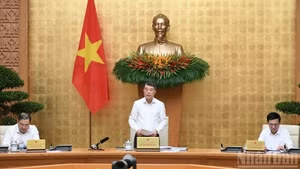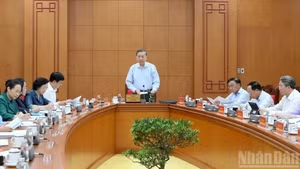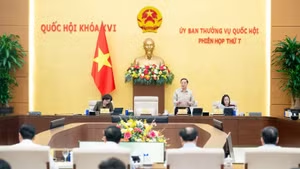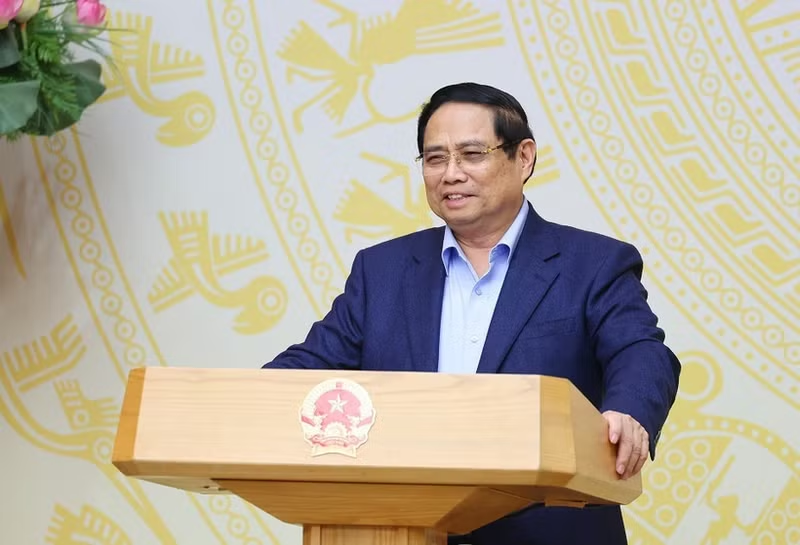
Chairing the seventh meeting of the Government's Steering Committee for reviewing and untangling knots in the legal document system in Ha Noi, the PM, who leads the steering committee, noted that efforts to build and refine laws and remove institutional bottlenecks achieved notable results, especially in 2025.
A report from the steering committee showed that since 2020, the Government and relevant ministries and agencies have reviewed and handled 3,093 issues, feedback items and recommendations related to legal regulations across all sectors. Of these, 2,142 have been settled, 817 are under review, 92 were clarified as not constituting legal bottlenecks, and 44 were transferred to competent authorities for handling.
The steering committee also reviewed laws, National Assembly (NA) resolutions, ordinances and resolutions of the NA Standing Committee that no longer align with the Law on Organisation of the Government, addressed legal issues arising from administrative restructuring and the two-tier local government model, and responded to 173 recommendations from businesses regarding legal obstacles.
In 2025 alone, institutional building and improvement were implemented with strong determination, yielding the largest legislative workload to date and a fundamental renewal in legislative thinking.
The Government submitted 99 laws and resolutions to the NA for approval, including 55 adopted at the 10th session of the 15th National Assembly, alongside 374 decrees and 18 normative resolutions.
PM Chinh assessed that transparency in law-making has improved, and coordination between the Government, the NA and other agencies has been strengthened, and a large volume of public and business feedback has been addressed.
He emphasised that review results constitute a reliable data source for institutional improvement, enabling timely amendments and supplements to legal documents.
However, the PM pointed to remaining challenges such as the large number of legal documents requiring review, uneven progress and delays in implementing guiding documents.
He highlighted key lessons, including adherence to Party guidelines and practical realities, strengthening leadership accountability, prioritising resources, enhancing inter-agency coordination, and encouraging public and business participation. Noting the great workload in institutional and legal building and completion ahead, he called on ministers, heads of sectors and local leaders to strictly implement the conclusions of Party General Secretary To Lam, proactively take full responsibility for institutional development in their respective fields, and ensure timely institutionalisation of Party policies, avoiding the situation that "laws await decrees and decrees await circulars".
Leaders of ministries, sectors and localities were instructed to continue to use review outcomes as input data for future legislative work, make timely proposals for amendments to be submitted to the NA and thorough reviews of legal bottlenecks, particularly those related to the two-tier local government model.
The Government leader assigned the Ministry of Justice, which serves as the standing agency of the steering committee, to urgently upgrade the system for receiving and handling feedback on legal documents, ensuring effective connectivity and timely resolution of public and business recommendations, under the continued supervision of Deputy Prime Minister Ho Quoc Dung.
Reaffirming that institutions remain the “breakthrough of breakthroughs,” the PM stressed that laws and institutions must be viewed as both a goal and a driving force for rapid and sustainable development.
He called for a shift in legislative thinking from management to facilitation and service, stronger decentralisation and delegation of authority, and the mobilisation of resources to transform institutional bottlenecks into competitive advantages.