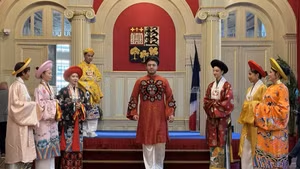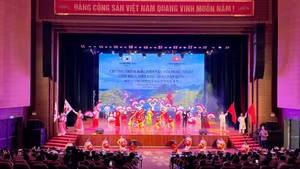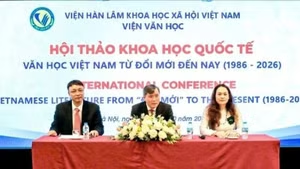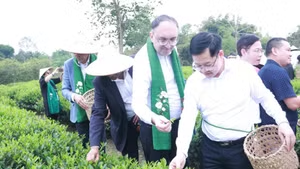
From this perspective, cultural diplomacy should be viewed as more than just cultural exchange, image promotion, or event organisation; it can serve as a mechanism to link domestic resources with international knowledge, markets, technology, capital, and networks.
From tangible assets to comprehensive strength
Traditionally, resources were understood as land, natural assets, capital, and labor. In the current context, however, the scope of resources has expanded to include: culture and history, which forge identity; human capital, which generates knowledge and creativity; trust, which enables cooperation; and data and technology, which provide the capacity for forecasting, innovation, and the reorganisation of resources.
Resolution No. 33-NQ/TW, dated June 9, 2014, on the development of Vietnamese culture and people to meet the requirements of the nation’s sustainable development, defines culture as the spiritual foundation of society—both a goal and a driving force for sustainable national development.
Culture must be placed on an equal footing with the economy, politics, and social affairs. Furthermore, the Resolution calls for the establishment of mechanisms and policies to foster external cultural relations, support the promotion of national arts, and facilitate the export of cultural products abroad.
This line of thinking was further advanced in Resolution No. 80-NQ/TW, issued by the Politburo on January 7, 2026. It defines Vietnamese culture as a vital endogenous resource that shapes the intellect, soul, spirit, and character of the Vietnamese people.
Furthermore, it establishes the development of culture and the human element as a foundational pillar—an endogenous resource and a driving force—for rapid and sustainable development. The Resolution sets a target for the cultural industries to contribute approximately 7% of the GDP by 2030, with the establishment of 5 to 10 national brands within the cultural sector.
This represents a significant shift: culture is no longer viewed merely as something to be preserved; rather, it must be organised to generate developmental capacity—though economic gain should not be the sole metric for assessing cultural value. The experience of the Republic of Korea (RoK) demonstrates that the decisive factor lies in the ability to establish mechanisms for such transformation.
By 2025, the RoK's cultural market was estimated to reach 274 trillion won (approximately 182 billion USD)—nearing the 300 trillion won target set for 2030—with cultural exports valued at around 71.8 billion USD, making the cultural sector the RoK’s third-largest export industry.
Viet Nam possesses a substantial digital foundation to facilitate this transition. By the end of 2025, Viet Nam had 85.6 million internet users—equivalent to 84.2% of the population—along with approximately 79 million social media user accounts.
The younger generation are not merely consumers of culture; they are also its creators, distributors, and the architects who reshape the nation’s image within the digital sphere. If managed effectively, this digital space can serve as a hub for creativity, education, market connectivity, and the development of a national brand.
Bottlenecks in connectivity
Viet Nam possesses vast cultural resources, yet they remain fragmented across various sectors—including heritage, the arts, tourism, education, media, creative enterprises, the Vietnamese diaspora, and international partner networks. A second major bottleneck is data.
A creative economy cannot function efficiently if data concerning heritage, artisans, artists, businesses, markets, audiences, international partners, and visitor flows lacks common standards, remains siloed, or is otherwise unanalysable. Without comprehensive input data, policies, market forecasts, and AI-driven applications will inevitably fall short in quality.
The government has moved swiftly toward concrete action by approving a National Data Strategy and a Digital Transformation Plan for the cultural sector, with a roadmap extending to 2030 and a vision toward 2045. Consequently, the digital transformation of culture and the national data strategy must be integrated within a unified governance framework.
The RoK’s experience—recognised by UNESCO for the significant “spillover effect” of K-pop and K-dramas into consumer goods and tourism—offers a valuable lesson. The RoK developed “WelCon”, an information infrastructure designed to facilitate the export of cultural content.
It integrated fragmented data from 14 different organisations, linking information on markets, buyers, and events, while providing access to legal, intellectual property, and financial consulting, as well as facilitating commercial transactions.
Therefore, the challenge for Viet Nam is not to centralise all creative activities, but rather to harmonise data architecture, standards, objectives, and coordination mechanisms, while simultaneously decentralising the spaces for creativity and business. Unified governance must go hand in hand with diverse forms of creativity.
From promoting an image to transforming value
If culture is a resource, then cultural diplomacy serves as a “bridge”—connecting this resource to the rest of the world, while bringing global resources back to Viet Nam. The strategy for external cultural relations, with a vision toward 2030 and 2045, provides a direct framework for this transition.
Accordingly, cultural diplomacy must shift from a mindset focused on organising events toward the development of a value chain encompassing: cultural values, international recognition, goodwill and trust, partner networks, branding, markets, tourism, trade, investment, education, science and technology, and the reinvestment in people and culture.
To achieve this, it is necessary to establish a data infrastructure for cultural diplomacy—one that connects information regarding heritage, artists, experts, businesses, the Vietnamese diaspora, markets, partners, and the outcomes of collaborative efforts.
Artificial intelligence (AI) can assist with audience analysis, translation, content personalisation, market forecasting, and digital preservation; however, its application must be accompanied by robust safeguards for privacy, copyright, cybersecurity, authenticity, and data sovereignty. This is also a fundamental requirement of a human-centered development model.
Cultural diplomacy must be situated within the broader framework of national interests: it should contribute to fostering mutual understanding and trust, expanding cooperation in economic, scientific, and technological spheres, while simultaneously helping to safeguard national identity and cultural sovereignty. Furthermore, it should bolster societal resilience in the face of crises, information conflicts, and the volatility of the international environment.
Unlocking national resources through cultural diplomacy is not about the commercialisation of culture; rather, it is about transforming culture into a core national capability. Identity generates appeal; appeal fosters trust; trust expands networks; networks create opportunities; opportunities yield new value; and this new value, in turn, nourishes the nation’s people, culture, science and technology, resilience, and global standing.
In a world likely to remain characterised by strategic competition, emerging technologies, crises, and unpredictable shifts, a nation’s enduring strength lies not merely in the resources it currently possesses, but in its capacity to continuously regenerate those resources.
Cultural diplomacy—when organised on the foundations of modern governance, data, science and technology, human capital, and national interests—can serve as a vital instrument for Viet Nam to both preserve its distinct identity and expand its horizons for development, while simultaneously strengthening its overall national power in this new era.