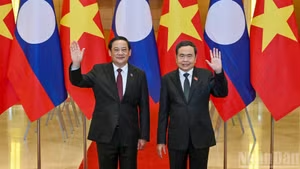
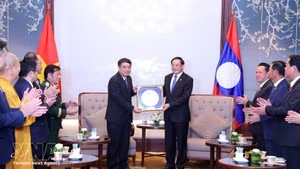
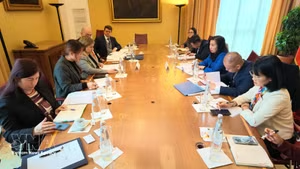
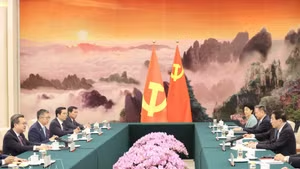
At the meeting, Secretary of the Phu Tho Party Committee Pham Dai Duong said the province attaches great importance to maintaining and expanding ties with Lao localities, particularly those in northern Laos.
During the 2021–2025 period, Phu Tho awarded more than 800 full scholarships to Lao students and supported the construction of several major infrastructure facilities in Lao localities, including a Political and Administrative School, a Public Security Hospital, a provincial National Assembly building and healthcare facilities, he said.
In February, the province signed friendship and cooperation memoranda of understanding with the northern Lao provinces of Luang Namtha, Luang Prabang, Bokeo and Houaphanh, laying the groundwork for more substantive and effective cooperation.
Building on these achievements, Phu Tho hopes to step up delegation exchanges and share experience in Party building, local governance, and socio-economic management and development. Priority will be given to education and training and human resources development, including maintaining scholarship programmes for Lao students, expanding vocational training and personnel training, Duong said.
The province proposed strengthening business links and promoting trade and investment, while expanding cooperation in processing industries, agriculture and services. Other priorities include cultural, tourism and sports exchanges and people-to-people exchanges.
In particular, Phu Tho invited Lao localities to take part in the annual Hung Kings Commemoration Day - Hung Kings Temple Festival, helping foster mutual understanding and solidarity between the peoples of the two countries.
Cooperation in healthcare, science and technology, and digital transformation was also identified as an area requiring greater attention.
Duong expressed his hope that the proposed areas of cooperation will be translated into practical programmes and plans with clear priorities, tailored to the strengths and needs of each locality. He affirmed that Phu Tho will proactively coordinate with central agencies and localities of Laos to ensure the effective implementation of cooperation agreements.
For his part, Lao NA President Sonexay Siphandone spoke highly of Vietnam's achievements under the leadership of the Communist Party of Vietnam, particularly in economic development, investment attraction and industrial development in Phu Tho. These experiences, he said, offer valuable lessons for the Lao Party, State and people to study and learn from.
Praising the cooperation between Phu Tho and the northern Lao provinces, he expressed his hope that both sides will continue to build on their close ties and step up exchanges and experience-sharing in leadership, management and the organisation of local People's Council activities.
He proposed Phu Tho continue working with Lao localities to organise activities marking the 2027 Laos-Viet Nam Year of Friendship and Solidarity. He also stressed the importance of raising public awareness and educating younger generations about the traditional relationship between the two countries, helping preserve and further strengthen their great friendship, special solidarity, comprehensive cooperation and strategic cohesion.
Agreeing with the cooperation orientations outlined by the Lao National Assembly President, Duong affirmed that Phu Tho will continue close coordination with central agencies and localities of Laos to translate cooperation plans into practical initiatives suited to local conditions and delivering tangible benefits to people of both sides.