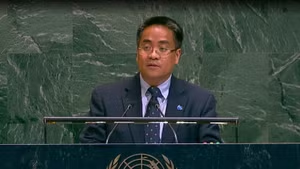
In an interview granted to Nhan Dan (People) Newspaper’s correspondents in Cambodia, Mengdavid said that the establishment of the modern State of Viet Nam in 1945 under the leadership of President Ho Chi Minh was not only a momentous event for Viet Nam, but also a pivotal moment for the revolutionary movement in Indochina and a clarion call for nations in the region to rise up against imperialism and colonialism.
He analysed that Viet Nam’s experience provided inspiration and practical, positive results for Cambodia’s political movement, particularly in party organisation, mass mobilisation, and the struggle against colonial domination.
“This historical experience laid the foundation for political trust and the building of political party institutions. Most importantly, this historical bond has helped to strengthen and emphasise the protection of sovereignty, independence, social stability, and national development centred on the people under the leadership of a strong political party,” he stated.
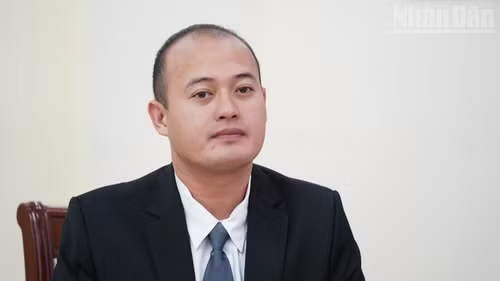
The Cambodian scholar emphasised that the above aspect plays a crucial foundational role in the relationship between the Communist Party of Viet Nam and the Cambodian People’s Party, which has steadfastly withstood external pressures over many decades — from the collapse of the Pol Pot genocidal regime in 1979 to the present.
In the subsequent years of national reconstruction and defence in Cambodia, the Communist Party of Viet Nam played a vital role in helping the Cambodian People’s Party build its party structure, state institutions, security forces, and administrative capacity. This was also the period in which Viet Nam–Cambodia relations were strongly consolidated, characterised by close affinity and similarities in state leadership ideology, alongside existing solidarity and trust.
Researcher Mengdavid highly appreciated the Communist Party of Viet Nam’s special attention to party-to-party diplomacy, viewing it as an indispensable pillar in this new era of development. This is especially true regarding neighbouring countries that share similar political systems, prioritising common interests, mutual respect, and people-centred approaches while adhering to international law and the spirit of multilateralism.
This approach has reinforced long-term stability and mutual trust amid increasingly complex and fragile regional security circumstances. Moreover, the strength, positive relations, and sound strategy between the two parties have directly influenced political stability and security cooperation between Cambodia and Viet Nam.
The Communist Party of Viet Nam has become an important model for ruling parties in the region, including the Cambodian People’s Party, to reference for leadership and apply more creatively, suited to Cambodia’s social context.
According to him, Cambodia, under the leadership of the Cambodian People’s Party, has drawn lessons from Viet Nam in economic reform, poverty reduction, and state capacity building.
“The Communist Party of Viet Nam has become an important model for ruling parties in the region, including the Cambodian People’s Party, to reference for leadership and apply more creatively, suited to Cambodia’s social context,” the Cambodian researcher analysed.
Commenting on Viet Nam’s political transformations, he hailed the success of the 14th National Congress of the Communist Party of Viet Nam as a decisive historical turning point. He noted that it not only shapes Viet Nam’s development future in the new era but also exerts a profound influence on regional stability, including Viet Nam–Cambodia relations.
The Cambodian scholar also proposed several major strategic orientations that the two parties should prioritise for further cooperation in the time ahead. He suggested the two sides develop leadership capacity for the next generation of cadres through official visits and policy seminars to enhance mutual understanding and consolidate the foundation of political trust.
The friendship between the two nations will grow even closer in the years ahead, continuing to make meaningful contributions to peace, development, and shared prosperity in Southeast Asia
Viet Nam and Cambodia need to intensify forward-looking economic cooperation, particularly in the digital economy, green energy, innovation, education, and technology. According to the Asian Development Bank (ADB), Southeast Asia’s digital economy could reach a value of over 1 trillion USD by 2030. Thus, this presents a shared opportunity for the two countries to jointly advance digital infrastructure development.
He pointed out that cross-border challenges — especially Mekong River basin governance, climate change adaptation, and food security — are urgent issues that the two countries must address together, as they directly affect the lives of millions. This requires sustainable political coordination at the party level to build joint resolution mechanisms for the benefit of both nations.
In addition, he highlighted the task of further deepening people-to-people diplomacy, including exchanges among students, researchers, journalists, and businesspeople to build long-term societal trust and promote mutual understanding.
He also expressed confidence that the friendship between the two nations will grow even closer in the years ahead, continuing to make meaningful contributions to peace, development, and shared prosperity in Southeast Asia.