This marks the first time in nearly four decades, since the 1988–1997 World Decade for Cultural Development, that an initiative of such scale has been relaunched within UNESCO, with Viet Nam playing a pivotal role.
According to the roadmap, the resolution recommends that the United Nations promptly launch the International Decade, scheduled for 2027–2036, which will be submitted to the United Nations General Assembly in 2026 for consideration and adoption. UNESCO will act as the lead agency, coordinating with relevant UN organisations and international partners.
Culture in the global development structure
For years, culture has been gaining increasing recognition as a key factor in sustainable development. Yet, in the United Nations’ 2030 Agenda, with its 17 Sustainable Development Goals (SDGs), culture is not identified an independent goal. Instead, it is woven into education, sustainable cities, responsible consumption and production, and economic growth, leaving a policy and resource gap.
Viet Nam’s initiative on the International Decade of Culture for Sustainable Development seeks to close that gap, positioning culture as a central pillar of sustainable development. It is not merely a supporting factor but an independent driver, linking economy, society, and environment.
Nguyen Phuong Hoa, Director of the International Cooperation Department under the Ministry of Culture, Sports and Tourism, explained that the initiative is expected to create a new framework of political commitment and international cooperation, mobilising financial resources, technical support, and participation from social actors in the cultural sector.
This is the largest-scale initiative launched by Viet Nam at UNESCO in many years. It demonstrates Viet Nam’s shift from participant to proactive contributor, shaping new standards for development.
Deputy Minister of Foreign Affairs Ngo Le Van
Crucially, the initiative redefines culture as an endogenous resource capable of generating economic value, fostering innovation, strengthening social cohesion, and ensuring environmental sustainability. Its novelty lies in its systemic approach: culture is integrated into economic and social policies and connected to creative industries, digital transformation, education, and sustainable tourism.
Deputy Minister of Foreign Affairs Ngo Le Van emphasised that this is the largest-scale initiative launched by Viet Nam at UNESCO in many years. It demonstrates Viet Nam’s shift from participant to proactive contributor, shaping new standards for development.
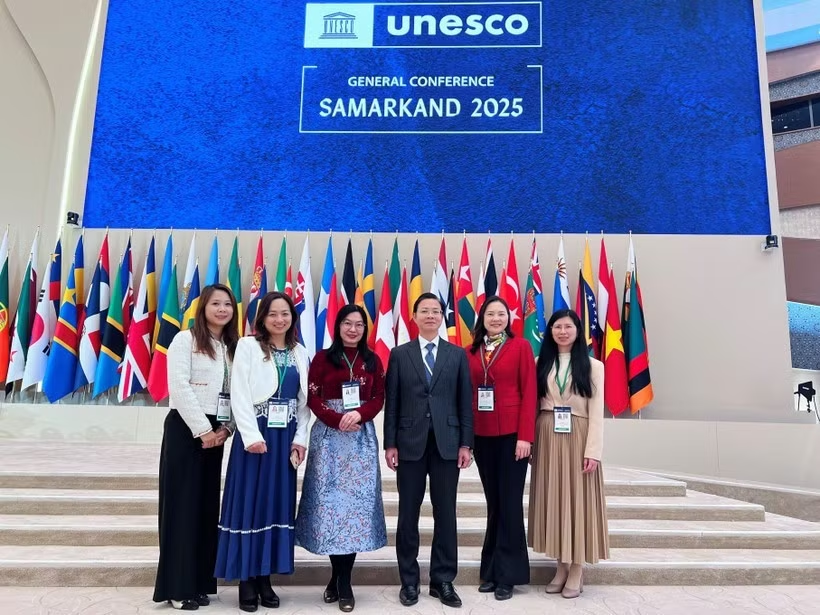
UNESCO Director-General Audrey Azoulay praised Viet Nam’s leadership, noting that the initiative aligns with UNESCO’s strategic focus on culture’s role in sustainable development and peace. UNESCO Assistant Director-General Ernesto R. Ottone added that, if adopted by the UN General Assembly in 2026, the initiative will embed culture more firmly into the global development agenda post-2030.
From national policy to global vision
The success of the “International Decade of Culture for Sustainable Development” reflects the consistency of Viet Nam’s domestic cultural policies. Politburo Resolution No. 80-NQ/TW (dated January 7, 2026) affirms: “Developing culture and people is the foundation, an important endogenous resource, a powerful driving force, a pillar, and a regulatory system for the country’s rapid and sustainable development.” The 14th National Congress documents further stress the need to harness culture and people as core resources for growth.
These principles have been translated into practice. The Strategy for Development of Cultural Industries to 2030 sets targets for boosting the sector’s economic contribution, building a professional creative environment, and promoting innovation and international integration.
According to the Ministry of Culture, Sports and Tourism, Viet Nam’s cultural industries have been contributing around 6.5–7.5% of GDP annually in recent years. Sectors such as film, performing arts, photography, design, video games, advertising, and cultural tourism have made significant strides. Additionally, programmes to preserve heritage, strengthen grassroots cultural life, and promote social justice have reinforced national identity.
Viet Nam is now an active member of key UNESCO conventions on cultural and natural heritage, intangible heritage, and cultural diversity. From beneficiary to initiator, Viet Nam has evolved into a nation proposing ideas and fostering cooperation — an embodiment of proactive and responsible integration.
Viet Nam’s UNESCO-listed heritages not only honour tradition but also drive sustainable tourism, community livelihoods, and national branding. The country is now an active member of key UNESCO conventions on cultural and natural heritage, intangible heritage, and cultural diversity.
From beneficiary to initiator, Viet Nam has evolved into a nation proposing ideas and fostering cooperation — an embodiment of proactive and responsible integration.
Jonathan Baker, UNESCO Representative to Viet Nam, highlighted that Viet Nam’s national strategies clearly integrate culture with development, from heritage preservation to creative industries, sustainable tourism, and rural recovery. This alignment with the UN’s SDGs provides a strong foundation for Viet Nam to transform the International Decade into global action.
Associate Professor Dr Bui Hoai Son, a full-time member of the National Assembly’s Committee on Culture and Education, noted that Viet Nam’s initiative reinforces global awareness in a new context. Contributing ideas at this scale reflects a nation’s readiness to share responsibility and co-create a common future.
Beyond development, culture opens space for dialogue and cooperation. It connects nations, reduces differences, and builds trust in a world marked by polarisation and competition. Viet Nam’s inclusive and humane initiative sends a powerful message of a nation committed to peace, cooperation, and sustainable progress.
Experts agree that the initiative’s success at UNESCO underscores Viet Nam’s rising international stature. More importantly, it embodies a proactive spirit, responsibility, and an aspiration to contribute meaningfully to humanity’s shared development journey.