In an interview with the Viet Nam News Agency (VNA)’s correspondent in Singapore, Balakrishnan highlighted three fundamental crises facing the world today.
First, he pointed to the erosion of international law and norms, warning that a global order in which “might makes right” poses particular risks to small and medium-sized countries such as Singapore and Viet Nam. Both nations depend on a rules-based international order to govern relations and resolve disputes peacefully in accordance with international law.
Second, Balakrishnan noted a growing trend among countries to turn inward and adopt protectionist measures in response to global pressures. Such approaches, he said, undermine competitiveness and innovation while narrowing development opportunities. To address these challenges, countries need greater diversification and stronger partnerships with like-minded nations to reduce trade barriers and deepen integration. Multilateral institutions such as the Association of Southeast Asian Nations (ASEAN) play an important role in advancing these efforts.
Third, the minister underscored the importance of constructive dialogue and confidence-building through mutually beneficial cooperation among nations.
According to Balakrishnan, Singapore and Viet Nam remain committed to supporting a rules-based international order, strengthening ASEAN integration, and enhancing the bloc’s resilience. The two countries upgraded their ties to a Comprehensive Strategic Partnership (CSP) last year, marking Singapore’s first CSP with an ASEAN member state.
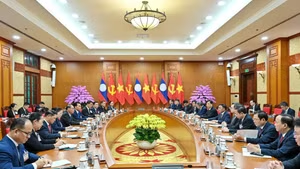
During the Vietnamese top leader’s state visit to Singapore, leaders of both countries reaffirmed their commitments to strengthening supply chain resilience and deepening strategic trust to foster a robust bilateral relationship and contribute to regional stability. This shared commitment led to the establishment of the Singapore–Viet Nam Strategic Dialogue, which facilitates high-level exchanges on governance and public administration while helping both sides manage the impact of geopolitical developments.
The two countries are also working closely to promote economic cooperation and connectivity. There are currently have 22 Viet Nam–Singapore Industrial Parks (VSIPs) across 15 localities in Viet Nam, attracting more than 28 billion USD in investment and generating over 340,000 jobs.
Balakrishnan said both sides are developing greener and smarter VSIPs and are exploring plans for Viet Nam to export electricity directly to Singapore through undersea power cables. The initiative could become a key component of the ASEAN Power Grid, contributing to the region’s energy resilience.
Looking ahead, Singapore will assume the ASEAN Chairmanship in 2027, while Viet Nam will host the Asia-Pacific Economic Cooperation (APEC) forum the same year. Balakrishnan described this as a unique opportunity for the two countries to support each other and work together to strengthen regional resilience and build stronger partnerships with other key economies.
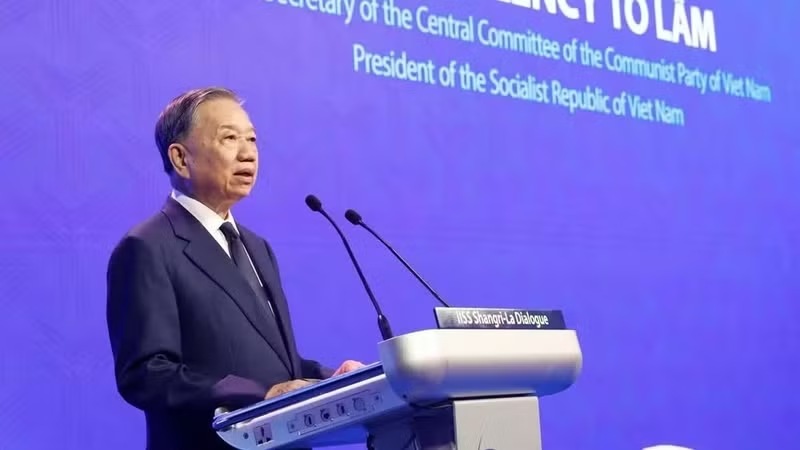
Regarding Viet Nam’s role in the region amid evolving geopolitical dynamics, the minister said that under the leadership and vision of Party General Secretary and State President Lam’s “era of the nation’s rise,” Viet Nam has emerged as one of the world’s fastest-growing economies and is on track to become ASEAN’s second-largest economy by 2031.
With its young and dynamic population, advanced digital and high-tech industries, and strategic position in global supply chains, Viet Nam is expected to play an increasingly important role in the region in the years ahead, he said.
ASEAN will be stronger if Viet Nam continues to work closely with other member states to uphold ASEAN's centrality, support rules-based multilateralism, and enhance regional resilience, the minister suggested.
Singapore looks forward to working closely with Viet Nam in advancing regional engagement and contributing to peace, stability and development in the Asia-Pacific region, he said.