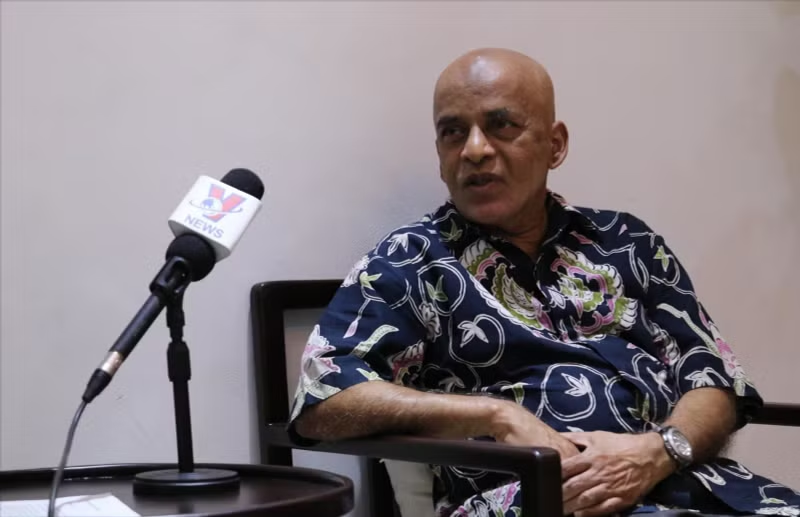
Speaking to Viet Nam News Agency reporters in Jakarta, Veeramalla Anjaiah, Senior Research Fellow at the Centre for Southeast Asian Studies in Indonesia, said the speech came at a highly opportune moment and at a forum of particular significance to global and regional security.
Anjaiah said General Secretary and President Lam directly identified three major challenges now confronting the world, including the crisis of the international order, development models, and strategic trust.
The speech accurately captured a global reality of escalating tensions and conflicts, he noted. Against that backdrop, the Vietnamese leader’s emphasis on managing differences within a rules-based framework and keeping competition limited, responsible, and predictable carried particular significance.
Anjaiah spoke highly of Viet Nam's proposals to broaden consultation channels, flexible mediation mechanisms, incident-response contact groups, semi-official forums, and confidence-building efforts spanning military, security, law enforcement, academia, business, and civil society.
These initiatives, he said, could provide credible “diplomatic off-ramps” to stop tensions spiralling into cycles of confrontation and conflict.
On ASEAN’s role, Anjaiah said the Vietnamese leader’s observation that ASEAN centrality is neither automatic nor self-sustaining was entirely valid. He endorsed the view that inclusiveness must be matched by effectiveness, dialogue must lead to action, and consensus must enable the region to respond promptly to shared challenges.
Commenting on the speech’s focus on dialogue, cooperation, and respect for international law, he said these principles are especially critical as strategic competition among major powers intensifies. With the world entering an era of sharper rivalry, such foundations are essential to maintaining global peace, stability, and prosperity. He added that some international conflicts might have been averted or contained had more effective dialogue mechanisms existed.
Assessing Viet Nam's stance on promoting strategic trust and reducing conflict risk, Anjaiah described them as strategic pillars for the country’s future. Because economic development is Viet Nam's top priority, peace and stability are prerequisites to ạchieve long-term goals, including the aspiration to become a developed nation by 2045.
Viet Nam should keep building strategic trust with major powers while helping reduce conflict risks in Southeast Asia, thereby nurturing an environment conducive to growth and development, he said.
The scholar noted that Viet Nam's proposals to boost dialogue, build trust, and uphold international law could help create a more inclusive, stable, and sustainable regional framework in Southeast Asia and the broader Asia-Pacific. He stressed the need to enhance the capacity to prevent crises early and from afar, noting that many major global crises have stemmed from unresolved misunderstandings, misinterpreted signals, or the failure to trigger preventive mechanisms in time. Maintaining constructive relations with all major powers, he added, is a key factor for regional peace, stability, and prosperity.
Reflecting on the speech’s broader significance, Anjaiah said the issues raised by Viet Nam's top leader demonstrate the country’s growing stature and influence in a fast-changing world. He noted that Viet Nam has forged Comprehensive Strategic Partnerships with numerous important countries, sustained robust economic growth, attracted substantial foreign investment, and continued to expand its global trade.
Viet Nam is becoming an increasingly attractive destination for foreign tourists while keeping friendly relations with its neighbours. Even with China, economic and trade ties continue to grow strongly, while the US remains one of Viet Nam's most important trading partners, he said.
Viet Nam's ability to maintain balanced relations with major partners while pursuing a foreign policy of peace, cooperation, and development has markedly elevated the country’s strategic standing on the global stage, he added.
![[In Pictures] General Secretary and President To Lam and his spouse visit and present books to Royal Library of Belgium](https://en-cdn.nhandan.vn/images/3NY4Z6Du1Md1PrS_s0ZZOrwc5xDfq4rRua69depr-TBkwatGjBcD9lagzrI2BmGDo4nKYA9qjKDjuB3-yYloL_1KbNBr00klMZQFyHQxQ6Jq6GzFfAiY0m5agKw6jNtArN4QnVntX8RQeUmD7pdCq7nwvn3e235v3kufpokBN_s/1-tong-bi-thu-chu-tich-nuoc-va-phu-nhan-tham-tang-sach-cho-thu-vien-hoang-gia-bi.jpg.avif)