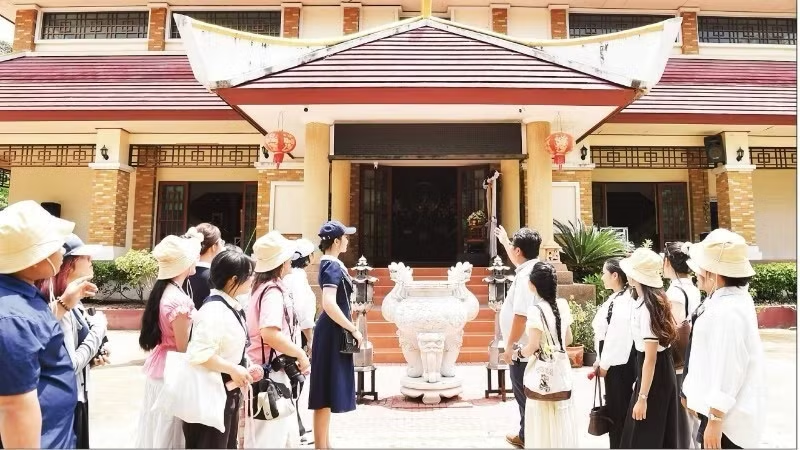
Viet Nam and Thailand share deep historical and cultural ties. Long before the two countries formally established diplomatic relations, President Ho Chi Minh was instrumental in fostering the bond between their peoples. Although he spent only a relatively short period in Thailand, he left behind a profound legacy of friendship.
Today, Thailand hosts three President Ho Chi Minh memorial sites in Udon Thani, Nakhon Phanom and Phichit, which stand as enduring symbols of the historic friendship and deep mutual respect between the two nations.
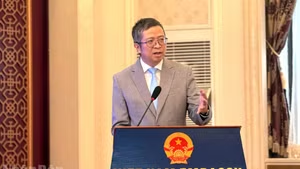
In his speech on the future of Thailand–Viet Nam relations after 50 years of diplomatic ties, Vietnamese Ambassador to Thailand Pham Viet Hung emphasised that Thailand occupies a unique place in Viet Nam’s modern history as the only Southeast Asian country where President Ho Chi Minh lived and conducted revolutionary activities.
During his stay in Thailand in 1928–1929, under the name Thau Chin, Uncle Ho secured not only the respect and affection of the Vietnamese community but also the goodwill of many Thai people.
Thailand also hosts a large community of Vietnamese nationals and Thai people of Vietnamese origin. Numbering more than 100,000, the Vietnamese community in Thailand serves as an important bridge of friendship, maintaining strong ties with their homeland while actively contributing to Thailand’s socio-economic development.
Members of the community have preserved and restored the President Ho Chi Minh memorial sites, helping to promote patriotism and transmit Viet Nam’s historical and cultural values to younger generations and international friends.
These sites not only preserve historical memories but also unite the community and stand as vivid testimony to the friendship between the peoples of Viet Nam and Thailand.
These historical and cultural links have strengthened people-to-people ties while also catalysing economic cooperation. They are among the reasons why Thailand’s first Viet Nam Town was established in Udon Thani Province.
Meanwhile, Thai culture has become increasingly familiar to the Vietnamese public, while Viet Nam’s traditional culture and tourism continue to captivate Thai audiences.
In 2025 alone, more than 1.1 million Vietnamese and Thai visitors travelled to each other’s countries. These strong people-to-people connections have imparted vitality, resilience, and significance to bilateral relations.
At the local level, around 20 pairs of sister-city and sister-province partnerships have further broadened exchanges in education, culture, tourism, and business.
In people-to-people exchanges, the Vietnamese language has emerged as a vital factor in unlocking the door to friendship and cooperation, helping the peoples of the two countries better understand one another and forge closer ties.
Once regarded simply as the language of a neighbouring country, Vietnamese is now considered a strategic language in Thailand, mirroring the increasingly robust relationship between the two Southeast Asian nations.
It is taught at numerous universities across Thailand, helping to foster cultural exchange and mutual understanding.
The Vietnamese community in Thailand regularly organises activities that maintain links with the homeland, preserve the Vietnamese language and national cultural identity, and promote the image of Vietnamese people as dynamic and compassionate, thereby actively contributing to the friendship between the two countries.
During a recent working visit to Udon Thani Province in north-eastern Thailand, home to a large Vietnamese community and many historical and cultural sites associated with President Ho Chi Minh, Deputy Minister of Foreign Affairs Le Thi Thu Hang voiced confidence that the Vietnamese community in Thailand would continue to prosper, integrate successfully into local society, and serve as an active force in strengthening friendship and cooperation between the two countries.
She noted that vibrant people-to-people exchanges would underpin the continued development of bilateral cooperation.