A “soft shield” at the grassroots level
Following Resolution No. 35-NQ/TW of the Politburo on strengthening the protection of the Party’s ideological foundation and countering wrongful and hostile viewpoints in the new situation, veterans’ associations at all levels have implemented the tasks synchronously and systematically, thereby forming a “soft shield” at the grassroots.
Steering Committees No. 35 have been established within the Central Committee of the Viet Nam Association of Veterans and in many provinces and cities. Plans and guidelines have been issued, creating a foundation for the effective implementation across the system.
Major General Ho Ba Vinh, Deputy Head of the Veterans’ Affairs Department and Deputy Head of Steering Committee No. 35 of the Viet Nam Association of Veterans, stated: “Thousands of oral briefings and thematic sessions have generated widespread outreach among the public. Through public opinion groups, core members are able to grasp shifts in public sentiment in a timely manner and address sensitive issues right from the grassroots.”
Many effective models have been widely replicated, including veterans participating in maintaining public security and traffic safety; mediation teams; border markers and boundary-management groups; and veterans’ clubs engaged in crime and social evils prevention. Veterans have also contributed to Party and government building and performed roles in supervision and social feedback.
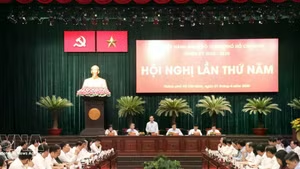
At the conference on implementing the task of protecting the Party’s ideological foundation in 2025, several creative models were highlighted. Notably, the model “Core Veterans Groups for Protecting the Party’s Ideological Foundation at the Grassroots Level,” implemented under Project 05 of the Standing Board of the Ho Chi Minh City Party Committee.
Each core team consists of three to seven members who are veteran soldiers with firm political resolve, and with the knowledge and experience needed to counter wrongful and hostile viewpoints. These teams operate under the direction of the Executive Committees of the commune- and ward-level Veterans’ Associations. Over the years, the teams have promptly identified and addressed grassroots-level tensions and advised Party committees and local authorities on preventive measures.
Promoting sustainable economic development
The movement “Veterans support each other in poverty reduction and successful economic development” has become one of the most effective initiatives of the Viet Nam Association of Veterans. The association has implemented a range of comprehensive measures: integrating poverty-reduction targets into resolutions at all levels; launching emulation campaigns in production and business; encouraging the establishment of veterans-led enterprises; and expanding preferential credit through the Viet Nam Bank for Social Policies.
The association has more than 8,200 enterprises, over 2,000 cooperatives, and hundreds of thousands of farms and household businesses, creating jobs for more than 781,000 veterans, ex-servicemen and their family members.
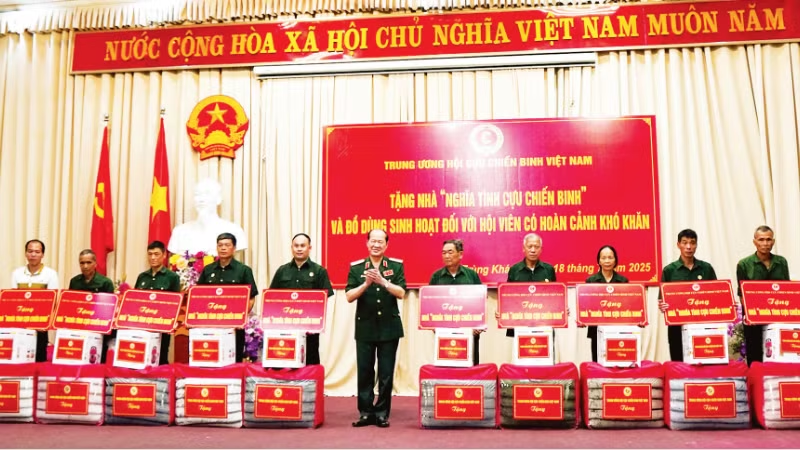
The association has more than 8,200 enterprises, over 2,000 cooperatives, and hundreds of thousands of farms and household businesses, creating jobs for more than 781,000 veterans, ex-servicemen and their family members. To date, more than 16,200 temporary and dilapidated houses have been eliminated, and 12,430 “Veterans’ Gratitude Houses” have been newly built, with total funding exceeding 940 billion VND.
According to the Viet Nam Veterans Entrepreneurs Association, veterans’ enterprises contribute tens of trillions of VND to the State budget annually and create hundreds of thousands of jobs. Veteran entrepreneurs also uphold a strong sense of social responsibility, actively participating in charitable activities and supporting the construction of homes for policy beneficiaries, persons with meritorious service and low-income households.
Many veteran entrepreneurs have become Labour Heroes in the renewal period, such as veteran Le Van Kiem with significant contributions across diverse fields, particularly in business and charitable activities; veteran Tran Manh Bao, a wounded soldier who transformed ThaiBinh Seed Group into a pioneering enterprise in Viet Nam’s seed industry; and veteran Hoang Manh Ngoc, Chairman of Kolia Company Ltd., who invested great effort in building a clean-agriculture and eco-tourism complex on Mount Phia Den in Cao Bang Province.
Passing the flame to future generations
In recent years, the Viet Nam Association of Veterans has collaborated with the Viet Nam People’s Army, the Ho Chi Minh Communist Youth Union Central Committee and local authorities to organise thousands of traditional education sessions and hundreds of “back-to-the-roots” and gratitude-paying activities.
Programmes such as “Following in Soldiers’ Footsteps” and conversations with historical witnesses have become familiar activities in youth education. Many students in Ha Noi fondly remember the inspiring talks delivered by veterans of Dien Bien, Truong Son, Khe Sanh and Quang Tri Ancient Citadel.
According to data from the Ha Noi Veterans’ Association, over the past five years the association has organised more than 2,800 talks on revolutionary traditions, attracting over 10,000 students. Many veterans who are now entrepreneurs, intellectuals or teachers have shared their journeys of building a career from nothing after leaving the army, helping young people gain a deeper understanding of history, live with purpose, appreciate the past, value the present and move confidently towards the future.
According to data from the Ha Noi Veterans’ Association, over the past five years the association has organised more than 2,800 talks on revolutionary traditions, attracting over 10,000 students.
At present, the restructuring and consolidation of organisational units and personnel within the veterans’ association system still face various shortcomings and obstacles, making it difficult to streamline the apparatus, especially at the grassroots level. The shortage of full-time staff – particularly at commune and ward levels following the mergers – has directly affected the quality of the association’s operations. In addition, as most members are elderly, their access to digital technology remains limited; members’ economic models also tend to be fragmented and weakly connected, making it difficult to scale up.
To address these challenges, the association has identified the need to advise and propose to competent authorities the urgent consolidation of organisational structures following the recent restructuring, while strengthening training and professional development for grassroots-level officers. Veterans’ associations at all levels regard the application of science, technology and digital transformation as essential. Expanding linkages and cooperation among different economic models is also considered an important pathway to improving effectiveness and creating sustainable livelihoods for members in the new period.
With its resilience, experience and credibility, the Viet Nam Veterans’ Association continues to fulfil its role as a core force in Party and State building, socio-economic development, the education of patriotic traditions and the safeguarding of political stability.