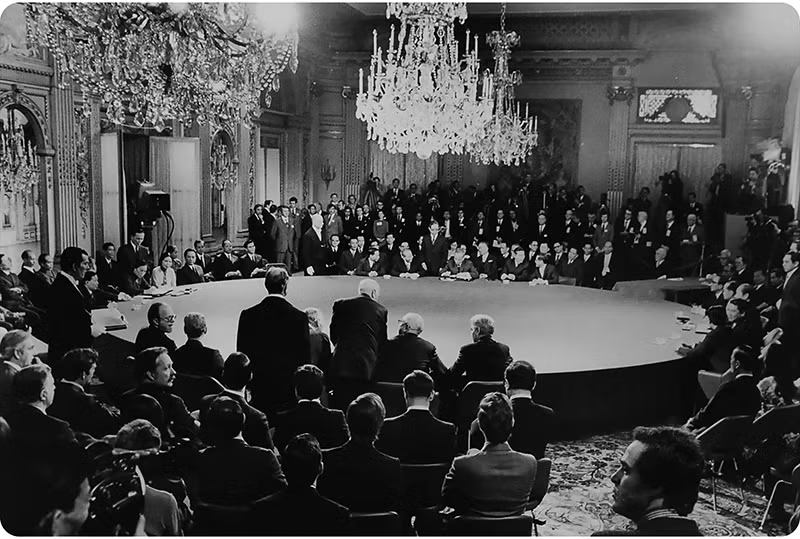
52 years ago, on January 27, 1973, the Paris Agreement on ending the war and restoring peace in Vietnam was officially signed, marking a brilliant milestone in the glorious revolutionary career of Vietnamese people and diplomacy.
This victory had strategic significance, creating a new situation for the army and people to advance and “defeat the puppet regime” with the climax being the historic Ho Chi Minh Campaign, completely liberating the South, reunifying the country, opening an era of peace, independence, unity and development in Vietnam.
The Paris Peace Accords was signed, successfully concluding the longest and most complicated negotiation in the history of Vietnamese diplomacy to end the longest war in the 20th century.
This great victory is the crystallisation of the results of the steadfast, indomitable struggle and immense sacrifices of the army and people on the political, military and diplomatic fronts under the wise and talented leadership of the Party and President Ho Chi Minh, from the Ben Tre Uprising in 1960 to the Tet Offensive and Uprising in 1968, the Spring-Summer Strategic Offensive in 1972 and the resounding victory of 12 days and nights of “Hanoi-Dien Bien Phu in the air”.
Diplomacy has become an offensive front, smoothly combining and completely transforming victories on the political and military fronts into victories at the negotiating table, brilliantly demonstrating the mettle, character and intelligence of Vietnam, imbued with the ideology, style and diplomatic art of Ho Chi Minh.
The Paris Peace Accords was not only a victory for the Vietnamese people but also went down in history as the common fight of the world’s people for peace, independence, freedom, progress and justice. The movement against unjust wars of aggression and in support of the just struggle for the national liberation of the Vietnamese people developed strongly and widely in the world. This movement became a symbol of the times and represented human conscience.
Therefore, the victory of the Vietnamese people at the Paris Conference as well as in the fight for national liberation and national reunification is also the victory of the people of the world in the fight for national independence, democracy and peace, a great encouragement for the peace-loving nations and peoples in the world to firmly believe in the victory of justice, morality and equity.
The process of negotiating, signing and implementing the Paris Agreement is an extremely valuable book on the Vietnamese school of foreign affairs and diplomacy, with many lessons that will forever remain valuable.
It is a lesson on promoting the combined strength of politics-economy, national defence-security and diplomacy to protect the Fatherland early and from afar, closely coordinating diplomatic fights with military and political fights, taking military and political victories as the basis for diplomatic attacks, international solidarity and isolation of the enemy.
It is a lesson on thoroughly grasping President Ho Chi Minh Thought on combining national strength with the strength of the times. In particular, it is a lesson in maintaining and strengthening the Party’s leadership in the entire process of fighting on the diplomatic front.
In the process of national development and national defence, inheriting and creatively applying Ho Chi Minh’s diplomatic ideology, the nation’s cultural and diplomatic identity, along with the historical lessons of the Paris Conference, Vietnam has consistently implemented a foreign policy of independence, self-reliance, peace, friendship, cooperation and development, multilateralisation, diversification, proactive and active international integration comprehensively and extensively; being a friend, a reliable partner and an active and responsible member of the international community; gradually building comprehensive and modern diplomacy with three pillars: Party diplomacy, State diplomacy and people’s diplomacy.
Vietnam’s foreign affairs and diplomacy continued to affirm its pioneering role, contributing to the creation and maintenance of a peaceful, stable, independent, sovereign and territorial integrity environment. Effectively serving the development and enhancing the country's position, prestige and new stature.
To date, Vietnam has established diplomatic relations with 194 countries and territories across five continents and built strategic cooperative partnerships and comprehensive strategic partnerships with all major powers in the world, especially having comprehensive strategic partnerships with nine countries, including China, the Russian Federation, India, the Republic of Korea, the US, Japan, Australia, France and Malaysia.
On the multilateral level, Vietnam has increasingly affirmed its capacity, role and responsibility in international issues. In international forums such as ASEAN, the United Nations, the Mekong Sub-region, APEC, G20, BRICS, AIPA, the Non-Aligned Movement, and the Francophone, Vietnam continues to promote its proactive and positive role.
For the first time, Vietnam successfully organised the ASEAN Future Forum, establishing an exchange mechanism and promoting Vietnam’s role in shaping the future of ASEAN after 2025, with a vision for 2045.
2025 is an important year of special significance to the nation, the year of commemorating the 80th anniversary of the founding of the country and the 50th anniversary of national reunification, the final year that determines the successful implementation of the Resolution of the 13th National Party Congress, and is also a pivotal year entering the era of national development. The country is facing a new historical starting point, setting new tasks for foreign affairs and diplomacy.
At the working session with the Party Committee of the Ministry of Foreign Affairs in August 2024, General Secretary To Lam requested that in the coming time, foreign affairs and diplomacy need to “proactively and promptly detect opportunities and challenges, increase the positive contributions of diplomacy in successfully implementing the strategic goals of 100 years under the leadership of the Party, 100 years of the founding of the country”, “raise the level and expand Vietnam’s contributions to the world revolutionary cause, to peace, cooperation, development and progress of humanity” and “strongly spread the version of Vietnam as an independent, self-reliant, peaceful, cooperative, friendly, developed, prosperous and happy country”.
Therefore, the overarching task of foreign affairs and diplomacy in 2025 as well as for the new era is to continue to inherit the goals, principles, mottos and methods of foreign affairs that have been affirmed in the 80-year journey of Vietnam’s revolutionary foreign affairs and diplomacy.
The lessons learned from the Paris Conference and the Paris Agreement still have contemporary value and need to be creatively applied to successfully implement the Party’s foreign policy in the new era.