However, turning this potential into sustainable orders and profits will require more than good products. Businesses must also meet increasingly stringent standards, strengthen financial risk management, and build internationally competitive capabilities.
A promising market, but no longer an easy one
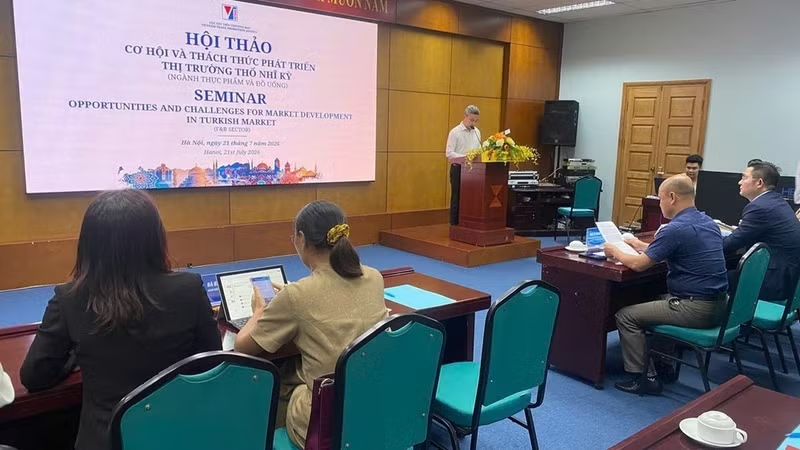
According to Ta Manh Cuong, Director of the Trade and Investment Promotion Support Centre under the Trade Promotion Agency, Turkey is becoming a key market in Viet Nam’s export diversification strategy.
Positioned at the crossroads of Europe, the Middle East, and Central Asia, the country is not only a major consumer market but also a gateway for Vietnamese products to expand into many other regions.
In the first six months of 2026, two-way trade reached 1.39 billion USD, with Vietnamese exports rising by 32%. The food and beverage sector remained a strong performer, generating export value of 950.2 million USD.
According to Cuong, this performance reflects sustained investment in advanced processing technologies, improved product quality, and stronger compliance with the standards of the importing market.
However, he warned that businesses would need to overcome a range of barriers, including plant quarantine regulations, customs procedures and mandatory halal certification when targeting Muslim consumers.
Nguyen Viet Hang, Trade Counsellor and Head of the Viet Nam Trade Office in Turkey, noted that 2026 marked a major shift in Turkey’s import management policies, particularly for food products. Among the most significant changes are a new 10-step food safety control system for plant-based food products and a new import facility registration system
These new requirements mean businesses must prepare legal documentation with complete accuracy. Even a minor error could result in shipments being destroyed, causing substantial financial losses and reputational damage.
Consumer behaviour in Turkey is also changing. According to Hang, consumers are spending less but making more informed purchasing decisions. They increasingly favour domestic, natural, and convenient products and have become more price-sensitive.
Vietnamese businesses therefore need to conduct thorough market research rather than relying solely on price competitiveness as they may have done previously.
Hang also advised businesses to avoid the risks of extended payment terms. Selling directly to major retail chains often results in lengthy payment delays, putting pressure on cash flow. Instead, companies should consider working with intermediaries or smaller distributors capable of making immediate cash payments, thereby ensuring sufficient working capital for production and business operations.
She also highlighted the “pepper paradox”. Although Viet Nam exports twice as much pepper to Turkey as Brazil, the export value is roughly the same. This demonstrates significant room for improving product quality, investing in deeper processing, and increasing value addition.
For products such as green coffee beans and raw cashew nuts, Hang suggested that Vietnamese businesses could capitalise on their raw material advantage by supplying Turkey’s private-label manufacturing sector rather than relying solely on conventional export models.
Halal certification — a passport to higher value for Vietnamese products
From an economic research perspective, Assoc Prof, Dr Dinh Cong Hoang of the Institute for South Asian, West Asian and African Studies under the Viet Nam Academy of Social Sciences said Turkey’s greatest advantage lies in its unique geopolitical position. Straddling two continents and linked to the European Union through a customs union agreement, the country serves as a major regional distribution hub.
With an economy worth more than 1 trillion USD and a rapidly expanding middle class, Turkey offers considerable purchasing power for food and consumer goods.
Importantly, the agricultural production structures of the two countries are complementary rather than competitive. While Turkey specialises in cereals and temperate fruits, Viet Nam has a clear advantage in tropical products such as coffee, cashew nuts, pepper, and coconuts.
According to Hoang, this provides a strong foundation for expanding bilateral trade in the years ahead.
To fully seize these opportunities, however, businesses must regard halal certification as a prerequisite. With around 90% of Turkey’s population being Muslim, halal is no longer simply a religious requirement but has become a recognised benchmark of quality and reliability.
Products with halal certification can increase the likelihood of consumer purchase by 30-50%, while also commanding price premiums of between 10% and 30%.
Hoang also recommended that businesses adopt a multi-channel market entry strategy. Mainstream products could target budget supermarket chains such as BIM and A101, while branded products should focus on premium retailers such as Migros.
At the same time, companies should develop the Horeca channel to serve Turkey’s fast-growing tourism industry and utilise e-commerce platforms such as Trendyol and Hepsiburada to test the market at relatively low cost.
Ramlan Bin Osman, Director of the Viet Nam Halal Certification Centre, said that a government decree on quality management and policies for the development of halal products and services, issued in April 2026, had established a legal framework for halal activities while designating the Ministry of Science and Technology as the lead authority responsible for halal quality management in Viet Nam.
According to him, halal should be viewed as a comprehensive quality management system covering the entire supply chain rather than merely a religious requirement. To strengthen international confidence, Viet Nam should establish a national halal database as soon as possible.
“When more businesses participate in building a comprehensive halal ecosystem, they can share costs, improve connectivity, and strengthen competitiveness, particularly for small and medium-sized enterprises,” Ramlan Bin Osman said.
Turkey is clearly opening up new growth opportunities for Viet Nam’s exports at a time when businesses are seeking to diversify markets and reduce dependence on traditional export destinations.
At the same time, the market requires companies to meet a wide range of demanding requirements, including technical standards, halal certification, transparent documentation, sound financial management, and well-planned, long-term market entry strategies.
In other words, the opportunities offered by Turkey are not simply about expanding exports. They also provide a powerful incentive for Vietnamese businesses to upgrade their competitiveness in line with international standards.
Once products are able to satisfy the rigorous requirements of a market that serves as a bridge between Europe, the Middle East, and Central Asia, the door to many other international markets will also become significantly wider.