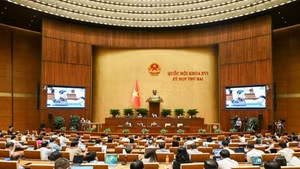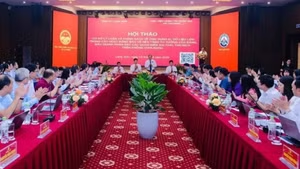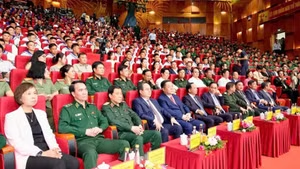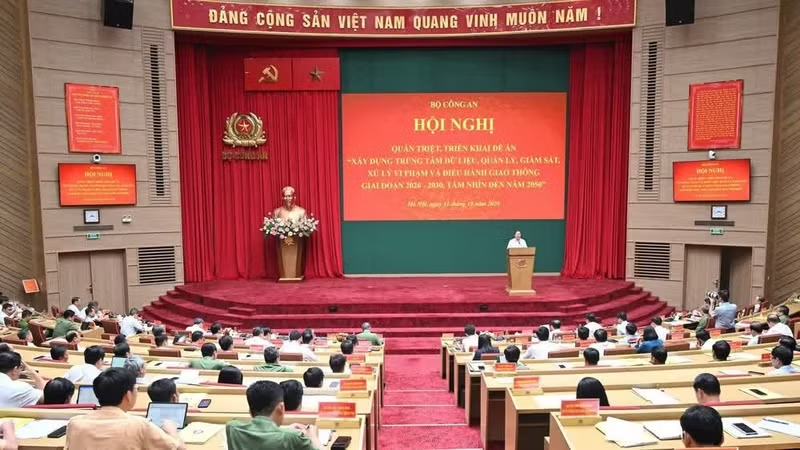
The conference was co-chaired by Politburo members: Pham Gia Tuc, Permanent Deputy Prime Minister, and General Luong Tam Quang, Minister of Public Security.
On March 20, 2026, the prime minister signed Decision No. 456/QD-TTg, approving the project “Development of a Data, Management, Monitoring, Violation Handling, and Traffic Operations Centre for the 2026–2030 period, with a vision toward 2050.”
To accelerate the implementation of this project, the Party Committee of the Government issued Resolution No. 05-NQ/DU on June 12, 2026, regarding the application of mechanisms and policies for the execution of Project 456.
Subsequently, on September 29, 2026, the government issued Resolution No. 298/NQ-CP, establishing the action plan to carry out the Party Committee of the Government’s Resolution No. 05-NQ/DU.
In his opening remarks, Minister Luong Tam Quang emphasised that the implementation of Project 456 represented a significant, concrete step toward realising the Party’s guidelines on ensuring human security and building a society that is disciplined, safe, civilised, harmonious, and prosperous.
It contributed to a fundamental transformation in the state management of the transport sector, shifting from a model primarily focused on handling violations to one based on proactive, data-driven traffic management, he said, adding that the system — comprising a data, management, monitoring, violation handling, and traffic operations centre — will be developed as a unified national infrastructure, ensuring consistency in architecture, standards, data, and shared platforms.
Concluding the conference, Permanent Deputy Prime Minister Pham Gia Tuc emphasised that Project 456 is a new, unprecedented undertaking of significant strategic importance. It serves not only to ensure traffic order and safety but also functions as a vital component of the national digital infrastructure, contributing to the realisation of policies focused on the development of science, technology, innovation, and digital transformation.
The permanent deputy PM directed ministries, sectors, and localities to promptly translate the project and the government’s plan into concrete programs and tasks, with clearly defined individual responsibilities.
He also called for the effective implementation of special, emergency investment mechanisms; the prioritisation of resource allocation; and the selection of eligible projects for immediate execution — all while ensuring openness, transparency, the proper and efficient use of the state budget as well as the prevention of corruption, waste, and misconduct.
Tuc further requested the urgent refinement of institutional frameworks, technical standards, regulations, and legal guidelines. He stressed the need to ensure a unified data and technology architecture as well as seamless connectivity and interoperability across systems.
Additionally, he highlighted the importance of human resource development, the digitisation of operational processes, and the application of artificial intelligence in traffic management and operations.
Regarding implementation responsibilities, the permanent deputy PM tasked the Ministry of Public Security with continuing its role as the focal agency — finalising the architectural framework and technical standards, while regularly monitoring, supervising, and inspecting progress to promptly address any challenges or obstacles that may arise.
Tuc requested that the people’s committees of provinces and cities provide direct oversight, proactively allocate budget resources, review existing systems, and ensure implementation is synchronised with the overall architecture of the project — with the effectiveness of service delivery to citizens and businesses serving as the ultimate benchmark.