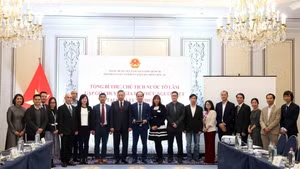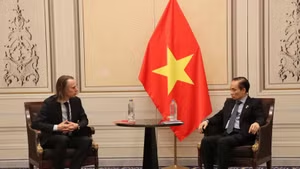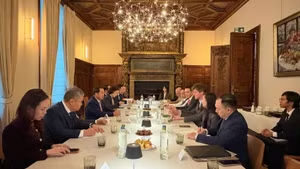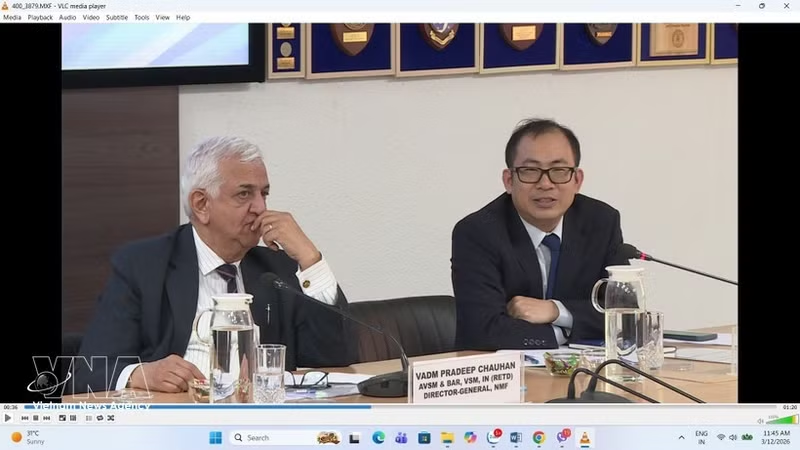
The event was jointly organised by India’s National Maritime Foundation (NMF) and the Diplomatic Academy of Viet Nam (DAV), with discussions focusing on ensuring comprehensive maritime security through greening ocean economies. The dialogue gathered researchers, experts and policymakers from both countries to discuss maritime security challenges and cooperation amid evolving dynamics in the Indo-Pacific region.
Maritime security has been identified as a key pillar of the Viet Nam–India strategic partnership. Through four rounds of bilateral “Track 1” Maritime Security Dialogue, the two sides have outlined priority areas of cooperation, including marine scientific research, blue economy development, humanitarian assistance and disaster relief, naval and coast guard cooperation, maritime law enforcement, capacity building, and maritime connectivity.
Building on these efforts, the NMF and DAV signed a memorandum of understanding in March 2024 establishing an annual dialogue mechanism to address shared maritime concerns and propose policy recommendations for both governments. The first dialogue, held in Ha Noi in March last year, focused on maritime cooperation and security in the Indo-Pacific.
Opening the second dialogue, NMF Director General Vice Admiral Pradeep Chauhan said the world is facing a “triple planetary crisis” of climate change, pollution and biodiversity loss, making ocean governance a systemic development issue.
He stressed that greening ocean economies would promote sustainable resource use while enhancing both traditional and non-traditional security, noting challenges such as overexploitation of resources, illegal fishing, marine pollution, geopolitical risks to shipping, and issues related to energy security, supply chains and seabed mineral resources.
Vietnamese Ambassador to India Nguyen Thanh Hai highlighted the need to strengthen maritime dialogue and cooperation amid rapidly evolving geopolitical developments, noting that recent conflicts in the Middle East and rising oil prices underscore the critical importance of maritime security to global economic stability.
He described the blue economy as a key pillar for advancing comprehensive maritime security in the Indo-Pacific, and expressed his hope that policy recommendations from the dialogue would further deepen bilateral cooperation.
Meanwhile, Do Thanh Hai, Deputy Director-General of the East Sea Institute under the Diplomatic Academy of Viet Nam, noted that as coastal nations with strategic positions in the Indian Ocean and the East Sea/South China Sea, Viet Nam and India share growing interests in ensuring maritime stability and sustainability. He stressed that ocean economic development must be aligned with environmental protection and long-term benefits for future generations.
Speaking to the Viet Nam News Agency (VNA), Hai said the second dialogue focused more deeply on long-term strategic issues, particularly sustainable blue economy development linked with ecosystem protection and maritime security, while promoting practical policy proposals and research cooperation between the two sides.
Experts agreed that amid global energy challenges and geopolitical tensions, advancing a sustainable blue economy carries long-term strategic significance, contributing not only to energy security and livelihoods but also to marine ecosystem protection, international cooperation, and peace and stability across the Indo-Pacific region.
![[In Pictures] General Secretary and President To Lam and his spouse visit and present books to Royal Library of Belgium](https://en-cdn.nhandan.vn/images/3NY4Z6Du1Md1PrS_s0ZZOrwc5xDfq4rRua69depr-TBkwatGjBcD9lagzrI2BmGDo4nKYA9qjKDjuB3-yYloL_1KbNBr00klMZQFyHQxQ6Jq6GzFfAiY0m5agKw6jNtArN4QnVntX8RQeUmD7pdCq7nwvn3e235v3kufpokBN_s/1-tong-bi-thu-chu-tich-nuoc-va-phu-nhan-tham-tang-sach-cho-thu-vien-hoang-gia-bi.jpg.avif)