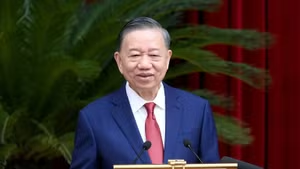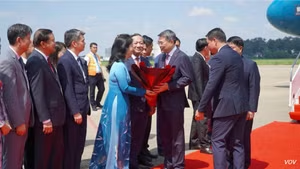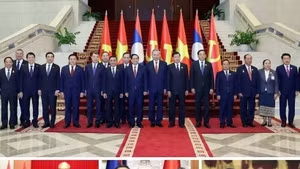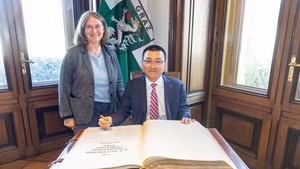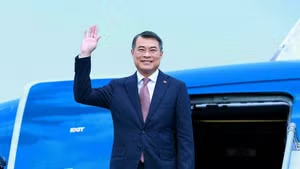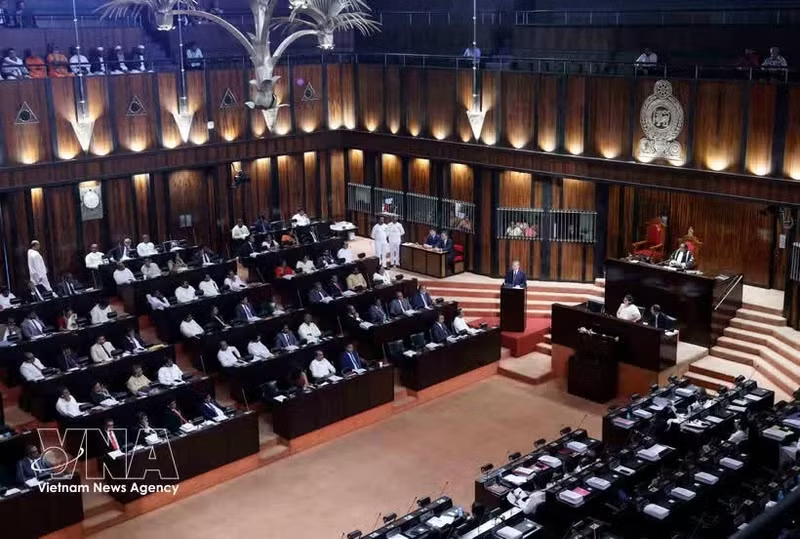
General Secretary of the Communist Party of Viet nam (CPV) Central Committee and State President To Lam addressed the Parliament of Sri Lanka on May 8 (local time) during his ongoing state visit to the South Asian nation on May 8 (local time).
Sri Lankan Parliament Speaker Jagath Wickramaratne described the Vietnamese leader’s speech as a reflection of the profound traditional ties between Viet Nam and Sri Lanka and a milestone in their ties.
According to him, the two nations nurtured a friendship grounded in deep respect, historical and cultural similarities and developmental aspirations. They boast long-standing traditions and rich cultural identities, and place strong emphasis on compassion, tolerance, and harmony. Buddhism and cultural values have helped nurture in each nation a love for peace, compassion, and a strong sense of community.
He reaffirmed that Sri Lanka has long been a traditional friend of Viet Nam, with the two countries supporting each other during their struggles for national liberation and reunification.
Praising the positive strides in parliamentary diplomacy, he expressed hope for more legislative cooperation initiatives, and stressed the top Vietnamese leader’s presence at the Sri Lankan Parliament as a symbol of friendship, solidarity and aspiration for peace, stability and cooperation in the region and beyond.
In his speech, General Secretary and President Lam congratulated Sri Lanka on its efforts and important successes in national stability, recovery and development. He said Viet Nam believes that Sri Lanka, backed by its strategic Indian Ocean location, resilient population and leadership resolve, will continue advancing toward peace, stability, prosperity and happiness.
The Vietnamese leader said Sri Lanka holds a special place in Viet Nam’s historical memory and public sentiment. President Ho Chi Minh visited Sri Lanka three times during his revolutionary journey, while the Ho Chi Minh Monument in Colombo, inaugurated in 2013, stands as a touching symbol of Sri Lankan goodwill toward Viet Nam.
“For the Vietnamese people, those were not simply the footsteps of a leader seeking national independence, but also a natural convergence between peoples who value freedom, peace, humanity and justice”, he said.
Despite geographically distance, Viet Nam and Sri Lanka remain closely connected through historical and cultural similarities and development ambitions, he said. Both nations, he added, have longstanding traditions and rich cultural identities, and value compassion, tolerance and harmony, with Buddhism and Eastern cultural traditions reinforcing commitments to peace, humanity and community spirit.
Reflecting on Viet Nam’s four decades of Doi Moi (Renewal), he said the country faced severe hardship when it launched reforms in 1986. “Viet Nam chose renewal, beginning first with renewed thinking,” he said, stressing the need to confront realities directly, dismantle outdated systems, unleash public creativity, uphold the role of enterprises, open up to global integration and build a socialist rule-of-law state “of the people, by the people and for the people".
Viet Nam does not become complacent with its achievements, he said, adding that development is a journey of continuous innovation, self-adjustment, self-improvement and rising-up.
Drawing on Viet Nam’s experience, he outlined several lessons relevant to developing countries. These include maintaining independence and self-reliance while proactively integrating globally, attracting global capital and boosting trade alongside strengthening domestic capacity, upholding the role of law, parliament and governance in development; placing people at the centre of development; and treating agriculture, rural areas and farmers as pillars of stability and growth.
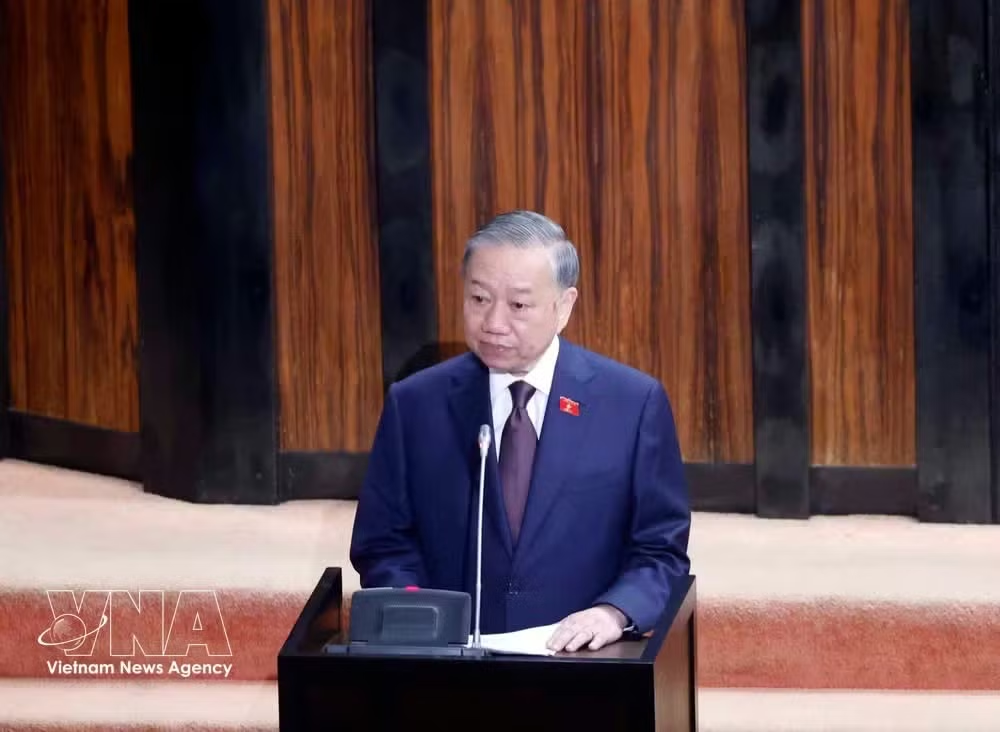
He revealed that the CPV’s 14th National Congress has set the goal of turning Viet Nam into a developing country with modern industry and upper-middle income status by 2030, and a high-income, developed nation by 2045.
To achieve those goals, Viet Nam is accelerating institutional reforms, upskilling workforce, building modern infrastructure; advancing sci-tech, innovation, digital transformation and green transition; sharpening national competitiveness, maintaining macroeconomic stability, improving living standards and building an advanced Vietnamese culture imbued with national identity.
“Great aspirations must be proven through concrete actions,” he said, calling for stronger reforms, more effective governance, broader democracy, deeper national unity and more substantive international cooperation. These, he stressed, are common challenges facing many developing countries, including Viet Nam and Sri Lanka.
On bilateral ties, the Vietnamese leader said Viet Nam wants to open a new phase of bilateral cooperation that is deeper, more substantive and effective. He announced that the two countries had agreed to elevate relations to a Comprehensive Partnership, citing growing political trust, longstanding friendship and expanding cooperation needs.
Describing the move as an important milestone, he said it would open broader and more practical cooperation avenues. He pushed for deeper political trust and parliamentary collaboration through high-level exchanges and closer links among Party, State, Government and parliamentary bodies, and more active friendship parliamentarian groups.
The two countries, he said, should also inject stronger momentum to economic, trade and investment ties. Viet Nam could act as a bridge for Sri Lanka to expand cooperation with ASEAN and Southeast Asia, while Sri Lanka could help Viet Nam expand its reach to South Asia and the Indian Ocean region. He encouraged easier trade flows, stronger business connectivity, more trade promotion activity and investor-friendly legal frameworks.
Both countries’ relevant agencies should work closely together to translate the signed agreements into concrete schemes, projects and measurable gains for their people and businesses, he said.
He also highlighted agriculture, food security and rural development as priority areas for teamwork, alongside emerging areas such as maritime economy, logistics, digital transformation, artificial intelligence and green growth. He further called for stronger links in education, culture, tourism and people-to-people exchanges, while maintaining mutual support at global and regional forums.
Viet Nam deeply understands the value of peace because it lived through wars, the value of independence because it fought long to gain and protect it, and the value of development because it rose from poverty, the Vietnamese leader said. He also underscored the importance of friendship, recalling the solidarity and support Viet Nam received from progressive peoples around the world, including Sri Lanka, during most difficult periods.
Viet Nam now wants to convert traditional friendship into a genuine source of development, transform political trust into concrete economic outcomes, while using cultural exchanges to foster mutual understanding between the two nations, he said.
Expressing confidence in the future of bilateral ties, he stated that with more than half a century of diplomatic ties, shared historical and cultural values, and strong support from their people, Viet Nam-Sri Lanka relations would enter a new stage of deeper, more practical and more effective development.
“From Ha Noi to Colombo, from the East Sea to the Indian Ocean, Viet Nam and Sri Lanka share a common belief: peace is the foundation, people are the centre, development is the goal, and friendship is the most enduring bridge connecting our two nations,” he concluded.