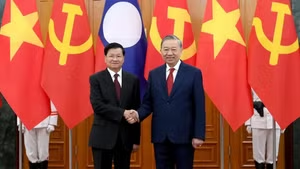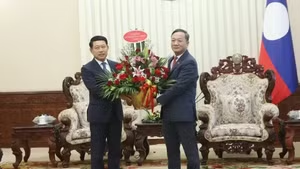
The editorial emphasises that the special bilateral relationship has deep historical roots, forged through centuries of shared hardship. The two neighbouring countries share a border of more than 2,000 km and are linked by the Truong Son mountain range and the Mekong River.
According to the article, the two peoples have remained closely connected through economic, cultural and everyday exchanges. Throughout history, they have supported one another while promoting trade and cultural interaction. Communities along the shared border are bound not only by family ties but also by a common aspiration for independence, peace and prosperity.
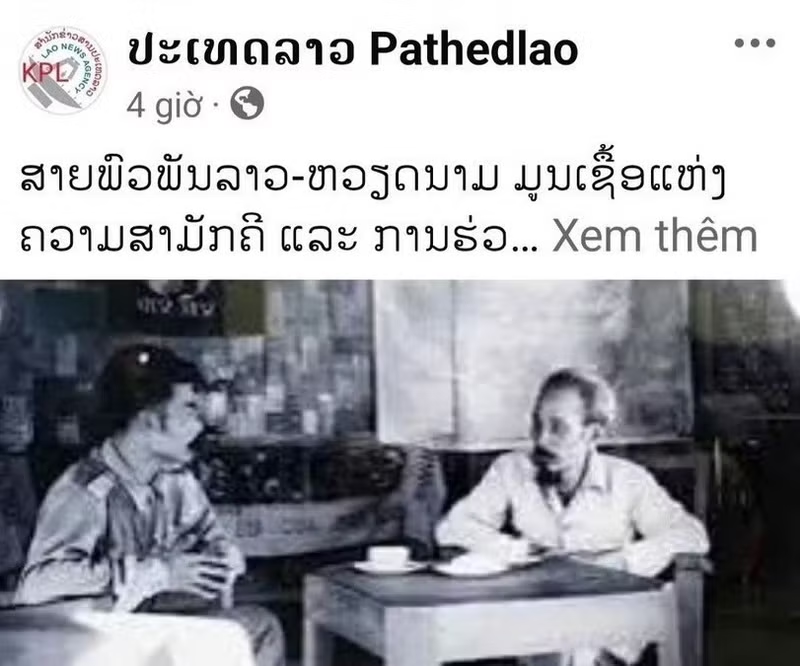
The editorial notes that the enduring Laos–Viet Nam relationship was tested during the revolutionary struggle under the leadership of the Indochinese Communist Party, and subsequently the Lao People's Revolutionary Party and the Communist Party of Viet Nam. It pays tribute to Vietnamese President Ho Chi Minh and Lao Presidents Kaysone Phomvihane and Souphanouvong as the founding architects of the special relationship, describing it as an invaluable shared asset of the two nations.
The article recalls that from the late nineteenth century to the early twentieth century, French colonial rule extended across the three Indochinese countries. Under the leadership of the Indochinese Communist Party, the peoples of Laos and Viet Nam fought together for national liberation. Following the success of Viet Nam's August Revolution in 1945 and its declaration of independence in September that year, Laos proclaimed its independence on October 12, 1945, and established the Lao Issara Government.
When French colonial forces returned in 1946, the armed forces and peoples of Laos and Viet Nam stood shoulder to shoulder in resisting what they regarded as their common adversary.
The editorial highlights that in 1954, Laos opened multiple fronts across the country and closely coordinated with Vietnamese forces during the Dien Bien Phu campaign. It says the victory led to the defeat of French colonial rule and the signing of the Geneva Accords, which recognised the independence, sovereignty and territorial integrity of the three Indochinese countries.
According to the article, from 1955 onwards, Viet Nam and Laos continued to face what it describes as a common challenge following intervention by a new form of imperialism in Indochina.
The editorial also recalls the historic meeting between President Ho Chi Minh and President Kaysone Phomvihane in 1960, during which they affirmed that the Laos-Viet Nam relationship was founded on traditional solidarity.
It notes that the formation of Laos' tripartite coalition government in 1962 marked the lawful establishment of state-to-state relations between Laos and Viet Nam. Between 1967 and 1973, the armies and peoples of both countries fought alongside one another in major military campaigns.
The article further states that Laos created favourable conditions for the Vietnamese struggle for national liberation and reunification, most notably by allowing Viet Nam’s Ho Chi Minh Trail to pass through its territory.
Following the liberation of southern Viet Nam on April 30, 1975, and the establishment of the Lao People's Democratic Republic on December 2, 1975, bilateral relations officially entered what the editorial describes as a new era of comprehensive cooperation.
In conclusion, the editorial says the historical milestones demonstrate and reaffirm that the great friendship, special solidarity, comprehensive cooperation and strategic cohesion between the two Parties, States and peoples will continue to develop and deepen in the years ahead.