Under the leadership of the Communist Party of Vietnam (CPV) and the DPRK’s Labour Party, the traditional friendship and co-operation between the two countries — founded by late Presidents Ho Chi Minh and Kim Il Sung and nourished by the leaders and peoples of the two nations — have been unceasingly consolidated and boosted.
The two Governments and peoples have both given each other spiritual and material support in their national process of construction and defence.
In the political field, the two countries have regularly exchanged visits at all levels. President Ho Chi Minh’s official visit to DPRK in July, 1957 and Prime Minister Kim Il Sung’s visit to Vietnam in 1958, laid the foundation for the development of bilateral relations. After the visits to the DPRK by President Tran Duc Luong in 2002 and Party General Secretary Nong Duc Manh in 2007, the Vietnam-DPRK co-operation was consolidated and elevated to a new height.
In May 2008, the two foreign ministries agreed to set up regular political consultative mechanism at the deputy ministerial level to discuss measures to boost multifaceted co-operation.
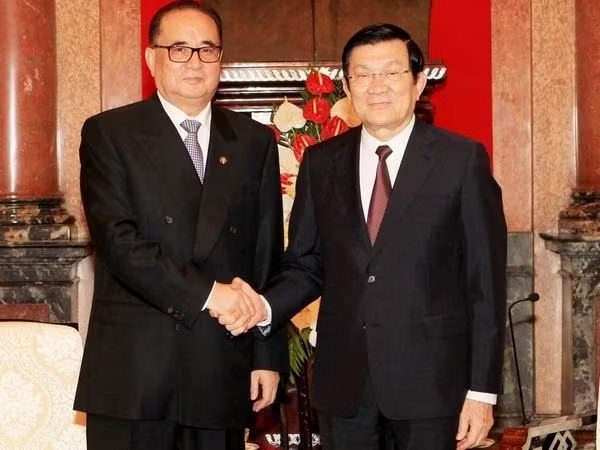
President of the Presidium of the Supreme People’s Assembly of the DPRK Kim Yong Nam visited Vietnam in August, 2012. President of the Vietnam Fatherland Front Central Committee Huynh Dam visited the DPRK in December, 2012, followed by the visit made by Head of the CPV Central Committee Office, Tran Quoc Vuong to the country in July 2013. Most recently, DPRK Foreign Minister Ri Su-yong paid a visit to Vietnam in August 2014.
Regarding economic relations, the two countries set up the Vietnam-DPRK Intergovernmental Committee on Co-operation in Economy, Science and Technology in August 2000.
The two sides signed five memorandums of understanding (MoU) on co-operation in mineral mining and technical exchanges in the field. Delegations of experts in oil and gas, and agriculture sectors of the two countries have maintained visits and exchanges.
Two-way trade turnover between Vietnam and DPRK in 2011 reached US$10 million and US$15 million in 2012.
A number of agreements have been signed between the two countries, creating a legal foundation for bilateral ties. They include the Agreement on Scientific and Technological Co-operation in October 1958, the Trade and Marine Agreement in December 1962, the Agreement on Health Care Assistance in December 1966, the Agreement on Civil Aviation Transport Co-operation in January 1977, the Marine Transport Agreement in 2002, the Trade Agreement in 2002, the Agreement on Investment Encouragement and Protection in2002 and the Agreement on Avoidance of Double Taxation in May 2002.
Covering an area of 122,762 kilometres square with a population of around 24.7 million and being rich with natural resources, the DPRK remains a potential market. The country has taken a wide range of measures to develop the economy and improve people’s living conditions, which have brought in initial positive outcomes.
In their bid to increase international exchanges and co-operation, the DPRK approved the Law on Economic Development Zones in 2013 and has established 19 economic development zones. Recently, the country put forward a detailed plan on developing its 13 special economic zones nationwide.
With the leadership from leaders of the two counties, the bilateral economic relations are expected to grow in line with the fine political ties.
The two nations have also maintained co-operation in culture, education and friendship exchanges. The Vietnam-DPRK Friendship Association and the DPRK-Vietnam Friendship Association have served as a significant bridge to bolster friendship between the two peoples.
The DPRK helped train hundreds of students from Vietnam in the 1960s and 1970s. Vietnam annually sends art troupes to the Spring Arts Festival, which is held annually in April in Pyongyang. The DPRK’s coaches have been training Vietnamese national squads of Taekwondo and women’s soccer.
Based on the achievements made over the past 65 years and the potential for co-operation in the coming time, along with the joint effort of the two countries’ leaders and people, the Vietnam-DPRK traditional friendship and co-operation is expected to develop further, matching the trend of the era and the mutual interests of both peoples while contributing to peace, stability, co-operation and development in the region and the world