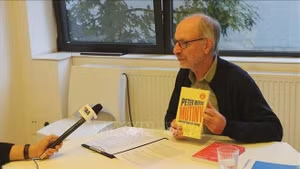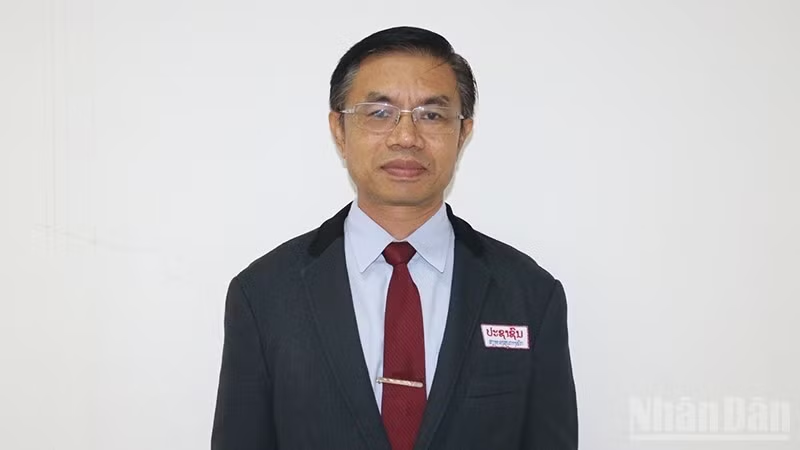
Syvanh Homxaiyaded made the affirmation during an interview with Nhan Dan (People) Newspaper reporters on the occasion of the 80th anniversary of the first General Election to elect the Vietnamese National Assembly (January 6, 1946–2026).
He cited evidence that, for the first time in history, the Vietnamese people, immediately after gaining independence, directly exercised their right to mastery through the General Election to elect the National Assembly.
This event not only ushered in a new era for revolutionary democracy but also marked a historic turning point laying the foundation for the socialist rule-of-law state, while creating valuable reference lessons for the Lao National Assembly and parliaments worldwide.
Viet Nam’s first general election took place in extremely difficult circumstances, when Viet Nam’s revolutionary government was still young, the country was in disarray after the war, the economy was exhausted, and internal and external enemies threatened the survival of the new state. Yet, with the clear-sighted vision of the Party and President Ho Chi Minh, the General Election affirmed the fundamental truth: supreme power belongs to the people.
The Vietnamese National Assembly, born from the people's ballots, exemplified the combination of revolutionary will and practical democracy, conferring legitimacy and enduring vitality on the former Democratic Republic of Viet Nam, now the Socialist Republic of Viet Nam.
The Vietnamese National Assembly, born from the people's ballots, exemplified the combination of revolutionary will and practical democracy, conferring legitimacy and enduring vitality on the former Democratic Republic of Viet Nam, now the Socialist Republic of Viet Nam.
According to the Lao journalist, the profound significance of the event lies not only in establishing the highest organ of power but also in enshrining the principle of “taking people as the root”, affirming that all state power derives from the people. This ideology has become the guiding compass throughout, steering the continuous maturation and renewal of the Vietnamese National Assembly over the past 80 years.
He assessed that, through each revolutionary phase, the Vietnamese National Assembly has ceaselessly perfected itself and affirmed its role as the highest representative body of the people. The Vietnamese National Assembly has institutionalised the Party's guidelines and policies into the Constitution and laws, building a coherent legal system that contributes to enhancing the effectiveness and efficiency of state management.
At the same time, the Vietnamese National Assembly has proactively renewed its methods of operation, improved the quality of deputies, strengthened supreme oversight, and ensured legal discipline and the legitimate rights of the people.
In the context of deep international integration, the Vietnamese National Assembly has also actively participated in regional and international parliamentary forums, elevating the country's prestige and position, while consolidating the special fraternal relations with brotherly Laos and friendly nations worldwide.

Syvanh Homxaiyaded noted that the revolutionary histories of Viet Nam and Laos share many similarities, closely intertwined in the struggles for national independence and the building of a State of the people.
Therefore, the success of Viet Nam's first General Election and the development of the Vietnamese National Assembly leave many valuable reference lessons for the Lao National Assembly as follows:
First, the General Election must truly be a political festival of the entire people. The National Assembly's power is solid only when it stems from the will, aspirations, and active participation of the people. Each ballot, each voice of the voters, serves as proof of socialist democracy, creating a firm foundation and long-term vitality for the National Assembly.
Second, the Party's sound leadership is the key factor determining success. The Party leads through sound guidelines and policies, directing the organisation of the General Election and orienting the National Assembly's operations, while respecting the National Assembly's autonomy and not directly interfering in legislative decisions. This enables the National Assembly to operate transparently and effectively, maintaining socialist orientation while unleashing people's power.
The success of Viet Nam's first General Election and the development of the Vietnamese National Assembly leave many valuable reference lessons for the Lao National Assembly.
Third, the quality of deputies determines the National Assembly's effectiveness. The National Assembly needs deputies with political mettle, revolutionary ethics, practical abilities, and close ties to voters. The quality of the deputies directly affects the feasibility of laws, the effectiveness of oversight, and the National Assembly's prestige among the people.
Fourth, the building of the National Assembly must be carried out in tandem with a rule-of-law state. Legislative activities, oversight, and decisions on major issues must be based on the Constitution and laws, ensuring openness, transparency, discipline, and accountability. This forms the basis for the National Assembly to operate effectively, fostering public trust and support.
Fifth, it is crucial to renew methods of operation and enhance democracy within the National Assembly. The National Assembly needs to apply modern methods, strengthen direct dialogue with voters, heed societal feedback, and utilise information technology in legislation and oversight. Such renewal brings the National Assembly closer to the people, promptly reflecting aspirations and safeguarding their legitimate rights.
Sixth, it is important to learn from international experience while preserving national identity. In the process of construction and development, the Lao National Assembly can draw on the experiences of friendly countries, but these must suit Laos's historical conditions, culture, and political traditions, while ensuring the nation's unity, stability, and sustainable development.
Affirming that Viet Nam’s first General Election is a precious lesson in people's power, the responsibility and prestige of the National Assembly, Editor-in-Chief Syvanh Homxaiyaded stated that those lessons offer valuable reference for the construction and development of the Lao National Assembly, towards building a state of the people, by the people, and for the people, contributing to consolidating peace, independence, and sustainable development in each nation.