Potential human resources
According to the urban railway (metro) development plan over the next five years, the city aims to complete six metro lines with a total length of 187km, and it plans to have 14 lines covering 462km in operation by 2035.
In the immediate future, Metro Line No. 2 (Ben Thanh-Tham Luong) is scheduled for completion and operation in 2030, along with priority investment projects including Metro Line No.1 (the New Binh Duong City-Suoi Tien section), Metro Line No.2 (Thu Dau Mot City-Ho Chi Minh City section), Metro Line No.3 (connecting Vung Tau-Ba Ria-Phu My), and Metro Line No.6, the Inner Ring Line (Phu Huu-Ba Queo-Phu Lam Roundabout-Phu Huu), with a total length of up to 180km. This therefore presents an urgent human resources challenge as the city develops a smart and modern transport system.
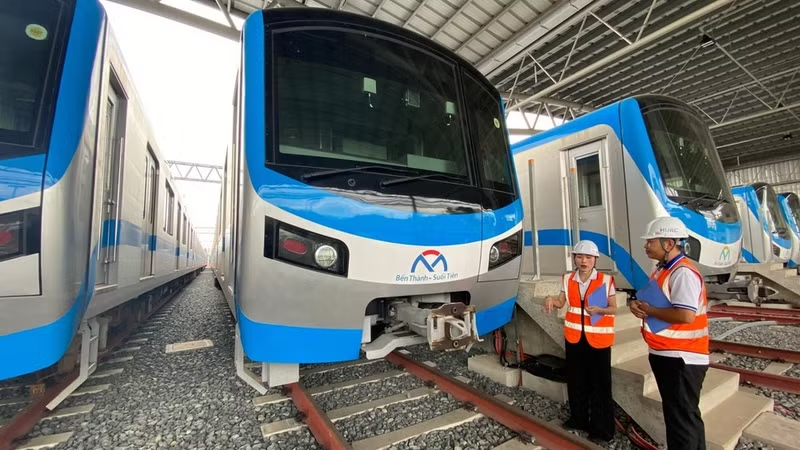
Le Minh Triet, Director of Ho Chi Minh City Urban Railway Company No. 1 (HURC1), said that operating the city's first Metro Line No.1 alone requires hundreds to even a thousand workers across various fields. As the city invests in more “backbone” metro lines in the coming years, the demand for human resources will increase exponentially.
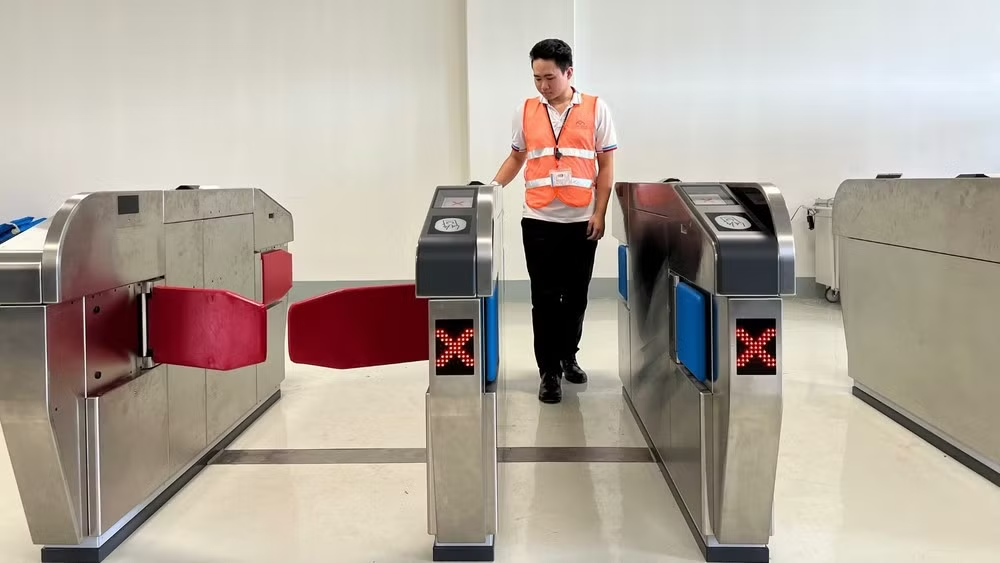
To operate Metro Line No.1 (Ben Thanh-Suoi Tien), the management unit currently employs a workforce of 700 people to maintain nearly 200 train trips each day. According to HURC1, these personnel work in departments including station staff, station managers, train operation technicians, traffic control technicians, and maintenance staff.
Recently, HURC1 announced recruitment for personnel to receive training as part of the technology transfer for the operation and maintenance of the Phu Quoc LRT railway. According to HURC1, a total of 168 positions will need to be filled, including 130 operation staff and 38 maintenance staff. These positions require university or college qualifications, or equivalent, in relevant fields such as mechanical engineering, mechanical manufacturing, industrial maintenance, electrical engineering, electronics, automation, railway signalling, telecommunications, information technology, railway engineering, locomotives and rolling stock, and other related technical disciplines.
“This is also one of HURC1's strengths in recruiting personnel to operate similar metro lines, as the company has many years of experience operating and managing Metro Line No.1,” Triet said.
Cooperation in training and mastering railway technology
According to the project on training and developing human resources for the development of the urban railway network, as approved by the Ho Chi Minh City People's Committee, Ho Chi Minh City will need around 70,000 people to support investment and development of its metro system, including project management personnel, operations and maintenance staff, engineers, technical workers, consultants, and designers from now until 2030.
Of this number, the operations and maintenance workforce and technical workers will account for the largest share, at around 30,000 people, while the construction workforce will number around 12,000. The city has also planned human resources training for the 2030-2045 period, with the number of personnel nearly twice that of the 2025-2030 period, in line with the demand for developing and investing in a metro system of up to 700km.
The Training Department of Vietnamese-German University said that, according to the Ho Chi Minh City Master Plan with a 100-year vision, the city aims to complete its entire urban railway network of 19 lines by 2045, with a total length of around 1,012km. Meanwhile, the Ho Chi Minh City Management Authority for Urban Railways (MAUR) estimates that the city will need between 30,000 and 40,000 urban railway personnel, with high-tech engineers and smart transport system operators accounting for up to 20%.
These practical requirements are prompting universities and research institutes to prioritise and strengthen the training of specialised, high-quality engineers, particularly in smart transport engineering. This is aimed at preparing a generation of engineers with systems thinking to stay ahead of Viet Nam's “billion-dollar” infrastructure development wave and address the “human resource shortage” amid major infrastructure projects.
Nguyen Quoc Trung, Deputy General Director of Dai Quang Minh Real Estate Investment Joint Stock Company under THACO, the enterprise serving as the general contractor for the construction of Metro Line No.2 (Ben Thanh-Tham Luong), said that the training and standardisation of human resources must be prioritised by the city and regarded as a decisive factor, as the country cannot remain dependent on foreign contractors' construction technologies and solutions indefinitely.
Therefore, THACO is prioritising the mastery of construction technologies for urban railway lines, while also preparing the necessary conditions to develop the domestic railway industry.
Recently, MAUR and GTEL held a ceremony to sign a memorandum of understanding on cooperation in system integration research and technology transfer for the urban railway network.
Colonel Luong Duc Minh, Chairman of GTEL, affirmed that GTEL would work alongside MAUR in research, system integration, and technology transfer, while leveraging its strengths in digital technology, digital transformation, and cybersecurity to help improve the management, operation, and exploitation effectiveness of urban railway systems and gradually build domestic technological capabilities.
The immediate focus of the cooperation is research and implementation on Metro Line No.2 (Ben Thanh-Tham Luong) and urban railway projects to be carried out during the 2026-2030 period. At the same time, the two sides will gradually research, receive, and master technologies for subsystems including communications, signalling, electrical systems, electrical and mechanical (E&M) systems, SCADA, the operations control centre (OCC), automatic fare collection (AFC) systems, and platform screen doors (PSD).