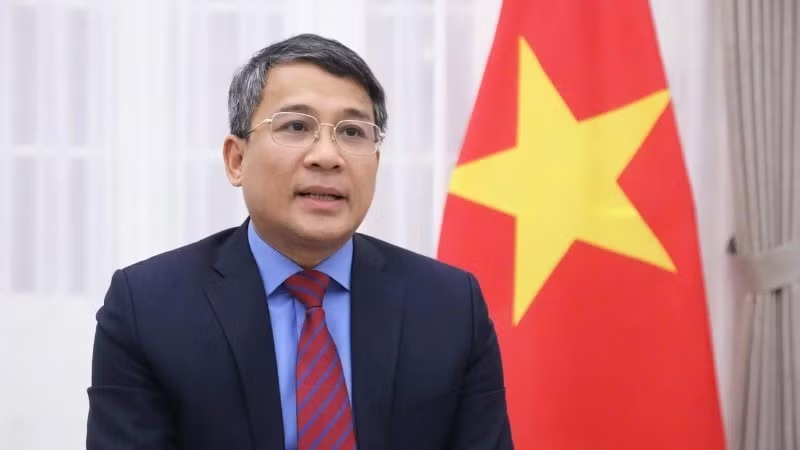
In an interview with the press ahead of the 33rd Diplomatic Conference and the 22nd National Conference on Foreign Affairs, to be held from August 1-7, Vu reviewed recent achievements and outlined priorities for protecting national sovereignty while advancing the country's development interests.
He said border and territorial affairs have long been regarded by the Party and State as a key and regular task, helping to safeguard sovereignty, preserve a peaceful environment and strengthen friendly relations with neighbouring countries.
Since the 32nd Diplomatic Conference and the 21st National Conference on Foreign Affairs in late 2023, the Ministry of Foreign Affairs (MoFA), working closely with ministries, sectors and localities, has actively implemented border and territorial work on both land and at sea.
According to the deputy minister, progress has been made in four key areas: strengthening the legal basis for protecting Viet Nam's sovereignty and legitimate rights and interests; improving border management on land and at sea; promoting negotiations, dialogue and cooperation; and integrating border affairs more closely with development-oriented diplomacy.
He noted that Viet Nam's land borders have remained peaceful and stable, supporting socio-economic development in border areas, improving local livelihoods and promoting exchanges and cooperation between border localities and neighbouring countries.
At sea, Viet Nam has continued to firmly and consistently safeguard its sovereignty, sovereign rights and jurisdiction in accordance with the 1982 United Nations Convention on the Law of the Sea (UNCLOS), while employing political, diplomatic and legal measures alongside public communications.
Vu said these efforts have contributed to the Resolution of the 13th National Party Congress and laid a foundation for the Resolution of the 14th National Party Congress by reinforcing peace, stability and development cooperation.
Highlighting recent milestones, he said Viet Nam and neighbouring countries have held 16 meetings of joint committees and specialised mechanisms since late 2023, helping manage borders in line with signed agreements, promptly address emerging issues and build mutual trust.
Border diplomacy has also supported economic development. The Ban Gioc (Viet Nam)-Detian (China) Waterfall Scenic Area officially began operations, while the Huu Nghi-Youyi Guan smart border gate model is being piloted. Since 2024, six pairs of international and bilateral border gates have been opened or resumed, facilitating trade and cross-border exchanges.
The MoFA has also helped local authorities resolve issues related to administrative restructuring and linking external relations with border management and local development.
Vu highlighted two major legal milestones: Viet Nam's submission in July 2024 of details on the extended continental shelf beyond 200 nautical miles in the central East Sea/South China Sea, and the Government’s announcement in February 2025 of the baseline for measuring the breadth of Vietnam’s territorial sea in the Gulf of Tonkin. In March 2025, Vietnam presented the legal and technical grounds for its submission to the UN Commission on the Limits of the Continental Shelf, wrapping up the presentation of its filed documents.
He said these steps reaffirmed Viet Nam's legal rights under UNCLOS while demonstrating the country's peaceful and responsible approach to resolving maritime issues.
To stay prepared for any situation, Viet Nam's authorities keep a close watch and take peaceful actions in line with international law to firmly safeguard sovereignty, sovereign rights, jurisdiction, and lawful interests.
Viet Nam has also continued dialogue and negotiations with relevant countries to manage differences, prevent incidents and promote maritime delimitation and cooperation. At the same time, it has actively implemented the Declaration on the Conduct of Parties in the East Sea (DOC) and contributed to negotiations on an effective and substantive Code of Conduct in the East Sea (COC) that is consistent with international law, particularly the 1982 UNCLOS.
Cooperation in offshore energy, fisheries, marine scientific research, environmental protection and climate change response has also expanded, helping increase shared benefits and build confidence among countries.
Looking ahead, Vu said the border work will face new challenges. While land borders are expected to remain generally stable, issues such as erosion, changing terrain, cross-border crime and the need to upgrade border infrastructure require continued attention.
At sea, illegal claims, strategic competition among major powers and emerging non-traditional security challenges require stronger efforts to protect Viet Nam's maritime sovereignty and legitimate interests.
To deal with these challenges, he said Viet Nam will continue to improve forecasting capacity and prepare policy responses early to ensure disagreements do not escalate into conflict or undermine peace and stability at the expense of the country's legitimate rights.
Priority tasks include firmly safeguarding sovereignty and territorial integrity, strengthening border management, promoting peaceful settlement of outstanding issues, and advancing negotiations and cooperation with neighbouring countries.
Viet Nam will also continue to promote development-oriented diplomacy by expanding infrastructure connectivity, upgrading border gates, developing smart border crossings and increasing trade, tourism and people-to-people exchanges, turning border areas into new centres of connectivity and growth.
In addition, it’s necessary to promote a modern, sustainable blue economy connected with environmental protection, national defence and security, and energy security; expand cooperation on offshore wind power, marine science and technology, biodiversity conservation, and climate change response based on international law, while respecting Viet Nam's legal rights and interests.
Viet Nam will modernise border management through digital technology and integrated databases while improving policy planning, communication, and public awareness of sovereignty issues. Developing a highly qualified diplomatic workforce and strengthening coordination among ministries, local authorities and Vietnamese representative missions abroad will also remain priorities.
With strong leadership from the Party and State and close coordination across the political system, Vu expressed his confidence that border and territorial affairs will continue to make meaningful contributions to protecting Viet Nam's sovereignty and territorial integrity, promoting national interests, maintaining peace and stability, and creating broader opportunities for cooperation and sustainable development.
![[In Pictures] General Secretary and President To Lam and his spouse visit and present books to Royal Library of Belgium](https://en-cdn.nhandan.vn/images/3NY4Z6Du1Md1PrS_s0ZZOrwc5xDfq4rRua69depr-TBkwatGjBcD9lagzrI2BmGDo4nKYA9qjKDjuB3-yYloL_1KbNBr00klMZQFyHQxQ6Jq6GzFfAiY0m5agKw6jNtArN4QnVntX8RQeUmD7pdCq7nwvn3e235v3kufpokBN_s/1-tong-bi-thu-chu-tich-nuoc-va-phu-nhan-tham-tang-sach-cho-thu-vien-hoang-gia-bi.jpg.avif)