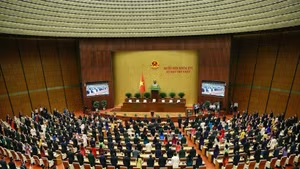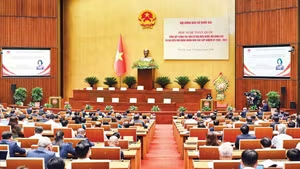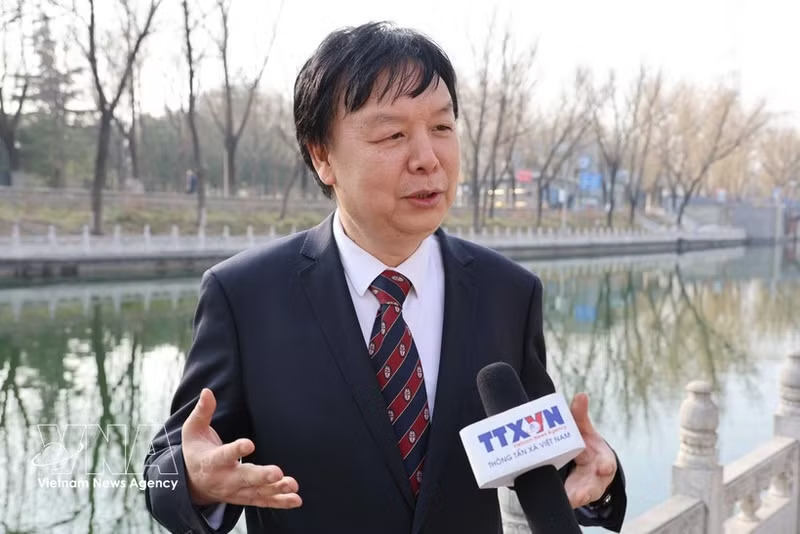
These goals are incorporated into the country’s five-year plans as well as long-term socio-economic development strategies, said Professor Mi Liang, Director of the Centre for Southeast Asian Studies at Beijing Foreign Studies University of China, during an interview to the Viet Nam News Agency ahead of the upcoming election.
According to the professor, the activities of the 15th NA and People’s Councils at all levels during the 2021–2026 tenure have been conducted effectively and successfully.
In particular, he highlighted the regular operations of local People’s Councils as one of the most important channels for realising socialist democracy in Viet Nam.
Vietnamese citizens elect their representatives to local People’s Councils through election. These representatives bring voters’ opinions to council meetings, forming the basis for local decision-making and fully demonstrating socialist democracy, he said.
“From my observations, these activities are very open, transparent and effective,” he said.
The Chinese scholar also pointed out that one of the key reasons behind Viet Nam’s remarkable socio-economic achievements since the beginning of the 21st century lies in its continuous reform process.
According to him, reform has served as a constant driving force for Viet Nam’s development, taking place in two key dimensions – reform of the political system and reform of the economic system – both of which are equally important.
In that context, he described the decision to hold the election for the NA and People’s Councils earlier than usual as a meaningful measure in Viet Nam’s ongoing political reform.
The adjustment, he explained, allows for a smoother transition between terms of the NA and local councils, thereby facilitating more effective performance of their duties.
Commenting on expectations for deputies in the new tenure, Mi said the development targets set out in the resolution of the 14th National Party Congress place several important requirements on newly elected representatives.
These expectations are reflected in four major aspects: strengthening legislation, ensuring effective policy implementation, improving governance efficiency, and enhancing representative responsibility.
He suggested that deputies to the NA and People’s Councils should continue improving the legislative framework and institutional safeguards to support the implementation of national strategies and breakthroughs in institutional reform.
At the same time, elected representatives should focus on promoting high-quality development and supervising the enforcement of policies to help realise ambitious economic growth targets, including the goal of achieving double-digit growth in the coming period.
Mi stressed the importance of improving governance capacity and accountability to meet people’s expectations, while strengthening discipline and responsibility in policy implementation.
In addition, deputies should actively disseminate the spirit and orientations of the 14th National Party Congress, enhance their role as a bridge between the Party, the State and the people, and contribute to building social consensus.
The scholar emphasised that the congress not only sets ambitious socio-economic development goals but also places broader responsibilities on newly elected deputies.
These representatives will take on multiple roles – legislators, supervisors, public servants and advocates, he said.
At the core of this approach, he added, is the effort to safeguard development through the rule of law, improve people’s livelihoods through effective governance and build consensus to advance Viet Nam’s long-term vision.
Viet Nam aims to become a developing country with upper-middle income by 2030 and a high-income developed country by 2045, he noted, adding that elected bodies will play a vital role in helping turn these aspirations into reality.