Over the past 96 years, it has been this constant capacity for innovation in response to the demands of each historical period that has forged the tradition of the Party’s communication and education sector — always “leading the way and paving the path, while accompanying implementation” on the Party’s ideological front.
Upholding a pivotal role on the ideological front
Following the Party’s founding conference on February 3, 1930, the Party Central Committee established the Propaganda and Agitation Board as the Party’s advisory body responsible for directing ideological work.
Its immediate tasks were to disseminate Marxism-Leninism; promote the Party’s Brief Political Platform, Brief Strategy, and revolutionary line; and mobilise the masses by raising revolutionary awareness, helping people understand, support, trust, and follow the Party in carrying out the revolution.
On August 1, 1930, the Propaganda and Agitation Commission published a document entitled “International Red Day – August 1.” It remains the earliest surviving publication to bear the imprint: “Published by the Propaganda and Agitation Board of the Communist Party of Viet Nam.” Immediately after its release, the publication attracted widespread attention and marked a significant milestone in the Party’s communication and education work.
In 2000, recognising the historical significance of this event, the Politburo decided to designate August 1 each year as the traditional day of the Party’s ideological and cultural work. In 2007, following the merger of the Central Commission for Ideology and Culture and the Central Commission for Science and Education into the Central Commission for Communication and Education, the Party Central Committee’s Secretariat designated August 1 as the traditional day of the Party’s communication and education sector.
Between 1930 and 1945, communication and education work accompanied every stage of the revolutionary movements, from disseminating Marxism-Leninism, promoting revolutionary policies, training propaganda cadres, developing the press, and publishing activities to fostering public confidence and inspiring patriotism across all sections of society.
The ideological work helped build unity in both thought and action, laying the political and ideological foundations for the success of the August Revolution in 1945.
During the resistance wars against the French colonialists and the US imperialists, communication and education work continued to play a vital role on the ideological front, serving as a powerful source of encouragement for the Party, the people, and the armed forces.
The press, literature, the arts, education, publicity campaigns, and mass mobilisation all contributed to strengthening the determination to fight and win, inspiring patriotic emulation movements, mobilising human and material resources for the front line, and reinforcing confidence in the ultimate victory of the struggle for national liberation and reunification.
These historic victories were the result of the Party’s correct leadership and also stand as compelling evidence of the power of ideological work in uniting the will and actions of the entire nation.
Renewing thinking and working methods to meet the demands of a new era
As the country enters a new stage of development, the Party Central Committee’s major policy decisions are aimed at creating new drivers of growth and opening fresh opportunities for national development.
For these policies to be effectively translated into reality, political determination alone is not enough; they also require unity in awareness, ideology, and broad social consensus. This has placed new and higher demands on the communication and education sector in terms of thinking, methods of operation, and proactive capacity.
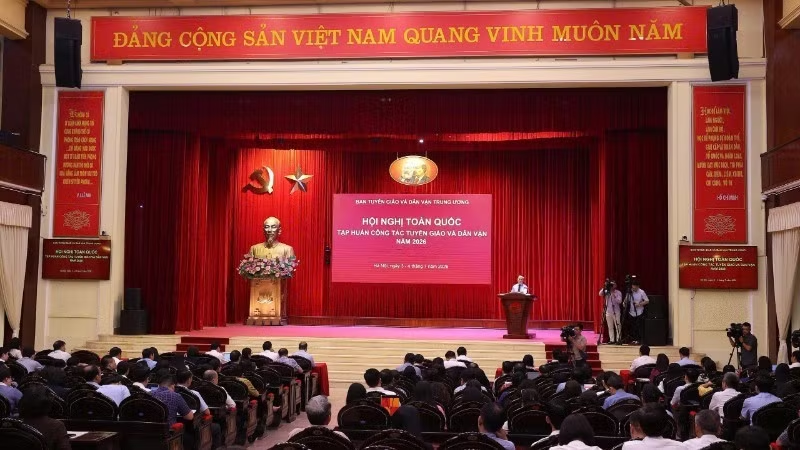
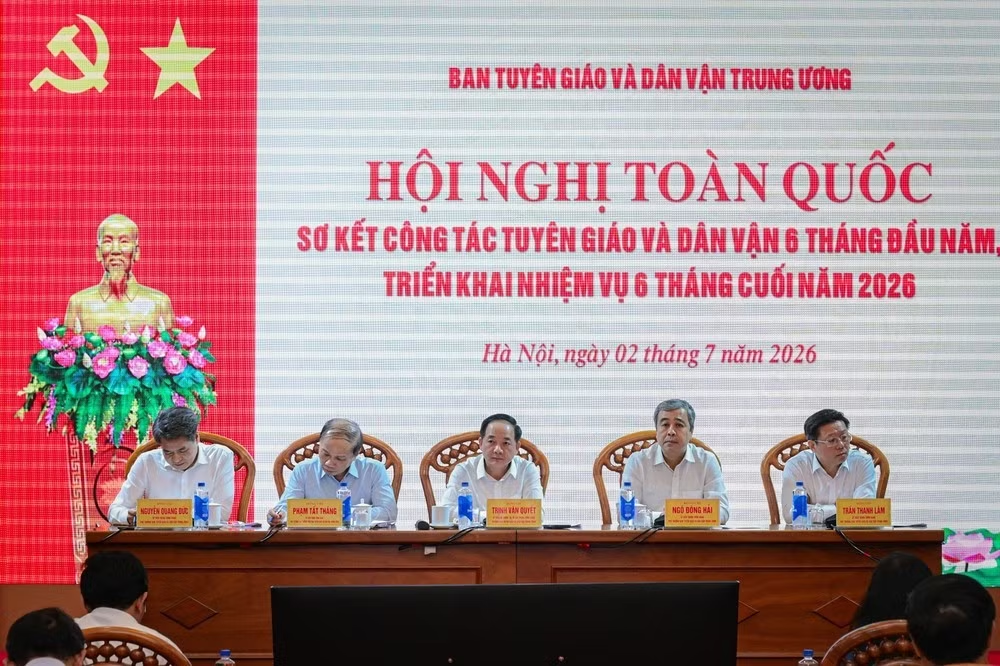
Addressing the conference reviewing the sector’s performance during the first six months of 2026, Politburo member Trinh Van Quyet, Head of the Commission for Communication, Education and Mass Mobilisation, stressed that the most noteworthy achievement was not merely the volume of work completed, but more importantly the transformation in thinking, working methods, and responsibility in both policy advice and implementation.
This requirement reflects the reality that, as the country embarks on a new phase of development, communication and education work must proactively innovate in order to accompany the implementation of the Party’s policies, helping transform orientations into consensus in understanding and action, thereby delivering tangible results in practice.
This spirit has been clearly demonstrated in the implementation of tasks over recent months. During the first half of 2026, the entire sector undertook comprehensive reforms in its thinking, content, and methods of operation.
Immediately after the 14th National Party Congress, it launched an action programme comprising 11 groups of tasks and solutions. By June 30, it had completed 13 major projects and advised the Politburo and the Secretariat in issuing eight important directives, including a regulation issued by the Party Central Committee on political and ideological work within the Party in April.
An especially notable achievement has been the sector’s comprehensive digital transformation. The development of a digital ecosystem for communication, education, and mass mobilisation, the application of artificial intelligence, the establishment of an integrated sector-wide information system, and a digital mapping system capable of identifying ideological “blind spots” at an early stage all reflect significant changes in leadership, management, and implementation methods.
Mastering the tools of the digital age has not only improved operational efficiency but also strengthened forecasting capacity, enabled the early detection of emerging issues, and enhanced the ability to provide timely policy advice and guide public opinion.
This represents a fundamental transformation and a clear demonstration of the sector’s ability to adapt to new development requirements, ensuring that communication and education work remains closely aligned with reality while supporting the implementation of the Party Central Committee’s strategic decisions.
Highlighting this shift in thinking and working methods, Assoc Prof, Dr Le Van Cuong of the Ho Chi Minh National Academy of Politics noted that, as the country enters a new stage of development, communication and education work continues to play a fundamental role in guiding public thinking, fostering shared understanding, and strengthening public confidence.
More importantly, the methods used to carry out these tasks are changing profoundly. Many localities have moved away from one-way communication towards dialogue and interaction, while expanding the use of digital technologies, multimedia communication platforms, online forums, and social media to deliver the Party’s guidelines and policies, as well as the State’s laws and regulations, to officials, Party members, and the public in a faster and more effective manner as well as in more accessible forms.
These changes are clearly reflected in the implementation of publicity and education work at the grassroots level. Phung Thi Dieu Huong, Deputy Head of the Communication and Education Commission of the Party Committee at Viet Nam National University Ho Chi Minh City, said that with more than 106,000 students and nearly 7,000 officials, lecturers, and employees, the university has shifted from simply processing information to managing the information environment. Its approach has evolved from reacting to emerging issues to proactively identifying issues at an early stage, providing timely information and fostering public confidence.
Rather than relying solely on traditional conferences to study and disseminate Party resolutions, the university has redesigned these activities into competitions and interactive forums where officials, lecturers, and students can actively participate, exchange views, and express their opinions.
This approach has not only enhanced the effectiveness of communication work but has also fostered greater consensus and wider public engagement in implementing Party resolutions.
The continuity of the 96-year tradition of the Party’s communication and education sector lies in its constant innovation in step with the nation’s development: leading the way in ideological guidance, accompanying implementation, and translating the Party Central Committee’s policies and decisions into reality.
In doing so, it continues to inspire aspirations for national development, strengthen public confidence, promote unity in thought and action, and contribute to achieving the country’s development goals in the new era.