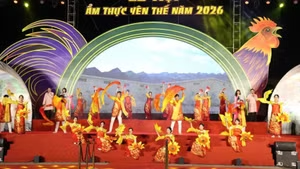
On the morning of November 14, the cultural exchange programme “Colours of Vietnamese ethnic cultures” took place at the Viet Nam National Village for Ethnic Culture and Tourism.
The event formed part of a series of activities marking the 96th anniversary of the Traditional Day of the Viet Nam Fatherland Front (November 18, 1930–November 18, 2026), in response to Viet Nam Culture Day (November 24) and the 80th anniversary of the First National Cultural Conference (November 24, 1946–November 24, 2026).
The programme brought together representatives of 16 ethnic groups who live and regularly participate in activities at the village, along with delegations of Dao artisans from Quang Ninh Province and Cham artisans from Khanh Hoa Province.
Speaking at the programme, Pham Tuan Long, Director of the Ha Noi Department of Culture and Sports, emphasised that the cultural exchange programme “Colours of ethnic cultures” provided an opportunity to honour the traditional cultural values of Viet Nam's 54 ethnic groups and affirm the strength of solidarity, compassion, and close bonds within the country's “common home.”
The event took place as the country prepares to mark the 96th anniversary of the Traditional Day of the Viet Nam Fatherland Front, the National Great Unity Day, Viet Nam Culture Day, and the 80th anniversary of the First National Cultural Conference.

Emphasising that great national unity begins with mutual understanding and respect for one another's cultures, Pham Tuan Long affirmed that cultural understanding is a sustainable path towards fostering greater affection and closer ties among communities. The National Great Unity Day also provides an opportunity to reflect on the traditions of patriotism, humanity, and mutual support that generations of Vietnamese people have upheld over the years.

Organising cultural exchange activities at the Viet Nam National Village for Ethnic Culture and Tourism demonstrates the capital's responsibility for preserving and promoting cultural heritage and connecting different regions across the country. Ha Noi residents and visitors have more opportunities to discover and experience the cultures of different ethnic groups, join hands in safeguarding heritage, promote traditional values, and help build a healthy, friendly, and humane cultural environment.

Organising cultural exchange activities at the Viet Nam National Village for Ethnic Culture and Tourism demonstrates the capital's responsibility for preserving and promoting cultural heritage and connecting different regions across the country. Ha Noi residents and visitors have more opportunities to discover and experience the cultures of different ethnic groups, join hands in safeguarding heritage, promote traditional values, and help build a healthy, friendly, and humane cultural environment.
On the occasion, a wide range of exhibitions, cultural exchanges, and artistic performances were held at the Viet Nam National Village for Ethnic Culture and Tourism.
A highlight was the space showcasing the traditional culture of the Dao people of Quang Ninh Province, featuring distinctive customs, practices, costumes, cuisine, and folk performing arts.
Members of the Dao Thanh Phan community performed bell dances and traditional horn music associated with the cap sac initiation ceremony, as well as courtship songs.
The Dao Thanh Y community introduced traditional dances, antiphonal courtship singing, and the techniques used to embroider patterns on traditional costumes. The programme also recreated the Song Mun Ceremony — a ritual for praying for peace and good fortune practised by the Dao Thanh Y, reflecting the community's spiritual beliefs and aspirations for peace and prosperity.
Other activities included cultural exchanges between the Dao community of Quang Ninh and H'Mong, Dao, and several other ethnic groups from northern Viet Nam. These showcased the distinctive cultural features of each locality through folk songs and dances, traditional musical instruments, handicrafts, cuisine, and folk games.

A wide range of lively cultural exchanges and artistic performances took place at the cultural spaces of the Tay Ethnic Village, the Ede Ethnic Village, the Cham Tower, and Hung Vuong Square. The delegation of Dao artisans from Quang Ninh joined forces with members of the Tay and Nung communities (Thai Nguyen), the Dao community (Ha Noi), and the H'Mong community (Tuyen Quang) for joint performances.
A delegation of Cham folk artisans from Khanh Hoa took part in cultural exchanges and performances with the Khmer community from Can Tho.
Members of the Muong, Kho Mu, Lao and Thai communities, together with seven ethnic groups from the Central Highlands, also enthusiastically joined the exchanges and performances, bringing a rich diversity of cultural colours to the event.
In the Cham cultural space, artisans presented traditional performing arts, instrumental ensembles featuring folk musical instruments, and traditional fan dances. They also demonstrated Bau Truc pottery-making techniques and displayed traditional pottery products.