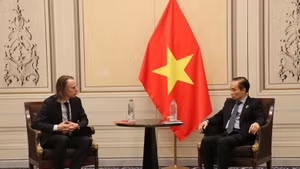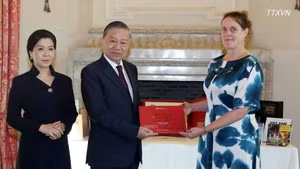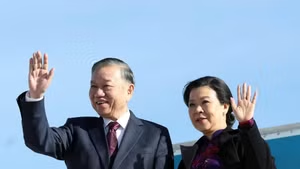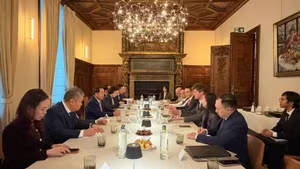
In July 1955, President Ho Chi Minh led the Vietnamese Party and Government delegation on his first visit to Mongolia. In September 1959, Yu. Tsedenbal, First Secretary of the Mongolian People’s Revolutionary Party Central Committee and Chairman of the Council of Ministers, led a Mongolian Party and Government delegation to visit Viet Nam. Today, Mongolia regards Viet Nam as a key comprehensive partner in the Southeast Asian region.
In the more than 70 years since the establishment of diplomatic relations on November 17, 1954, Viet Nam–Mongolia ties have been vigorously advanced across many fields and have achieved substantive, comprehensive progress in recent years, while political and diplomatic relations have been consolidated and strengthened.
The two sides established the Viet Nam–Mongolia Comprehensive Partnership during the state visit to Mongolia by Vietnamese Party General Secretary and President To Lam in September 2024, opening a new chapter aimed at expanding, deepening, and increasing the sustainability of cooperation between the two countries.
The two sides established the Viet Nam–Mongolia Comprehensive Partnership during the state visit to Mongolia by Vietnamese Party General Secretary and President To Lam in September 2024, opening a new chapter aimed at expanding, deepening, and increasing the sustainability of cooperation between the two countries.
Party-to-party channels have all seen positive development, along with cooperation in trade, investment, defence, security, justice, culture, education, tourism, and people-to-people exchanges. The two sides regularly maintain exchanges of delegations, high-level contacts at various levels, local-level interactions, and activities by friendship organisations and people’s associations.
In recent years, Viet Nam–Mongolia cooperation in economics, trade, investment, and agriculture has become increasingly dynamic, with the two sides signing numerous cooperation documents that create a favourable legal framework to boost bilateral trade turnover. In 2025, two-way trade reached more than 155 million USD, of which Viet Nam’s exports accounted for over 100 million USD.
Located in Central Asia, with much of its territory consisting of grassland steppes and mountains, Mongolia enjoys favourable conditions for developing livestock farming. The two countries have stepped up cooperation in supplying agricultural products, including the export of goat and sheep meat from Mongolia to Viet Nam, and poultry meat and eggs from Viet Nam to Mongolia.
At present, several Vietnamese enterprises have implemented or are implementing large-scale investment projects in the energy sector.
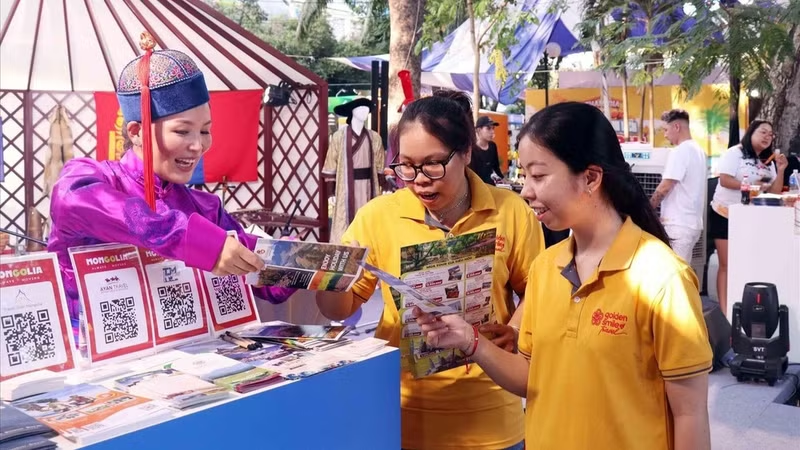
The two sides have also witnessed new developments in cooperation on culture, tourism, and education and training, notably including the signing of an agreement in 2023 on visa exemption for holders of diplomatic, official and ordinary passports; and the launch of direct flights from Mongolia’s capital city of Ulaanbaatar to Viet Nam’s Ha Noi, Ho Chi Minh City, Phu Quoc, and Nha Trang, facilitating people-to-people exchanges and tourism cooperation.
The two countries have actively exchanged lecturers, pupils and students under government scholarship schemes. To strengthen enduring friendship and people-to-people ties, a monument and a traditional room dedicated to President Ho Chi Minh were inaugurated at Inter-Level School No.14, named after the late President Ho Chi Minh, in Ulaanbaatar in 2009.
The two sides jointly produced the film ‘Cuoc Song Nhu Mot Bo Phim’ (Life is Like a Movie) in 2013, which was widely screened in both Mongolia and Viet Nam. They have also coordinated the translation and publication of numerous Vietnamese literary works, poems and history books into Mongolian, including ‘Prison Diary’ by President Ho Chi Minh, ‘The Life and Revolutionary Career of President Ho Chi Minh’, and Nguyen Du’s ‘The Tale of Kieu’.
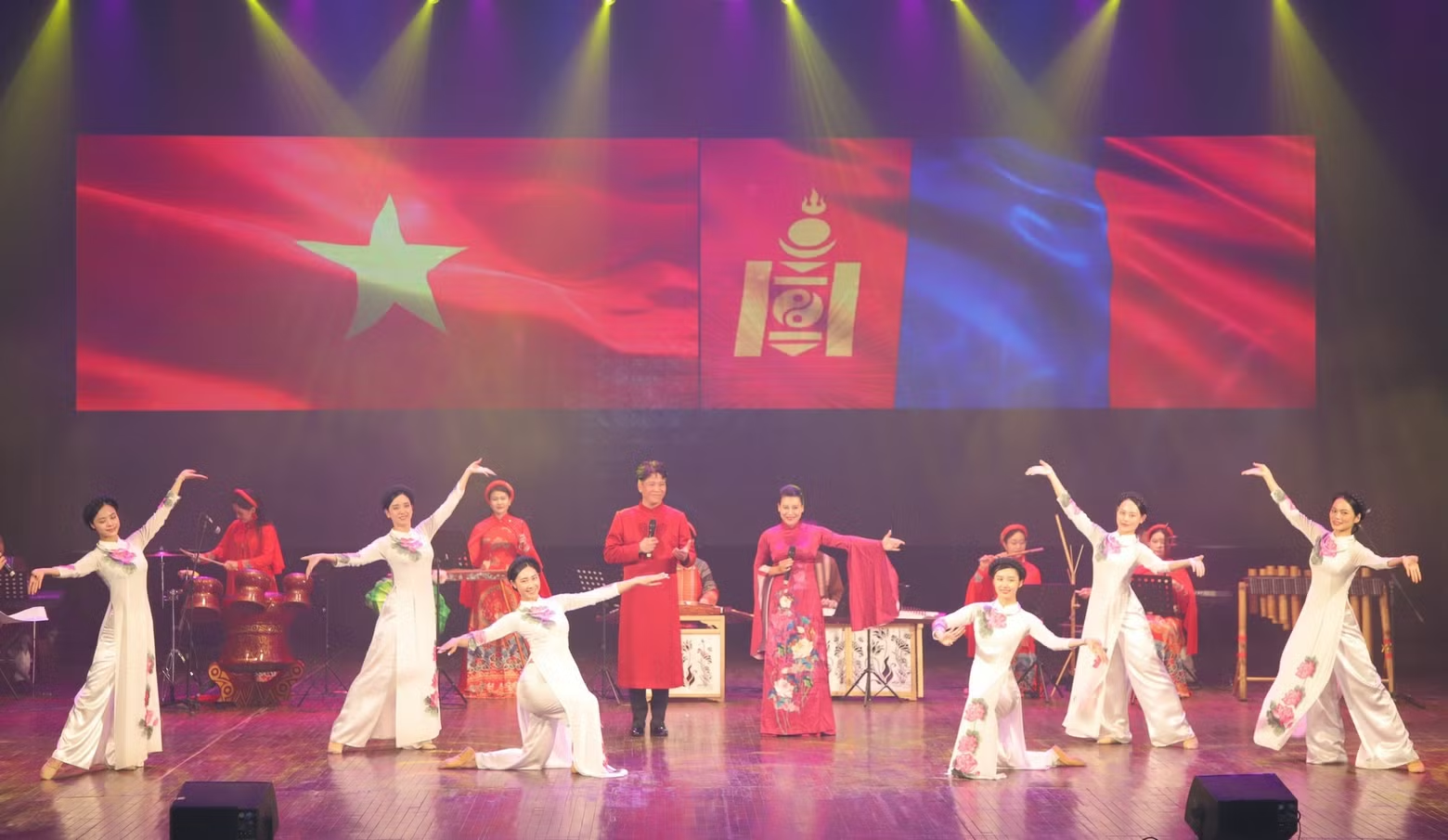
Mongolia has sent art troupes to participate in Hue Festival and many other international cultural and artistic events held in Viet Nam; Viet Nam, in turn, has sent several artistic delegations to perform in Mongolia in recent years. “Vietnamese Culture Day in Mongolia” was held in September 2024 to mark the 70th anniversary of bilateral diplomatic relations.
Together with consolidating political trust, stepping up cooperation in areas where both sides have strengths and needs will help elevate the Viet Nam–Mongolia Comprehensive Partnership to new heights, making it more effective, substantive, and extensive in the time ahead.
Alongside traditional areas of cooperation, the two sides have begun exchanges in the field of artificial intelligence (AI), sharing experience on building e-government and digitising public services. Mongolia is interested in cooperating with Viet Nam on AI development, the digital economy, start-ups, and the application of new technologies.
Building on their traditional friendship and cooperation potential, Viet Nam and Mongolia are striving to increase bilateral trade turnover by expanding trade; diversifying and enhancing the value of exports and imports; strengthening logistics and transport connectivity; deepening cooperation on technology, digitisation, and innovation; enhancing agricultural cooperation and food security; and cooperating on environmental protection and climate change response.
Together with consolidating political trust, stepping up cooperation in areas where both sides have strengths and needs will help elevate the Viet Nam–Mongolia Comprehensive Partnership to new heights, making it more effective, substantive, and extensive in the time ahead.