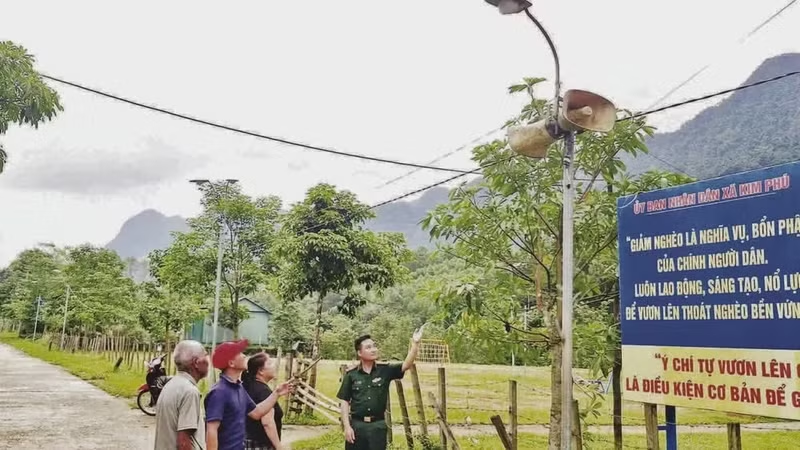
Quang Tri Province shares a land border with Laos spanning over 409 km. It includes 15 border communes comprising 144 villages, which are primarily inhabited by ethnic minority communities.
In an era of rapid information technology advancement, people in lowland and urban areas can easily access information via television, the internet, social media, the press, and various digital platforms. However, in the border regions of Quang Tri, many areas still lack the necessary infrastructure for residents to access these channels.
An initiative born from grassroots realities
While local public radio systems have been established in border localities, their reach has largely been limited to commune centres or residential clusters near administrative offices. Consequently, information often fails to reach residents in remote, isolated areas effectively or comprehensively.
Lieutenant Colonel Nguyen Son Binh, Political Commissar of the Con Roang Border Guard Station in Thuong Trach Commune, explained that the commune covers a vast area and is home to nearly 900 households—totalling 3,873 people—spread across 13 villages. Among these, Doong village, consisting of 12 households, is located more than 70 km away from the station. Currently, the “Remote Village Public Radio System” model is being implemented in eight of the commune’s villages.
In reality, villages located far from the commune centre have a constant need for information directly relevant to their daily lives and livelihoods—such as seasonal farming schedules, technical guidance, disaster and disease prevention, legal awareness, and other local administrative matters.
Meanwhile, the fragmented terrain, scattered population, difficult transportation, and local labour practices—centred around swidden (slash-and-burn) cultivation—have made it challenging to hold regular community meetings, often preventing essential information from reaching the people in a timely manner.
More than five years ago, officers from the Con Roang Border Guard Station pioneered the “Border Guard Radio” initiative. This model utilised motorcycles equipped with mobile public radio systems to travel to individual villages and hamlets, disseminating vital information. During the COVID-19 pandemic, when large gatherings were restricted, this method proved highly effective, ensuring that residents could promptly access information on safety protocols and pandemic prevention measures.
However, this mobile approach remained dependent on available vehicles, personnel, and weather conditions; it was also limited to specific deployment periods, failing to provide a consistent, daily channel of communication within the residential areas.
In 2021, the Con Roang Border Guard Station developed and piloted the “Radio for Remote Villages” model, which introduced fixed public radio systems to local communities. The system is designed for flexibility, comprising an amplifier, microphone, radio, USB drive, protective cabinet, wiring, and three to five radios—depending on the size of the settlement. The average cost to install one such system ranges from 15 to 20 million VND.
According to Colonel Ngo Van Dung, Deputy Political Commissar of the Quang Tri Provincial Border Guard, these initial results provided a foundation for refining the processes for the construction, management, and operation of the system. By 2023, the model was officially expanded across the entire land border, under the standardised name: “Public Radio System for Remote Villages”.
These initial results provided a foundation for refining the processes for establishing, managing, and operating the model. By 2023, the model was officially expanded across the entire land border, under the unified name “Remote Village Public Radio System”.
Colonel Ngo Van Dung, Deputy Political Commissar of the Quang Tri Border Guard Command
The expansion of this model presented numerous challenges, including a lack of funding for equipment, as well as the fact that the personnel tasked with its implementation had not received specialised training in information technology or electronic engineering.
To ensure timely service to the local population, the border guard personnel took the initiative to conduct research, seek out knowledge, and learn from experience. They experimented with various installation configurations—ranging from speaker placement, sound projection angles, and wiring layouts to the selection of equipment compatible with local power sources and specific climatic conditions.
Through a continuous cycle of research, implementation, and practical adjustment, they gradually perfected the procedures for establishing, managing, and operating the system, creating a standardised framework for application across the entire border region.
Recognising the significance of this initiative, natives of Quang Tri province serving in the Ho Chi Minh City Border Guard contributed 750 million VND to support the development of additional projects. To date, the Provincial Border Guard has completed and handed over 50 “Remote Village Public Radio System” projects for local use. In Dan Hoa commune alone, 11 such systems have been installed across 11 villages, comprising 61 radio clusters connected by approximately 12 kilometres of transmission lines.
As this practical and meaningful model gained traction, the Provincial Border Guard—in coordination with the Department of Culture, Sports and Tourism—developed and donated two additional “Remote Village Public Radio System” units to villages in neighbouring Laos, located along the border with Quang Tri.
These were presented during the establishment of “sister” relationships between residential clusters on both sides of the border: specifically, between Dan Hoa commune and the Lang Khang village cluster, and between Thuong Trach commune and the Nong Ma village cluster (in Bua La Pha district, Khammouane province, Laos). This effort helps foster solidarity and friendship among residents living along the border.
A key innovation of this model lies in its management and operational mechanism
Lieutenant Colonel Duong Dinh Hoan, Political Commissar of the Ca Xeng Border Guard Station—which oversees the communes of Kim Phu and Kim Dien—explained that these two communes encompass 17 villages, home to nearly 6,000 households and approximately 25,000 residents.
Through practical implementation, the model has been refined and enhanced to maximise the effectiveness of its public outreach and communication efforts. The innovation of the “remote village broadcasting” model lies not merely in the investment in broadcasting infrastructure for these villages; more importantly, it involves establishing an operational framework.
This has been achieved by advising local party committees and authorities to form editorial and management teams, issuing regulations for the operation and maintenance of the broadcasting system, and tasking the village-level Front Working Committee with the direct management and utilisation of the system.
In each village, a designated border guard officer oversees the local broadcasting system, assisting with content curation, operational guidance, equipment maintenance, and troubleshooting to ensure the facilities remain functional and sustainable in the long term.
Cao Xuan Phong, Secretary of the Party Cell for Yen Hop Village, Kim Phu Commune, explained that broadcast schedules are tailored to the villagers’ daily routines—airing in the morning before they head to their fields, and again in the afternoon after they finish their work. In addition to relaying programmes from national and provincial media outlets, the system broadcasts content developed locally—specifically policies, guidelines, and laws directly relevant to the residents’ lives.
The radio also served as a communal alert system, replacing traditional gongs to announce village meetings; they further support cultural and sporting events during holidays, the Tet festival, and the “Great National Unity” celebrations, fostering a joyful, vibrant atmosphere and strengthening community bonds.
Cao Duc Chien, a resident of Hoa Luong Village, Kim Dien Commune, shared that the “Remote Village Radio” initiative provides the community with a wealth of useful and reliable information. The content disseminated by border guards and local officials not only equips villagers with practical knowledge for agricultural production but also helps prevent confusion or anxiety caused by unverified, misleading information circulating on social media.
According to Colonel Ngo Van Dung, what began as a grassroots initiative has gradually expanded across the entire border region of Quang Tri Province, evolving into a specialised outreach model employed by the provincial Border Guard.
This model has helped disseminate information regarding the guidelines and policies of the Party and the State within villages in remote and isolated areas. It establishes a consistent communication channel at the grassroots level, contributing to the innovation of mass mobilisation methods in border regions.