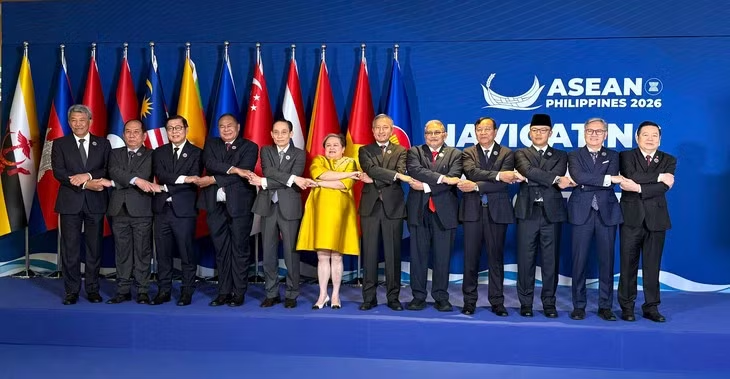
Viet Nam’s engagement at the ASEAN Foreign Ministers’ Retreat on January 28–29 in Cebu, the Philippines, underscored its strategic commitment to ASEAN and its determination to translate foreign policy orientations into concrete action, contributing to peace, stability, and sustainable development in Southeast Asia, according to Deputy Minister of Foreign Affairs Dang Hoang Giang.
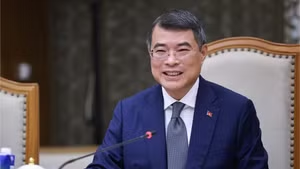
The Vietnamese delegation to the retreat was led by Politburo member and Minister of Foreign Affairs Le Hoai Trung.
Viet Nam’s participation left three clear imprints, marking a qualitative shift from “deep integration” to “full integration,” with a more proactive, constructive, and responsible role in addressing regional and global issues.
First, it reaffirmed Viet Nam’s strategic commitment. Minister Trung underscored the country’s consistent foreign policy of independence, self-reliance, multilateralisation, and diversification, while reaffirming ASEAN as Viet Nam’s top strategic priority and common home. The positive response from other member states reflected broad recognition of Viet Nam’s growing role and credibility.
Second, the country demonstrated a strong action-oriented mindset. Actively contributing to the shaping of priorities for 2026 and beyond, the minister emphasised the need for ASEAN to stay ahead of change, strengthen unity and centrality, and maintain its role as a regional anchor of peace and stability. He also called for deeper intra-bloc connectivity in infrastructure, energy, knowledge, and innovation to enhance resilience and competitiveness.
Third, Viet Nam highlighted its sense of responsibility for common affairs, with Minister Trung proposing the review of ASEAN’s confidence-building and conflict-management mechanisms, including the establishment of consultations among ASEAN legal advisers, to strengthen the bloc’s institutional and legal foundations. Maintaining a balanced and constructive approach, Viet Nam helped preserve ASEAN consensus and, as coordinator for ASEAN–UK and ASEAN–New Zealand relations, promoted practical cooperation aligned with ASEAN’s development priorities.
Assessing the outcomes of the retreat, Giang said the meeting went beyond the routine start of a new cooperation year, helping to shape ASEAN’s collective response to profound global and regional changes. With higher expectations placed on ASEAN’s role, responsibility, and contribution, the retreat conveyed a clear action-oriented message: ASEAN remains committed to unity, coordination, and proactive engagement, rather than being drawn into intensifying global competition.
Under the theme “Navigating Our Future, Together,” the Philippine Chairmanship highlighted ASEAN’s determination that it will not stand on the sidelines or be swept into competition, but will reinforce unity, coordination, and collective action for regional stability and development. In that spirit, the retreat achieved several important outcomes of strategic significance, Giang stated.
First, ASEAN agreed to renew its approach to cooperation by prioritising effectiveness and substance, narrowing the gap between decisions and implementation. This approach was reflected in three strategic priorities proposed by the Chair, focusing on peace as the foundation, prosperity as the driving force, and people as the centre of development.
Second, the meeting emphasised the need to accelerate the implementation of the ASEAN Community Vision 2045 and its strategic plans. Member states acknowledged past limitations in execution and agreed to improve accountability, coordination, and implementation capacity. Particular priority will be given to emerging growth drivers such as the digital economy, artificial intelligence, and the semiconductor industry, which are expected to enhance regional connectivity and deliver tangible benefits to businesses and citizens.
Third, it reaffirmed ASEAN’s unity, resilience, and strategic autonomy amid increasing geopolitical fragmentation, conflicts, and unilateral pressures challenging multilateralism and international law.