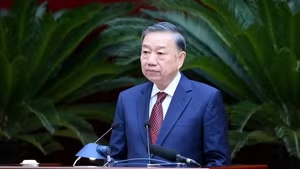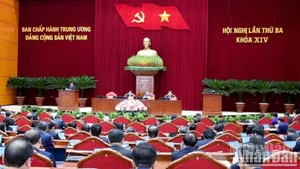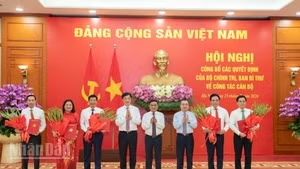
The message of Party General Secretary and State President To Lam carries special significance in the country’s new stage of development.
It sets requirements for working style and standards of responsibility, leadership capacity, and organisational capacity among Party committees, authorities, officials, and Party members, as the country, together with localities, agencies, and units, focuses on implementing action programmes to realise the strategic orientations of the Party Central Committee.
In Ha Noi, with the 2026 working theme identified as “Discipline and professionalism – breakthrough and creativity – effectiveness and sustainability”, the Ha Noi Party Committee has strongly renewed its methods of leadership, direction, and administration, taking substantive effectiveness as the measure and work results as the basis for assessing the capacity and responsibility of each agency, unit, and individual.
The city has thoroughly implemented the action motto: once something is said, it must be done; done quickly, properly, effectively, and to the end. At the same time, it has applied the principle of “six clear requirements”: clear person in charge, clear task, clear timeline, clear responsibility, clear product, and clear authority; along with the requirements of “one task, one consistent focal point” and “real work, real progress, real effectiveness.” As a result, many policies, projects, and key works have been implemented immediately after directives from competent authorities were issued.
One of the clearest examples is the city’s determination to tackle five major bottlenecks of the capital: flooding, traffic congestion, environmental pollution, construction order, and food safety. These have all been long-standing and pressing issues, directly affecting people’s quality of life and the city’s sustainable development.
By focusing on removing these five bottlenecks, Ha Noi has included them in its action programme to implement the Resolution of the 14th National Party Congress, with a new spirit of action that is more resolute, more synchronous, and measured by substantive effectiveness. Accordingly, solutions to remove bottlenecks have been assigned to each relevant agency and unit under a “countdown” approach. Urgent tasks are prioritised, complex issues are resolutely prevented from arising, and the responsibility of leaders is tied to implementation results.
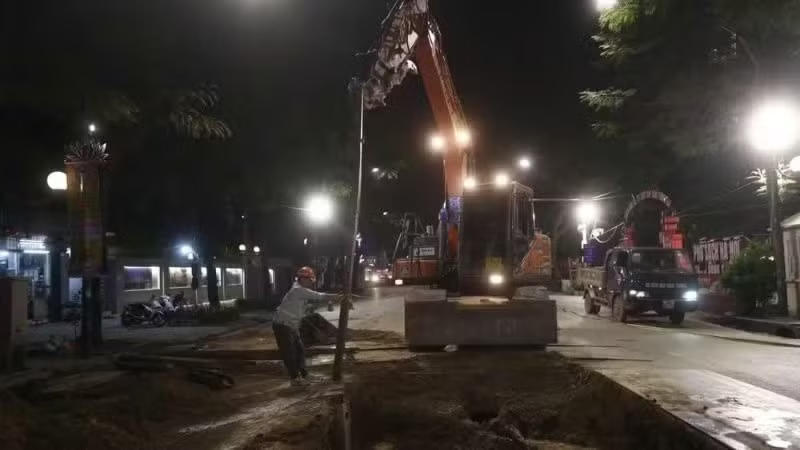
In the field of flood prevention, the city has identified this as one of the urgent tasks requiring focused solutions. The project on “Addressing flooding in inner Ha Noi in the 2026-2030 period” has been concretised with clear targets on reducing the number of flooded areas, lowering flood depth and shortening flood duration. All works must have clear effectiveness, completion deadlines, and clearly identified responsible units and individuals.
In the spirit of “making the right choice, implementing quickly, carrying things through to completion, and measuring outcomes by results”, Ha Noi has simultaneously launched 12 flood prevention projects under an emergency mechanism.
Notably, Ha Noi has not only set the right goals but has also chosen an appropriate method of implementation. The city has thoroughly applied the principle that “emergency” must be operated under an emergency mechanism, preventing situations where urgent tasks are carried out slowly or prolonged unnecessarily. Accordingly, the processes from approval and capital allocation to site clearance and construction have been carried out in an urgent manner under the mechanism, while still ensuring compliance with the law.
According to the Ha Noi management board for technical infrastructure and agricultural construction investment projects, in the past, a project of similar scale would have taken at least two to three years to complete. However, in just four months, seven emergency projects have completed about 90% of their workload and are currently being accelerated, with all expected to be completed before June 30. Initial effectiveness has been verified through several regulating lakes and drainage items that have been put into operation, helping to improve flood regulation capacity.
During heavy rainfall in late May, although many areas recorded high rainfall and some locations experienced localised flooding, water drained more quickly than before, showing the positive impact of the emergency flood prevention works.
In the new context, as the country simultaneously implements major decisions, what is needed more than ever is resolute action that turns determination into concrete results and puts people at the centre. The implementation of the Party’s policies and resolutions must all be directed towards clear goals, measurable indicators, specific timelines and responsibility assignments, substantive results, and visible changes in social life, so that people can place their trust in, support, accompany, and actively respond to these efforts.