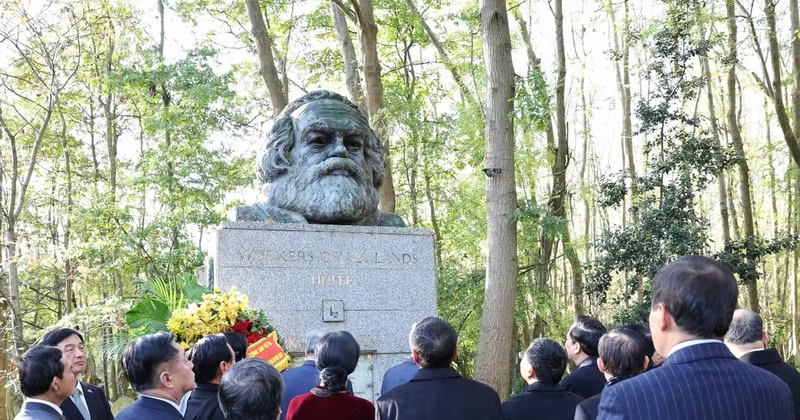
The same spirit that builds railways with the hands of workers is also building philosophical systems in the minds of philosophers” [1]. “All genuine philosophy is the spiritual quintessence of its time” [2]. Therefore, Marx also argued that the task of philosophy is not to construct a system “suitable for all future ages”, but to subject everything that exists to ruthless criticism. Criticism serves to reveal the irrationality of the old, thereby opening the path to building a new society. In his Eleventh Thesis on Feuerbach, Marx wrote: “The philosophers have only interpreted the world in various ways; the point, however, is to change it” [3].
The philosophy of action in Marxism–Leninism requires the constant re-examination and reassessment of theoretical viewpoints in relation to the movement and development of reality. From this, theory must be supplemented and developed in accordance with specific historical conditions. This philosophy also affirms that human beings are the subjects who create history through practical activity. Humans not only perceive the world but also transform it through material production, socio-political activity, and scientific endeavour. Therefore, Marxist theory is always closely linked with revolutionary action, with the aims of human emancipation and social development.
The philosophy of action in Marxism–Leninism is most clearly expressed in the principle of the unity between theory and practice. As Viet Nam enters a new era of development — associated with digital transformation, the knowledge economy, innovation, and deep international integration — its theoretical work faces new demands in terms of content, methods, and effectiveness. This requires improving the quality of research and closely linking theory with the country’s development practice. The application of the Marxist–Leninist philosophy of action is not only of methodological significance but has also become an urgent requirement for theoretical work. It provides the foundation for renewing thinking, enhancing forecasting capacity, strengthening the ability to synthesise practical experience, and developing theory suited to the new context.
Theoretical work must originate from and directly serve the practical development of the country. The documents of the 14th National Party Congress emphasise the need to “closely integrate the summarisation of practice and theoretical research with the formulation and organisation of the implementation of the Party’s guidelines and policies, and the state’s laws.” This shows that theory cannot remain at the level of dogmatic interpretation; it must delve into new issues arising from reality, such as the development of the digital economy, green transition, innovation in growth models, modern national governance, and international integration. Therefore, theoretical work must promptly synthesise changes in socio-economic life and provide a scientific basis for leadership, direction, and implementation in practice.
It is essential to enhance the forecasting and guiding capacity of theoretical work. The 14th National Party Congress calls for “close adherence to reality, firm grasp and accurate forecasting of the situation; proactive, flexible, timely, and appropriate policy responses”, while emphasising the task of strengthening forecasting capacity, strategic thinking, and vision. This clearly reflects the spirit of action in Marxism–Leninism: theory must not only interpret the world but also guide its transformation. In a world undergoing “rapid and unprecedented complex changes”, theoretical work must excel in forecasting trends, identifying opportunities and challenges and thereby shaping strategic actions for the entire political system.
Theoretical work must be closely linked with innovation and digital transformation. The 14th National Party Congress identifies the need to “promote breakthroughs in science and technology, innovation, and digital transformation”, to “take science, technology, innovation and digital transformation as the primary driving force”, and to “develop new productive forces.” This provides a crucial basis for affirming that theoretical work in the new era cannot be separated from modern scientific and technological achievements. As knowledge, data, artificial intelligence, and digital technologies become decisive factors of development, theory must also renew its approaches and methods of research and dissemination so as to adapt to the digital environment and contribute to leading the national digital transformation.
The role of human agency in theoretical activity must be brought into full play. The documents of the 14th National Party Congress repeatedly emphasise the human factor, calling for efforts to “promote the strength, mettle and intellect of the Vietnamese people”, to “attract and utilise talent”, and to “encourage and protect dynamic, creative officials who dare to think, dare to act, and dare to take responsibility for the common good.” This affirms that theoretical activity is first and foremost a creative human endeavour. The contingent of theoretical cadres must possess strong political resolve, independent thinking, creative capacity, and close ties with reality; they must overcome scholastic and dogmatic thinking detached from life, so that theory truly becomes a spiritual and intellectual driving force for development.
To effectively apply the Marxist–Leninist philosophy of action in theoretical work, several key orientations should be prioritised:
First: promote the summarisation of practice and theoretical research in connection with the country’s major issues. The 14th National Party Congress calls for “stepping up the summarisation of practice and theoretical research on socialism, the socialist model, and the path to socialism in Viet Nam; and continuing to refine the theoretical system on the renewal process.” This requires that theoretical work be conducted in a scientific and systematic manner, closely linked to the major, new, and complex issues facing the country in its new stage of development.
Second: renew methods of research and dissemination of theory in a modern direction, with strong application of digital technologies. It is necessary to “accelerate administrative reform and digital transformation within the Party”, to “apply digital technologies and artificial intelligence in Party and state management and administration”, and to “study the development of a strategy for ideological work in the context of digital transformation.” This is an important direction for modernising theoretical activity, expanding its reach, and enhancing its persuasiveness in social life.
Third: build a contingent of theoretical cadres with firm political resolve, high professional qualifications, and strong practical capabilities. The 14th National Party Congress emphasises the tasks of “training, fostering, and developing the contingent of theoretical cadres, and valuing leading experts” while requiring the building of a cadre corps that is “truly exemplary in political mettle, qualities, competence, and prestige.” This is a decisive condition for theoretical work to fulfil its function of ideological orientation, guiding awareness, and directly contributing to the formulation of lines and policies.
Fourth: strengthen the linkage between theoretical research institutions and policy-making bodies as well as practical management. Theory can only realise its value when it is integrated with leadership, management, and practical governance. The close connection between theoretical research bodies and policy-making agencies will ensure that theory is not detached from life, but truly serves as a scientific foundation for leadership, management, and national development.
The philosophy of action in Marxism–Leninism is an important methodological foundation for theoretical work in Viet Nam. In the new era of development, applying this philosophy will not only improve the quality of theoretical research but also directly contribute to the formulation and implementation of the country’s development strategies.
In essence, it is a process of making theory truly “live within practice”, which becomes a material force when it is mastered and creatively applied by the masses. This is also the path for theoretical work in Viet Nam to continue playing a pioneering and guiding role in the cause of national construction and defence in the new period.
[1] Karl Marx and Friedrich Engels: Collected Works, Vol. 1, National Political Publishing House, H.1995, p.156.
[2] Karl Marx and Friedrich Engels: Collected Works, Vol. 1, National Political Publishing House, H.2005, p.156.
[3] Karl Marx and Friedrich Engels: Collected Works, Vol. 3, National Political Publishing House, H.1995, p.20.