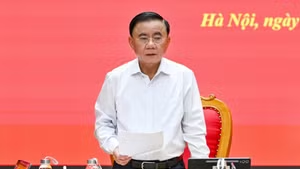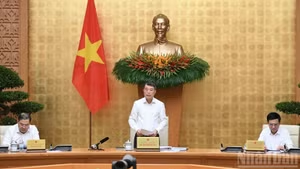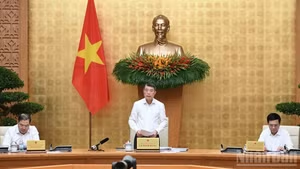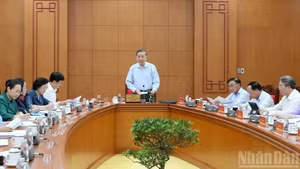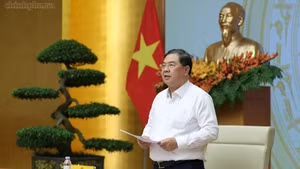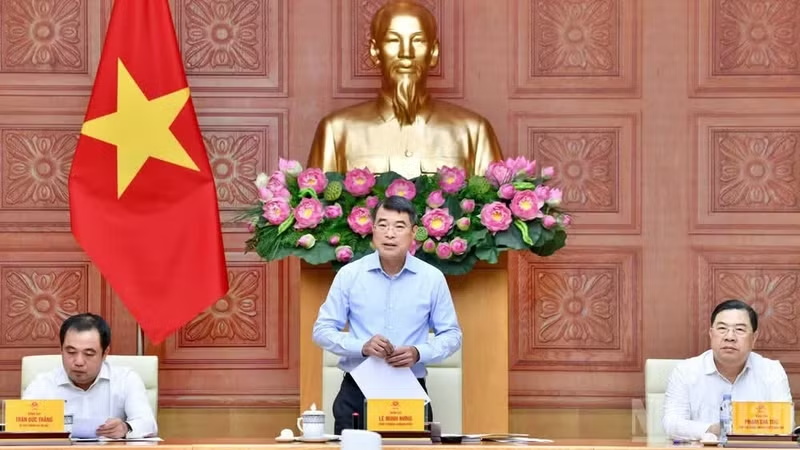
Chairing a working session on May 25 with the Ha Noi People's Committee and ministries on rental housing development in the capital, the PM said there is high consensus on approaches to institutionalise Party policies, improve mechanisms and accelerate rental housing development.
He noted that developing affordable commercial housing and rental housing is a major policy consistently reaffirmed in Party directives, including Directive No. 34-CT/TW of the Secretariat of the Party Central Committee and most recently Notice No. 64-TB/VPTW.
Describing Ha Noi, the country’s political and administrative centre, as one of Viet Nam’s fastest-urbanising cities, the PM said the capital is chosen to pioneer practical and scalable rental housing models that could later be replicated in other major urban and economic hubs nationwide.
Participants at the meeting agreed that social housing and rental housing development has achieved positive results in recent years, with improvements in legal frameworks, simplified investment and construction procedures, broader beneficiary groups and increased social housing supply. Ha Noi has already exceeded its 2025 social housing target and is implementing a large pipeline of projects for the coming years.
However, PM Hung acknowledged persistent bottlenecks, particularly the mismatch between housing supply and demand. He noted that the market remains heavily tilted toward commercial housing and that for sale, while long-term rental housing at affordable prices remains limited. He also pointed out inefficient use of public housing assets and insufficiently attractive policies to encourage private investment in long-term rental housing.
The Government leader stressed that while the State will not subsidise housing entirely, neither should the market be left to regulate itself. Instead, the State should play a facilitating role through planning, legal frameworks and financial, credit and land policies to support healthy rental housing market development, while mobilising businesses and social resources to invest with reasonable returns and ensuring people can access stable, affordable and safe housing.
He said rental housing development must be integrated with urban planning, land-use planning, public transport, industrial zones and labour market development, with priority given to major cities, industrial parks and key economic corridors with full infrastructure.
He called for diversified funding sources, stressing that while public investment remains important, the sector cannot rely solely on the state budget. Authorities should unlock private capital and long-term funding from investment funds and credit institutions, while using state resources effectively to guide and stimulate the market.
PM Hung also urged strict action against abandoned or inefficiently used public housing assets, alongside tighter and more transparent oversight of policy beneficiaries to prevent speculation and policy abuse.
He requested Ha Noi take the lead in implementing long-term rental housing models by leveraging special mechanisms under the Capital Law to proactively design, implement and supervise policies.
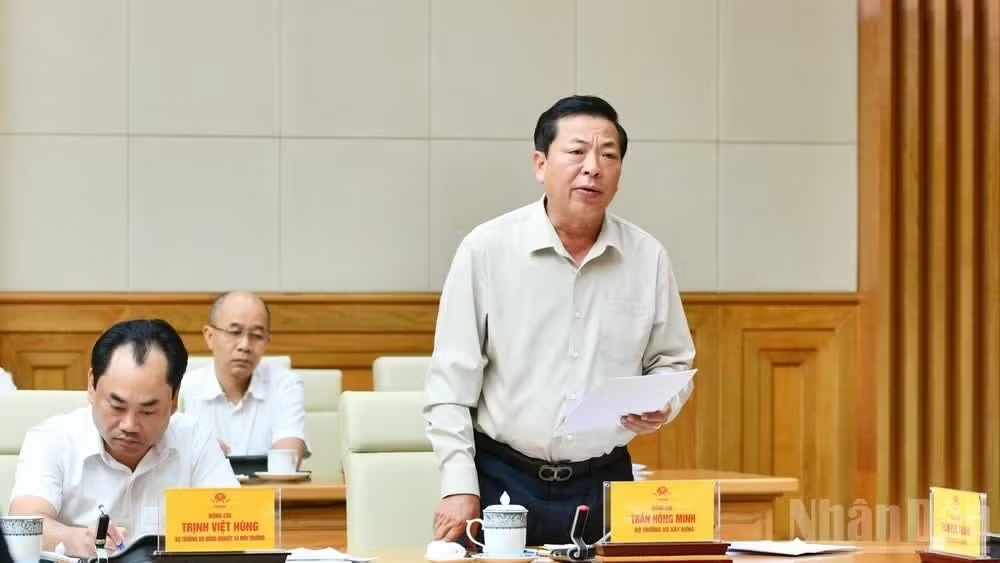
The city was tasked with urgently reviewing land-use plans, urban and rural planning, and inefficiently used public land and housing assets for rental housing development. It must report results to the PM in June 2026.
The PM said successful pilot mechanisms in Ha Noi could later be expanded nationwide, urging the city to proactively assess demand, target groups and investment mechanisms for large-scale rental housing projects that meet the needs of residents and workers in the capital.
Ha Noi was asked to strive to break ground on several rental housing projects this June while flexibly using social housing obligation revenues under a model in which the State invests in and professional enterprises operate projects.
He also instructed the city to develop plans for investment, construction and operation of rental housing projects, report to the Government in July, propose mechanisms to mobilise social resources, devise suitable land allocation and leasing policies.
The Ministry of Construction (MoC) was assigned to review and propose new policies and mechanisms, coordinate with several localities to identify rental housing demand across different groups, and develop a supply – demand map as a basis for planning and resource allocation.
Stressing institutional perfection as the decisive factor, the PM further called for breakthrough solutions in investment procedures, land management, planning and construction through the single-window mechanism with standardised procedures and clearly defined responsibilities for relevant agencies.
The MoC was also told to work with ministries and agencies to accelerate amendments to the Law on Housing and the Law on Real Estate Business in line with Notice No. 64-TB/VPTW, with draft revisions expected to be submitted to the National Assembly at its second session in October 2026.
Meanwhile, the Ministry of Finance was tasked with urgently giving guidance in accounting mechanisms for social housing obligation revenues paid in cash, capital preservation plans for rental housing investment and financial and tax incentives for long-term rental housing projects aimed at attracting private and long-term institutional capital.
The State Bank of Viet Nam was assigned to study and propose preferential credit policies, including stable interest rates and loan terms aligned with project capital recovery cycles, for long-term rental housing developers.