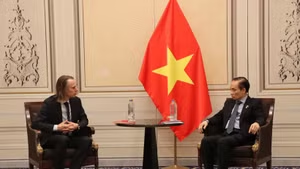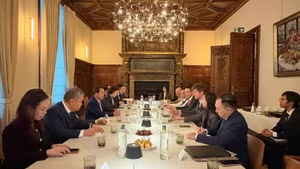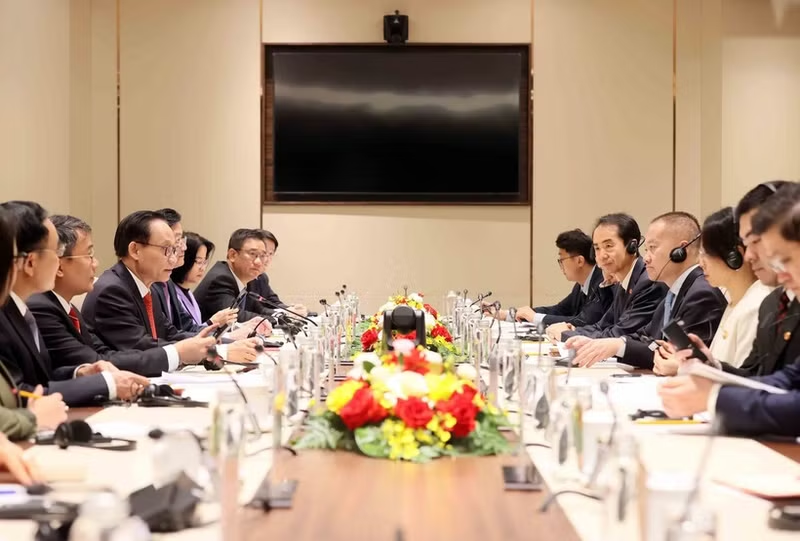
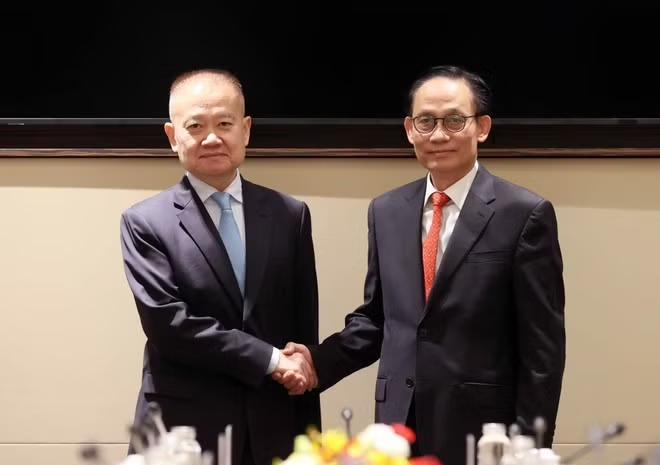
Politburo member and Minister of Foreign Affairs Le Hoai Trung on January 30 held talks with Liu Haixing, member of the Communist Party of China (CPC) Central Committee and head of its International Department, who is visiting Viet Nam as the special envoy of CPC General Secretary and President of China Xi Jinping to congratulate Viet Nam on the success of the 14th National Congress of the Communist Party of Viet Nam (CPV).
On this occasion, the two sides held the first meeting under the mechanism between the Secretary of the Party Committee of Viet Nam’s Ministry of Foreign Affairs and the head of the CPC Central Committee’s International Department.
Liu described the 14th National Congress of the CPV as a historic event in Viet Nam's new era of development, and congratulated Trung on his election to the Politburo of the 14th Party Central Committee.
The special envoy stressed that the CPC Central Committee and Party General Secretary and President Xi support the CPV Central Committee, led by General Secretary To Lam, in guiding the Vietnamese people to successfully implement the Resolution of the Congress and build socialism suited to Viet Nam’s conditions.
Trung briefed his guest on the overall outcomes of the 14th National Congress, saying it not only set out goals and orientations for the 2026–2030 tenure but also made strategic decisions concerning the country's future and destiny.
He highlighted new breakthrough and innovative points in Congress documents, reflecting intensive and more comprehensive advances in theoretical thinking and the Party’s leadership line, as well as the unity of will of the entire Party and the Vietnamese people.
The minister emphasised that the Congress, for the first time, identified foreign affairs and international integration, together with strengthening national defence and security, as key and permanent tasks. He affirmed Viet Nam’s consistent foreign policy of independence, self-reliance, resilience, peace, friendship, cooperation and development, multilateralisation and diversification of external relations, and proactive and responsible participation in addressing common regional and global issues.
Underscoring the high priority given to Viet Nam–China relations, the two sides reviewed recent cooperation and important progress in ties between the two Parties and countries. They exchanged views and reached broad consensus on effectively implementing high-level agreements and common perceptions, especially those achieved by the two Party chiefs during their phone talks on January 26.
Affirming that the Vietnamese Party and State always attach top priority to relations with China, Trung proposed that both sides closely coordinate in organising high-level exchanges in the coming period, further promote Party-to-Party cooperation mechanisms, strengthen coordination at multilateral forums of political parties, continue cooperation in cadre training, enhance exchanges of experience and theory, and soon sign new cooperation programmes and plans between the two Parties.
He also called for stronger friendly exchanges and cooperation among Party committees of localities, particularly those sharing the border line, mass organisations and especially young people, while stepping up communication efforts to consolidate a firm social foundation for bilateral ties.
Agreeing with the minister’s proposals, Liu affirmed that the International Department stands ready to work closely with the Party Committee of Viet Nam’s Ministry of Foreign Affairs to maintain the tradition of close coordination between the external relations and diplomatic agencies of the two Parties and countries, contributing actively to promoting friendship between Viet Nam and China.
The two sides concurred to play a more active role as strategic adviser, ensure regular high-level exchanges, improve the effectiveness of Party-channel cooperation and dialogue mechanisms, strengthen theory research cooperation and experience sharing in Party building and national governance, and boost training and capacity building for officials.
They agreed to optimise Party channels in promoting high-quality economic, trade and investment cooperation, infrastructure connectivity and people-to-people exchanges.
Both sides also consented to enhance multilateral coordination, make responsible contributions to maintaining peace, stability and development in the region and the world, and jointly manage and properly resolve differences on the basis of high-level common perceptions and in accordance with international law.