This is hardly a new tactic; whenever standards for the online environment are discussed, hostile forces and extremist elements immediately label the State’s actions as “controlling,” “silencing the public,” or imposing a “tightening noose” on social media users.
Their aim is to attack the political system, tarnish Viet Nam’s image, drive a wedge between social media users and the Government, and conspire to spark an underground wave of resistance intended to weaken the regime.
In 2018, when the National Assembly passed the Law on Cybersecurity — aimed at curbing cybercrime and protecting national security and user data — the terrorist organisation Viet Tan, RFA Vietnamese, and various overseas anti-government groups immediately decried it as a “law to silence the people,” claiming it destroyed freedom of speech.
More recently, when Decree No. 147/2024/ND-CP—regulating the management, provision, and use of internet services and online information — came into effect in late 2024, hostile actors once again used the “tightening noose” metaphor to criticise the regulation. This decree implemented technical measures to limit fake accounts and the spread of disinformation — practices common in many other countries.
Experience shows that whenever Viet Nam issues a policy regarding cyberspace management — whether it is a law, a decree, or a set of voluntary guidelines — these hostile actors recycle a familiar formula: applying labels, making sweeping accusations, calling for external intervention, and turning every policy into a pretext to propagate the narrative that “Viet Nam lacks freedom of speech.”
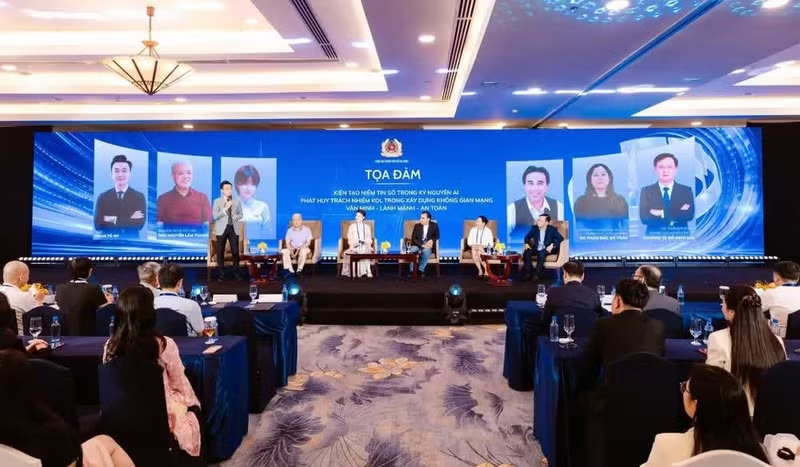
This same tactic was employed regarding the KOL Summit 2026, held on September 7. The event convened over 1,000 delegates and was organised by the Digital Trust Alliance in collaboration with VCCorp Joint Stock Company. It was held under the auspices of the Ministry of Public Security, with the participation of the Department of Cybersecurity and High-Tech Crime Prevention (A05) and the National Cybersecurity Association.
Launched in August 2025, this annual forum gathers key opinion leaders (KOLs), businesses, digital platforms, media outlets, and state regulatory agencies. It focuses on pressing issues within the digital landscape — such as AI, misinformation, KOL responsibility, copyright, and the building of digital trust — under the theme “Viral with Conscience, Influence with Substance.” During the summit, the Digital Trust Alliance announced the KOL Credibility Programme.
However, hostile actors deliberately steered public opinion to believe that the event was directly organised by the Ministry of Public Security to control and monitoring KOLs, thereby baselessly accusing the State of violating freedom of speech.
In reality, whenever Viet Nam issues policies to manage cyberspace — whether in the form of laws, decrees, or voluntary codes of conduct — hostile actors recycle a familiar formula: applying labels, making sweeping accusations, calling for external intervention, and turning every policy into a pretext for the narrative that “Viet Nam lacks freedom of speech.”
Notably, RFA published an article titled “Ministry of Public Security places a ‘magic headband’ on content creators/KOLs”, distorting the situation by claiming that “those who do not comply will face a binding spell.”
Meanwhile, Luat Khoa magazine (a site claiming to be an independent publication focused on law, politics, and history regarding Viet Nam) argued that KOLs are being “forced into an institutional cage” and are now “required to censor user comments.” These articles share a common narrative, baselessly accusing regulatory bodies of seeking to control the voices of online influencers.
What both RFA and Luat Khoa ignore is that the “Code of Conduct for Influencers and Content Creators” (Version 1.0) — which they criticise — is a voluntary set of rules applicable only to individuals who proactively commit to participation or register for certification.
In other words, a KOL has the full right not to join the Digital Trust Alliance or obtain the “Digital Trust” label. The distinction between a voluntary trust programme and a mandatory administrative order is clear, yet certain organisations and individuals deliberately conflate the two to sow public confusion.
Luat Khoa also seized upon Clause 8.4, which stipulates that influencers must proactively report to the platform and hide or delete comments if their channels are exploited by third parties to post content characterised as “politically, religiously, or ethnically negative.”
This is a baseless interpretation: this obligation is merely a condition for retaining the voluntary label, not a legal requirement subject to administrative or criminal penalties.
Clause 19.1, cited by Luat Khoa, also indicates that the most severe consequence is merely a reminder or a warning... ...issuing notifications, requesting content removal, or suspending/revoking certifications — without infringing upon anyone's freedom of speech or right to practise their profession.
Moderating comments on personal channels is nothing new; major social media platforms have long required channel owners to remove comments that violate community guidelines.
In reality, whenever Viet Nam issues policies to manage cyberspace — whether in the form of laws, decrees, or voluntary codes of conduct — hostile actors recycle a familiar formula: applying labels, making sweeping accusations, calling for external intervention, and turning every policy into a pretext for the narrative that “Viet Nam lacks freedom of speech.”
It is important to clarify that this is merely version 1.0 of a set of standards developed for a nascent field; any ambiguities are areas for feedback and refinement through practical application, rather than evidence of a “censorship conspiracy.”
In reality, establishing professional standards for influencers is a practice being adopted by many countries. In the Republic of Korea, the Korea Communications Standards Commission (KCSC) has the authority to order the removal of violating content or impose administrative fines amounting to hundreds of millions of won.
In Singapore, the Infocomm Media Development Authority (IMDA) has issued a Code of Conduct for content creators, requiring them to verify information sources before posting and to avoid spreading inflammatory content. Many European nations also mandate that influencers disclose sponsored content and hold them legally accountable for sharing misinformation.
In Viet Nam, the amended Law on Advertising — effective January 1, 2026 — stipulates that influencers must comply with consumer protection laws, provide documentation upon request by authorities, and bear legal responsibility for the advertising content they disseminate. The Digital Trust Alliance’s set of standards thus aligns with global trends in influencer governance: the greater the influence, the greater the responsibility.
It is essential to distinguish between regulation and prohibition. In a society governed by the rule of law, freedom of speech always goes hand in hand with responsibility: individuals have the right to express their views, critique policies, and offer diverse perspectives, but this right does not extend to disseminating false information, engaging in slander, or causing harm without facing accountability.
Freedom allows people to speak out, while responsibility ensures they answer for their words. These two principles are not contradictory but complementary. Therefore, establishing standards for the conduct of Key Opinion Leaders (KOLs) cannot be equated to imposing a “tightening headband” or “chanting a binding spell” — narratives propagated by outlets like RFA and Luat Khoa.
In reality, the true objective behind the distorted rhetoric of extremist and hostile actors is not a genuine concern for policy; rather, it is to sow doubt and drive a wedge between social media users and regulatory authorities, gradually fostering an attitude of suspicion and defiance among segments of the public.
Recognising these malicious motives allows individuals to equip themselves with a “vaccine” against disinformation, thereby preventing bad actors from manipulating or exploiting them.