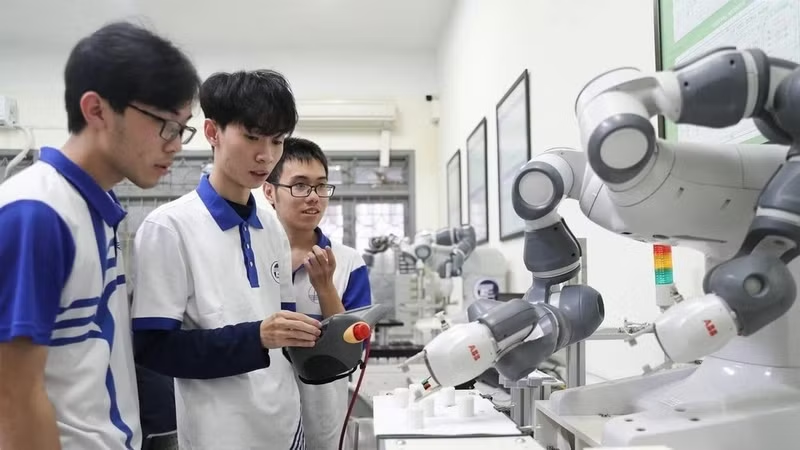
This underscores an urgent need for policies to utilise current resources, specifically young people – the young workforce – to provide them with the best conditions to develop their creativity and work abilities.
"Joining hands to realise the aspirations of young people for a bright future" is the theme of this year's World Population Day (July 11), striving to elevate global awareness of urgent population issues and call for action to address these challenges, while promoting the achievement of sustainable development goals.
Viet Nam still has the advantage of a golden demographic structure, although this period is projected to end sooner, in 2036.
According to Nguyen Thi Viet Nga, a member of the National Assembly's Committee on Culture and Society, we need to capitalise on the vigour of today's young generation. Investing in youth is how we shape the future of our population, building a prosperous, inclusive, and sustainable nation.
Young people are not only the successors but also the vanguard, the innovators, directly engaged in forging the future of the country.
However, to fully utilise the strength of the young generation during this golden demographic period, we need to surmount the current impediments of population development in the country, such as the low birth rate below replacement level in many provinces and cities; and the relatively high gender imbalance at birth. The quality of human resources (the proportion of trained workers, labour productivity) in many localities remains lacklustre, failing to meet the demands of digital transformation and economic development. Many businesses are facing the paradox of "a surplus of labour but a shortage of high-quality human resources".
Mai Trung Son, Deputy Head of the Department of Population Scale and Family Planning, Viet Nam Population Authority under the Ministry of Health, pointed out that the trend of declining birth rates and rising marriage ages is mainly due to socio-economic barriers that prevent young people from fulfilling their aspirations to start a family and have children. Many young people today have different viewpoints on marriage than in previous periods.
Many young people prioritise their careers, waiting for economic stability before considering marriage and having children. In addition, financial pressure also causes many young families to delay, or even not have children at all, leading to a gradual decline in birth rates and hastening the ageing of the population.
In this context, the Population Law 2025, which came into effect on July 1, 2026, signals a paradigm shift in Viet Nam's population policy by expanding support policies for population groups, from young families, pregnant women, children to the elderly.
Among these, young workers, young people of marriageable and childbearing age, and workers in industrial zones are the groups receiving the most support from the new policy.
The Population Law 2025, which came into effect on July 1, 2026, signals a paradigm shift in Viet Nam's population policy by expanding support policies for population groups, from young families, pregnant women, and children to the elderly.
Specifically, new regulations such as extending maternity leave for female workers giving birth to their second child, adding leave for husbands when their wives give birth, supporting pre-marital health check-up costs, partially covering infertility treatment costs for disadvantaged families, supporting women who have two children before the age of 35 in localities with low birth rates, and prioritising access to social housing, all aim to create more favourable conditions for people to confidently start families, have children, and care for their children in their early years.
Luong Thi Hong (Na Loi Commune, Nghe An Province), currently working in the Me Linh Industrial Park in Ha Noi, recounted that due to economic difficulties, after getting married, she had to send her only daughter back to her parents' home to be cared for, even though the child was still quite young. She and her husband did not dare to have more children because they did not have the means to raise them.
However, many young workers like her have recently been very enthusiastic about policies supporting maternity leave and facilitating the purchase of social housing.
On July 1, 2026, the Prime Minister issued Decision No. 1184/QD-TTg approving the adjustment and supplementation of the Strategy for the Development of Vietnamese Youth in the 2021–2030 period.
The strategy aims to build a generation of comprehensively developed youth, striving to achieve a youth unemployment and underemployment rate of less than 6% by 2030; and 40% of young people participating in green and circular economy activities. The strategy aims for 70% of young people to have sustainable jobs, green jobs, jobs in the digital economy, high-tech sectors, or sectors of national development priorities.
Regarding the protection, care, and improvement of youth health, the strategy aims to achieve the following goals annually: over 70% of young people will receive information and access friendly services for counselling and care related to reproductive and sexual health; over 50% of young people will have access to psychological counselling services; over 90% of young men and women will receive pre-marital health counselling and check-ups; and young workers in economic zones, industrial parks, and industrial clusters will receive regular health check-ups and medical care.
According to population experts, to capitalise on the golden population period, young people need to be given the best conditions to fully develop their labour capacity.
Solutions should focus on reforming education towards digital skill and green skill transformation, building a lifelong learning society; strengthening vocational training linked to the needs of the labour market; supporting youth entrepreneurship; and strengthening the career guidance and job placement system.



![[Video] Renewal and growth milestones of Ha Noi through the lens](https://en-cdn.nhandan.vn/images/1XgBTSIw0KyfD4abQsg-hd4ly6fBUHXC7_OAKyN4YwPfAhBw0Xs6rVX3rF0up9Tr6rLNn30Muc4bzp90E7yOqg/10-10-hanoi-cover.jpg.avif)