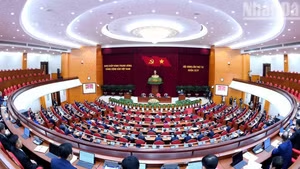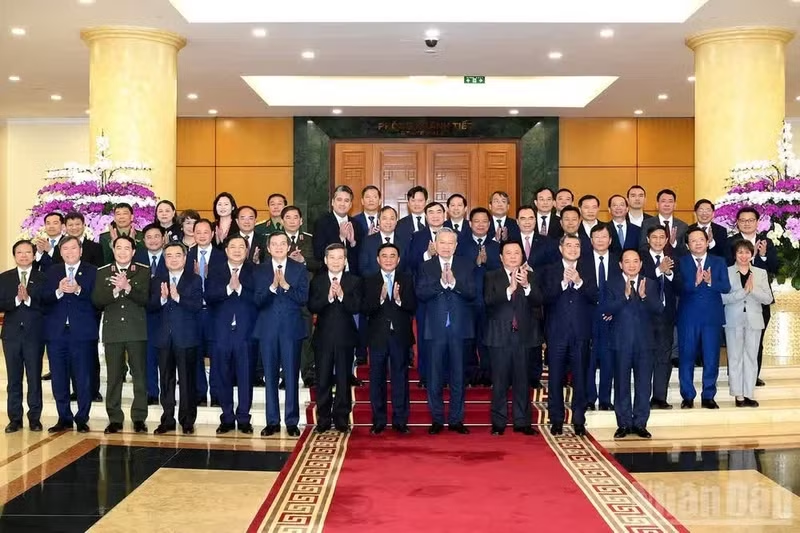
Along with consolidating the organisational structure and supplementing and rejuvenating research staff for the Scientific Secretariat, the Central Theoretical Council (the Council) focuses on reforming the content and methods of operation to meet the increasingly high demands in research and creative application of theory in practice.
According to Duong Trung Y, Member of the Party Central Committee and Editor-in-Chief of the Communist Review, the fact that the Council has become an agency under the Ho Chi Minh National Political Academy contributes to promoting the quality and expanding the conditions for scientific activities.
This is one of the foundations that helps the transfer of work between the two terms of the Council to proceed smoothly, gradually stabilising the organisation and methods of operation, preventing gaps in scientific research and practical summation, and basically ensuring the progress and requirements set forth.
In the past period, the Central Theoretical Council has strengthened close coordination with central agencies, ministries, and branches to implement theoretical research and practical summation; at the same time, expanding strategic theoretical forums; publishing and disseminating research results; and strengthening expert exchanges and cadre training.
Doan Minh Huan, Member of the Politburo, Director of the Ho Chi Minh National Political Academy, and Standing Vice Chairman of the Central Theoretical Council, stated that the new model for cadre training being developed by the Ho Chi Minh National Political Academy focuses on developing learners’ capabilities by linking theory with practice through situational teaching.
From real-life situations, lecturers apply theory to develop issues, prompting learners to analyse and handle them appropriately to the specific circumstances of each locality, agency, and unit. Therefore, in addition to the Council’s team of experts, it is necessary to gather and utilise the strengths of in-depth research from scientists from institutes, universities, academic journals, and research agencies of ministries, departments, and localities.
Through the implementation of this task, the Council’s experts have gradually improved their understanding of the central role of theory; actively participating in theoretical struggle and defending the Party’s ideological foundation. With the scientific research topic “Research and application of artificial intelligence in protecting the ideological foundation of the Party”, the Council aims to increase proactive orientation of ideological awareness on digital platforms, instead of passively refuting erroneous and hostile viewpoints on a case-by-case basis.
In the first year of implementing the Resolution of the 14th National Congress of the Party, the country is implementing strategic decisions that require strong progress in theoretical work, enhancing predictive capabilities, contributing to guiding awareness, thinking, and action, closely following and promoting practical implementation to achieve development goals.
In the first year of implementing the Resolution of the 14th National Congress of the Party, the country is implementing strategic decisions that require strong progress in theoretical work, enhancing predictive capabilities, contributing to guiding awareness, thinking, and action, closely following and promoting practical implementation to achieve development goals.
In response to these demands, the Central Theoretical Council, along with many research institutions, continues to focus on perfecting the theoretical system, clarifying urgent, strategic, crucial, and core issues; and strengthening interdisciplinary, field-specific, and geographical research.
To enhance effectiveness and achieve the set goals, the Standing Committee of the Council has actively urged and directed the Central Theoretical Council to coordinate with the Ho Chi Minh National Political Academy to research and standardise new theoretical concepts and terminology that closely reflect new issues arising from practice.
This has contributed to creating unity in the understanding of the entire political system regarding new concepts, ensuring consistency in action and policy implementation. The Standing Committee of the Council and the Board of Directors of the Ho Chi Minh National Political Academy recognise this standardisation as a means to promote innovation in training towards self-learning, self-assessment, and digital evaluation.
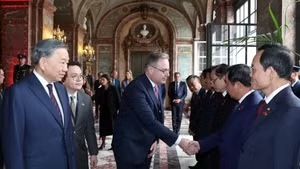
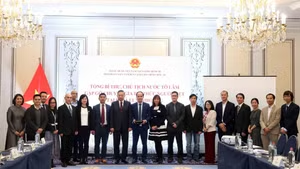
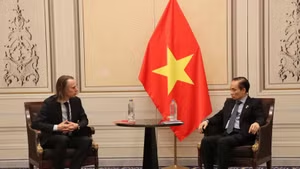
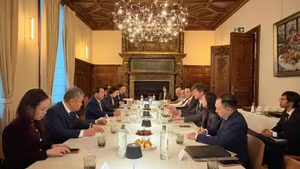
In addition, the Council has promoted theoretical exchanges, expanded and strengthened cooperative relations with several political parties that have ties to Viet Nam, as well as with theoretical research institutions. Alongside organising thematic seminars, the Council, together with the Ho Chi Minh National Academy of Politics, have promoted research and organised cooperative training in theory and public policy to become an important content in the Party’s foreign affairs work, in the spirit of learning and sharing experiences, while affirming the identity and theoretical achievements of Viet Nam over 40 years of reform.