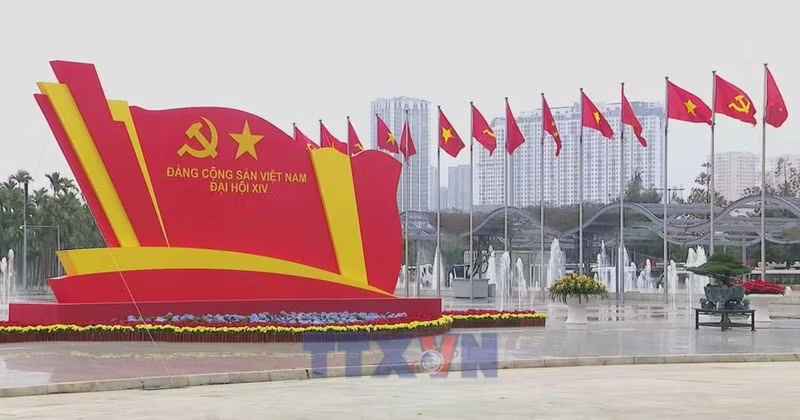
Sustainability and human capital: from growth-first to people-centred development
The achievements of more than four decades of Doi Moi, as well as the comprehensive results of the 2021–2025 term amid multiple challenges, are attributed to the collective strength of the Party, the people and the entire political system. These outcomes not only affirm Viet Nam’s development path but also provide the foundation for a deeper rethinking of how development should be pursued in the next stage.
Reflecting on four decades of socialist-oriented Doi Moi, the scholars largely agreed that Viet Nam stands out as a development success story, while also undergoing a shift in development thinking - from a growth-first approach to one that places people at the centre of sustainable development.
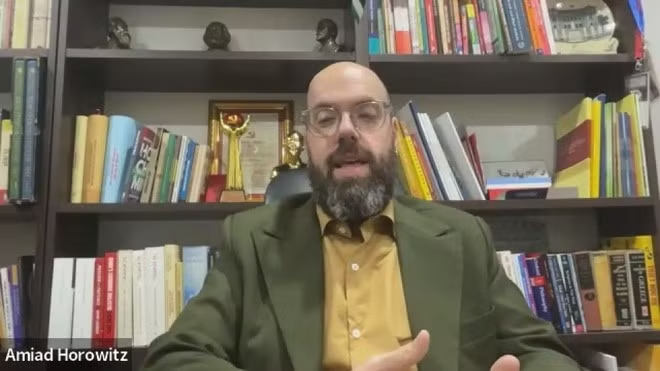
Journalist Amiad Horowitz pointed to tangible economic and social indicators, including rapid growth, infrastructure expansion and urbanisation, which have helped lift millions out of absolute poverty. He cited Viet Nam’s transformation from a food-insecure country into a major agricultural exporter as a striking illustration of that progress.
“Viet Nam going from a country that couldn’t feed itself, to a country that exports food and is able to gift staples like rice to Cuba, a country under assault and in need of such staples, highlights Viet Nam’s rapid economic rise and success,” he underscored.
Looking ahead, Horowitz stressed that the 14th Congress signals a growing recognition of sustainability, noting that economic development can no longer be pursued at the expense of the environment or people’s well-being.
Dr Valeria Vershinina shared this assessment, while drawing particular attention to the CPV’s heightened emphasis on human capital. In her view, investment in education, skills and labour quality is essential not only for sustaining growth, but also for enhancing national competitiveness and long-term economic efficiency.
“The CPV’s emphasis on human capital reflects a clear understanding of how to maintain political stability, overcome emerging challenges and mobilise all available resources for development,” she said.
International commitments amid volatile global environment
The 13th National Congress of the Communist Party of Viet Nam underscored the task of strengthening and elevating multilateral diplomacy, with an emphasis on proactively shaping multilateral institutions, particularly within ASEAN and the United Nations. Building on this orientation, and looking toward the 14th National Party Congress, Viet Nam is seeking to further enhance its role in multilateral mechanisms - not only as a participant, but as a proactive contributor to rule-making and to a shared future of peace, cooperation and sustainable development amid rapidly evolving geopolitical, economic, technological and environmental challenges.
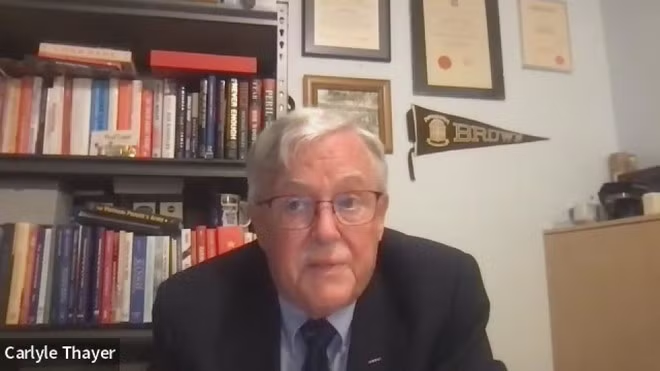
Against this backdrop, Professor Carl Thayer noted that the 14th Congress is convening under exceptionally challenging international conditions, marked by heightened strategic competition, economic uncertainty and growing global fragmentation.
He pointed to intensifying major-power rivalry, ongoing conflicts in Ukraine and the Middle East, and growing fragmentation of the international system, trends that are disrupting globalisation, weakening multilateral institutions such as the United Nations, and eroding respect for international law.
Within this context, Professor Thayer linked sustainability and human development to Viet Nam’s international commitments. He noted that Viet Nam has pledged not only to become an upper-middle-income country with a modern industrial base by 2030, but also to realise the 17 United Nations Sustainable Development Goals (SDGs).
While acknowledging progress, he cautioned that significant challenges remain across most SDGs, requiring sustained reforms and international cooperation.
The scholars also explained why the 14th Party Congress has drawn growing international attention.
Dr Vershinina observed that Viet Nam is increasingly regarded as an emerging middle power exercising leadership in selected areas of cooperation. She argued that understanding Viet Nam’s future foreign policy requires close attention to domestic policy directions, particularly as the Congress coincides with 40 years of Doi Moi and approaches the CPV’s centenary in 2030.
“The outcomes of the 14th National Party Congress will probably define how Viet Nam will celebrate this milestone,” she said.
Horowitz added that Viet Nam’s expanding economic and diplomatic integration has elevated its international profile.
“The world pays attention to what happens at this Congress because it will affect the rest of the world as well, through Viet Nam’s international economic and diplomatic activities,” he noted.
Strategic resolutions and substantive implementation
A central focus of the discussion was how Viet Nam is translating strategic vision into concrete implementation through a coordinated set of Politburo resolutions issued in late 2024 and 2025.
These resolutions cover science, technology, innovation and national digital transformation; international integration; legal reform; private sector development; energy security; education and training; public health; the state economy; and Vietnamese culture.
Dr Vershinina described the resolutions as timely and essential for achieving Viet Nam’s long-term ambition of becoming a high-income country by 2045. She viewed recent administrative reforms as part of a broader shift in governance thinking, aimed at unlocking new growth drivers as traditional ones lose momentum.
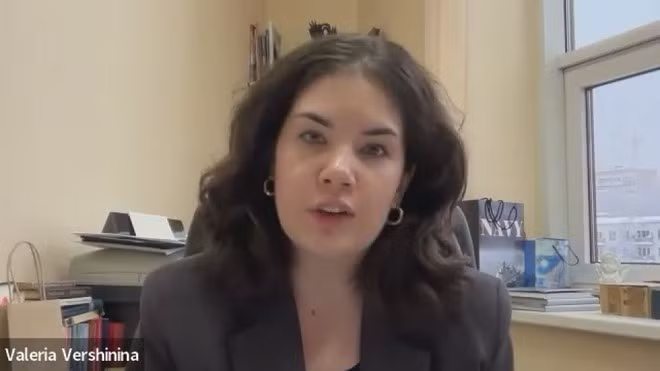
“Viet Nam needs to unlock new economic engines and improve public and legal systems,” she emphasised, adding that the resolutions help translate long-term strategic vision into concrete and practical policies.
Horowitz similarly viewed the resolutions as crucial for enabling Viet Nam to move beyond a manufacturing- and agriculture-based growth model, especially in emerging fields such as artificial intelligence and advanced technology.
“If Viet Nam wants to compete in the modern fields of AI and tech development, then new human-resource capabilities, education, technological infrastructure, and legal and systemic advances will be needed,” he explained.
From a strategic standpoint, Professor Thayer highlighted the interlinked nature of the resolutions, noting that they are designed to be implemented simultaneously rather than in isolation. He singled out Politburo Resolution No. 59-NQ/TW on international integration as particularly significant, as it strengthens the linkage between foreign relations, defence and security in an increasingly complex external environment.
The scholars’ assessments suggest that the 14th National Party Congress represents not only a moment of reflection on nearly four decades of reform, but also a critical turning point in Viet Nam’s development strategy.
Taken together, these orientations are underpinned by tangible social progress in recent years. According to the United Nations Development Programme’s Human Development Report 2025, Viet Nam’s Human Development Index (HDI) rose by 14 places to 0.766, placing the country in the group of nations with high human development. Meanwhile, Viet Nam ranked 46th out of 143 countries in the World Happiness Report 2024, climbing 33 places compared to the previous year, reflecting notable improvements in quality of life, the social environment and spiritual well-being.
By placing sustainability and human capital at the core, reaffirming international commitments, and advancing implementation through a coordinated system of strategic resolutions, the Congress is widely expected to provide clearer direction for Viet Nam’s next stage of development. In a rapidly changing regional and global landscape, these strategic breakthroughs are seen as key to strengthening national resilience, deepening international integration and reinforcing a people-centred development path in the years ahead.