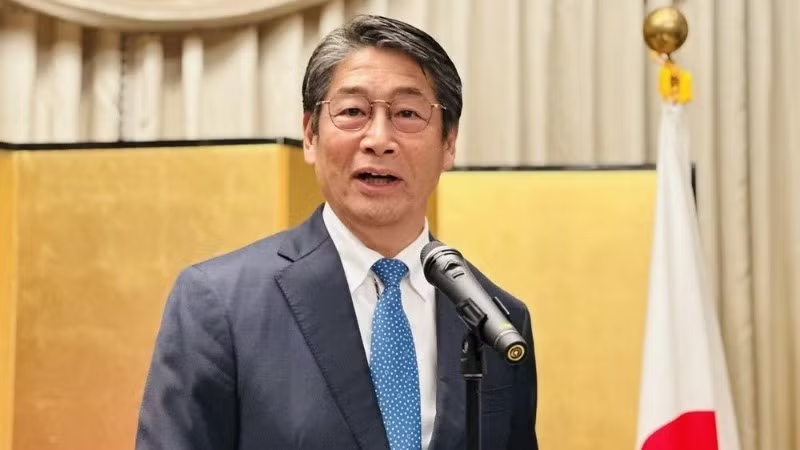
On the occasion of the second anniversary of the establishment of the Comprehensive Strategic Partnership for Peace and Prosperity in Asia and the World between Viet Nam and Japan (November 27, 2023 – November 27, 2025), Ambassador Ito Naoki highlighted the major achievements across various areas of cooperation and outlined directions to advance bilateral relations in the coming time.
Strengthening political trust and expanding local-level cooperation
Ambassador Ito Naoki noted that, two years after elevating ties to the Comprehensive Strategic Partnership for Peace and Prosperity in Asia and the World, Viet Nam–Japan relations “have become closer than ever”, as reflected in significant progress in political dialogue and high-level exchanges.
Since taking office in October this year, Japan’s new Prime Minister Takaichi Sanae has held three meetings with Vietnamese leaders: with Prime Minister Pham Minh Chinh at the ASEAN Summit in Kuala Lumpur; with President Luong Cuong at the APEC Economic Leaders’ Week; and most recently, with Prime Minister Pham Minh Chinh at the G20 Summit in South Africa. Both sides affirmed that they would continue to reinforce bilateral cooperation under the Comprehensive Strategic Partnership.
Earlier, Prime Minister Ishiba Shigeru paid an official visit to Viet Nam in April, during which he affirmed Japan’s support for the reform direction Viet Nam is pursuing as it enters a “new era”, and reiterated that Viet Nam is an indispensable partner. Under both former Prime Minister Ishiba and current Prime Minister Takaichi, Japan has maintained its resolve to strengthen its solid and enduring relationship with Viet Nam.
At the parliamentary channel, National Assembly Chairman Tran Thanh Man’s visit to Japan in December last year made an important contribution to enhancing bilateral relations. Subsequently, the Chairman continued to strongly promote parliamentary cooperation, including inviting the Japan–Viet Nam Parliamentary Friendship Alliance, led by Obuchi Yuko, to visit Can Tho City and organise and host an investment promotion seminar.
Leaders of the Japan–Viet Nam Parliamentary Friendship Alliance also met with Le Minh Hung, Politburo member, Secretary of the Party Central Committee, Chairman of the Viet Nam–Japan Parliamentary Friendship Group, paving the way for exchanges between new generations of legislators of both countries.
Building on this political foundation, local-to-local cooperation has expanded robustly, becoming a “new trend” in bilateral ties. The Viet Nam–Japan Local Cooperation Forum, held in Quang Ninh on November 24–25, gathered representatives from 16 Japanese localities and 31 Vietnamese provinces and cities, with the participation of Prime Minister Pham Minh Chinh and Minister of Foreign Affairs Le Hoai Trung.
This marked the first time such a large number of delegates from both sides participated, demonstrating growing attention to local-level cooperation, which is expected to drive economic development and strengthen investment connectivity.
In a message to the forum, Prime Minister Takaichi stressed that the experience of Japanese localities in community development, industry, tourism, and human resources training would make practical contributions to Viet Nam’s development process.
Practical cooperation across new pillars
According to Ambassador Ito Naoki, key cooperation pillars identified during Prime Minister Ishiba’s visit to Viet Nam — digital transformation, green transition, semiconductors, and innovation — have all achieved important progress.
In the semiconductor sector, Viet Nam aims to train 500 PhD-level researchers by 2030; Japan has committed to receiving about half of them, 250 researchers, through international research cooperation programmes.
These programmes have been implemented since September this year among five universities from each country, with plans to receive 63 Vietnamese PhD candidates in Japan over the next three and a half years. The Viet Nam–Japan University has also launched a “Semiconductor Chip Technology” programme in October, with 106 students currently enrolled.
In the field of innovation, during Viet Nam Innovation Days (October 1–3), Japan and the National Innovation Centre (NIC) launched the “VietLeap AI Accelerator” project to support 11 Vietnamese AI start-ups in fundraising, and operations.
Regarding green and energy cooperation, the two countries are promoting 15 investment projects with a total value of around 20 billion USD under the Asia Zero Emissions Community (AZEC) initiative, covering renewable energy, and LNG power.
Four high-level AZEC meetings between Viet Nam and Japan have been held since December last year, with significant progress recorded in each project. The Japan Bank for International Cooperation (JBIC) has signed a Memorandum of Understanding with the Joint Stock Commercial Bank for Investment and Development of Viet Nam (BIDV) to support Viet Nam’s decarbonisation process.
The Japan International Cooperation Agency (JICA) is considering a programme loan of over 300 million USD to support climate change adaptation and green transition, including promoting high-quality, low-emission rice production in the Mekong Delta, and strengthening natural disaster prevention.
Major strategic infrastructure projects undertaken by Japan continue to create notable impacts, such as the inauguration of Ho Chi Minh City’s Metro Line 1; the groundbreaking of Aeon Hai Duong commercial centre; the northern Ha Noi smart city project; the completion of the Yen Xa wastewater treatment plant; the Quang Tri wind power plant; the commencement of the O Mon 4 power plant; and the groundbreaking of Ha Noi’s Metro Line 2.
According to the Ambassador, reforms currently underway under the direction of General Secretary To Lam are facilitating bilateral economic cooperation. Two dialogues between Prime Minister Pham Minh Chinh and Japanese enterprises this year have helped address difficulties, including amendments to regulations allowing the extension of investment licences for machinery used for more than 10 years.
More than 2,000 Japanese enterprises are now operating in Viet Nam; according to a survey by the Japan External Trade Organisation (JETRO), nearly 60% plan to expand investment in the next one to two years. Bilateral trade reached 42.5 billion USD from January to October 2025, up 11% year-on-year, and is expected to surpass 50 billion USD for the first time. Investment during this period rose by 18% year-on-year.
People-to-people exchanges have also been vibrant, with 580,000 Vietnamese travelling to Japan and 680,000 Japanese visiting Viet Nam in the first ten months of 2025; total two-way exchanges are expected to reach 1.4 million for the full year.
Beyond economic ties, cooperation in security and defence has expanded. In December, the two countries will, for the first time, hold their first deputy-minister-level 2+2 dialogue in Tokyo, discussing regional strategic issues, defence industry cooperation, equipment transfer, and Official Security Assistance (OSA). Naval and coast guard exchanges between the two sides have also been maintained.
In the field of criminal justice, Ambassador Ito Naoki noted that Japan and Viet Nam signed a bilateral extradition treaty in 2020. Earlier this month, for the first time, a Vietnamese national was extradited back to Viet Nam under the treaty. This marks a new and growing area of cooperation between the two countries.