The results have been pronounced, contributing significantly to Party building — encompassing politics, ideology, ethics, organisation, and personnel — and strengthening public trust.
However, alongside these achievements, a tendency toward superficiality persists at various levels and in many localities. In some areas and units, the study process has yet to yield tangible practical changes.
Meanwhile, the global and regional landscape continues to shift rapidly and unpredictably, and the ideological battleground is increasingly expanding into cyberspace, involving new and more complex methods of influence. The country is entering a new phase of development characterised by higher goals and greater demands.
This reality necessitates innovative approaches and methods so that studying Uncle Ho’s example does not stop at mere pledges or superficial gestures, but truly becomes a driving force for action, heightens responsibility, and creates tangible changes in both work and daily life.
This is the key significance of the Political Bureau’s Directive No. 07-CT/TW (dated July 13, 2026) on intensifying the study and practice of Ho Chi Minh’s ideology, morality, methods, and style in the new development era.
This innovation is first reflected in the approach itself, encapsulated in the phrase “study and practice”, replacing the previous “study and follow”.
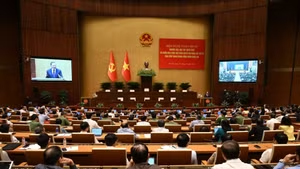
According to the comprehensive thematic guidelines outlined by Trinh Van Quyet—Politburo member, Secretary of the Party Central Committee, and Head of the PCC’s Commission for Publicity—at the national conference on the morning of September 3, while Directive No. 05 posed the questions “what to learn and how to emulate”, Directive No. 07 raises the bar by asking “what results are achieved through practice and how are they measured”.
Directive No. 07 mandates that work output, quality, and efficiency—along with the satisfaction of the public and the business community—serve as the benchmarks for evaluating the results of studying and emulating Uncle Ho.
This requirement aligns the study of Uncle Ho’s example more closely with the daily tasks of every official and Party member. Its value lies not merely in one's commitment to self-cultivation; more importantly, it must be demonstrated through concrete, practical results.
If the requirement to use results as a benchmark raises the question “what is the purpose of this implemented?”, then a particularly significant new aspect of Directive No. 07 addresses the question “how should this be practiced?”
This involves incorporating the “Ho Chi Minh method” into the curriculum of study and practice, alongside Ho Chi Minh’s ideology, morality, and style. According to Quyet, the addition of the “Ho Chi Minh method” element creates a bridge connecting awareness to action, and morality to work efficiency.
Within Ho Chi Minh’s legacy, ideology serves as the guiding compass for morality, method, and style; morality acts as the root and spiritual foundation; method provides the analytical tools to translate ideology and morality into real life; and style represents the vivid manifestation—the crystallisation—of that ideology, morality, and method in daily practice.
Including the “Ho Chi Minh method” in the study and practice agenda emphasises learning from Uncle Ho to cultivate the capacity for handling tasks scientifically and effectively—an approach grounded in reality that prioritises proximity to, respect for, and attentiveness to the public.
On this basis, Directive No. 07 directly links the study and practice of Uncle Ho’s teachings with a spirit of innovation and the courage to think, act, and accept responsibility for the common good.
In an era where new, difficult, and complex issues are increasingly emerging, breakthroughs are impossible without officials who have the courage to undertake challenging tasks, make decisions, accept responsibility, and identify the correct methods to resolve problems.
Therefore, Directive No. 07 requires officials and Party members to have the courage to confront difficulties and challenges, while mandating the timely replacement of those who evade or shift responsibility, or who lack the courage to make decisions and take action for the common good.
In this way, the mandate to “learn from Uncle Ho” is translated into a highly practical requirement for the contingent of cadres: they must possess not only the character to want to act, but also the methodology to act correctly, the mettle to take decisive action, and the sense of responsibility to see the task through to the end.
The implementation of Directive No. 07 is all the more significant as the Party intensifies the reform of its leadership methods and demonstrates its determination to achieve the strategic goals set forth by the 14th Party Congress.
Truly internalising and effectively implementing Directive No. 07 means moving from learning for knowledge to learning for action; from merely following a model to putting principles into practice; and from making pledges to delivering tangible results.
Only when such transformations become part of daily routine does learning from Uncle Ho become truly effective; only then do Ho Chi Minh’s ideology, ethics, methods, and style genuinely become a spiritual resource and a driving force for action in the country's new phase of development.