On the Central Highlands front, in the early morning of March 18, Regiment 9 of Division 320 launched an attack on Phu Thien District, cutting off the enemy’s formation from the rear. Regiment 48 blocked the enemy at Chu Pa and moved in from the north to encircle Cheo Reo, while Regiment 64 reinforced the siege from the south. A unit under Division 320 engaged the enemy in Cheo Reo.
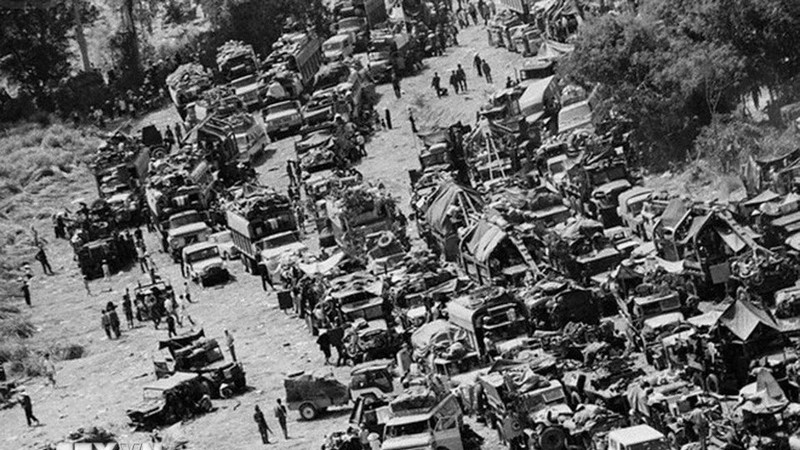
By 6:00 PM, our forces had seized the airport, Ngo Quyen prison camp, and the radio station, destroying the 23rd Ranger Group. By 9:00 PM, we had gained control of Cheo Reo Town. The remaining enemy forces retreated along Road 7, regrouping into two clusters about 2 km south of Cheo Reo.
At Chu Cuc, at noon on March 18, with artillery support, Regiment 28 and tanks from Regiment 273 launched a direct assault on the enemy base, forcing 1,500 enemy troops to surrender. The remaining forces attempted to flee eastward but were intercepted by Regiment 25. In particular, 500 enemy soldiers were eliminated and captured.
In the northern region of Thua Thien Province, on March 18, Battalion 15 of the Main Regiment 4 of the Military Region, along with Special Forces Company 10 and local forces, fiercely repelled enemy counterattacks, held their positions, and mobilised the masses to rise up.
In Phong Hoa, Phong Binh, and Phong Chuong Communes (Phong Dien District), the people proactively rose up to take control. Corps 2’s artillery bombarded enemy bases at Hiep Khanh, An Lo Bridge, Tap Loc, and Mang Ca, inflicting heavy damage on the enemy.
At the Dinh Quan front, on the morning of March 18, Battalion 4 under Regiment 16, which was reinforced with three tanks, swiftly attacked and seized control of Hill 258 and Dinh Quan District headquarters. Capitalising on this victory, Regiment 141 (minus one battalion) and Battalion 4 of Regiment 165, supported by four additional tanks, destroyed Battalion 2 of Task Force 43, which had regrouped north of the district headquarters.
In Military Region 9, on March 18, the forward command decided to leave a small contingent of Regiment 1 to continue besieging the Vinh Xuan stronghold, while the main force swiftly moved to Tam Binh to execute the plan for liberating the Mang Thit River.
On the same day, Deputy Chief of the General Staff Le Trong Tan sent an urgent telegram to the Tri-Thien Military Region and the Corps 2, demanding bold and rapid actions. The military region was instructed to quickly deploy forces into the deep hinterlands of the delta, coordinating with local troops to seize control, eliminate enemy repression, and establish full control over key areas. The Corps 2 was ordered to swiftly eliminate Phu Loc district headquarters, sever Road 1, and prepare firepower for an attack on Da Nang.
That same day, the General Staff issued a directive for the Tri-Thien Military Region and Corps 2 to intensify their operations, acting boldly and swiftly to prevent the enemy from retreating safely from northern Hue to Da Nang, where they could regroup and pose further resistance. Forces were instructed to cut off Road 1, attack airfields and depots at Phu Bai, and disrupt enemy logistics.
On March 18, at Nha Con Rong (Dragon House), the Politburo and the Central Military Commission convened to assess the results of ten days of offensives and determine the next strategic moves. The Politburo concluded that the major victories marked a new strategic turning point, reflecting the further collapse of US-backed Saigon forces. Recognising the enemy’s shift to a strategic retreat, the leadership decided to seize the opportunity, escalate the strategic offensive into a general offensive, and complete the two-year campaign plan within 1975. The primary strategic objective was Saigon, but the immediate priority was to eliminate all enemy forces in Military Region I and liberate Hue and Da Nang as soon as possible.